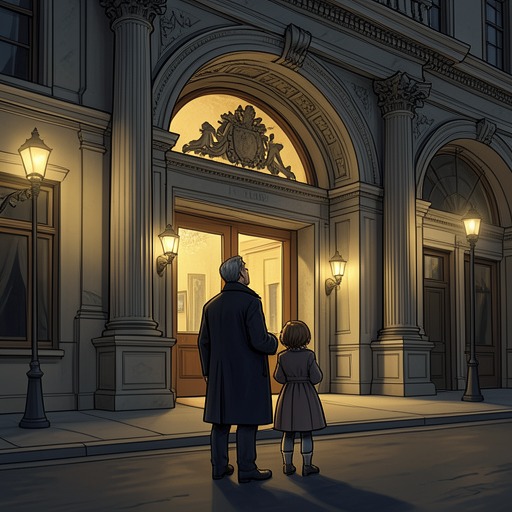
Louis meets the Théâtre des Vampires
Interview with the VampireLouis meets the Théâtre des Vampires in Paris at the moment when his search for other vampires changes from a solitary quest into an encounter with an organized, seductive, and horrifying community. Armand’s invitation leads Louis and Claudia from the Paris streets into a theater whose public performances conceal real killings, while the meeting offers Louis both the fellowship he has sought and a deeper recognition of how thoroughly vampire existence can turn violence into art.
The Encounter in the Latin Quarter
Louis’s first contact with the Théâtre des Vampires begins outside its walls. While walking through a dark Paris street, he becomes aware of footsteps that reproduce his own pace with impossible precision. The pursuer is too distant for mortal hearing, yet stops whenever Louis stops and follows whenever he moves. When roof tiles crash into the street beside him, Louis turns into the gaslight and sees an enormous, gaunt vampire with a long white face, black eyes, black hair, and clothing that duplicates his own coat and cape. The stranger imitates Louis’s stance, gestures, blinking, words, and even his expression, becoming a grotesque living mirror rather than a conventional assailant.
The encounter turns violent. The mocking vampire strikes his own chest in rhythm with Louis’s heartbeat, laughs with exposed canine teeth, and attacks him on the sloping cobblestones. Louis is thrown down, feels the attacker’s boot against his ribs, and seizes the leg when he realizes that the figure possesses physical substance. Another vampire intervenes, battling the attacker decisively and forcing him away. This second figure is broader and less gaunt, with a large dark eye and a face that seems almost motionless. From a high ledge he assures Louis that he is unharmed and promises that the other vampire will not be allowed to harm him.
The rescuer then gives Louis a white card marked in purple script. He invites Louis to come the following night, promises not to hurt him, and identifies the venue as the Théâtre des Vampires. The card also bears a direct invitation to bring the petite beauty, Claudia. The name astonishes Louis because the address is familiar as a theater district, yet the institution presents itself as a hidden society accessible by invitation rather than an ordinary public entertainment. The vampire signs the invitation as Armand, establishing the relationship that will draw Louis into the theater’s subterranean world.
Invitation and Threshold
Louis has only the remaining hours before dawn to return to the hotel and tell Claudia what has occurred. The next evening they approach the theater in the rain, and a doorman examines the card before admitting them. The building appears entirely human at first: posters advertise penny-dreadful vampires, couples press through a crowded lobby, and the audience consists of perfumed men and women in wet wool, gloves, hats, and fashionable clothes. Louis and Claudia have fed earlier so that their skin will not appear too white and their eyes will not seem too unclouded, but Louis recognizes that the theater’s greatest concealment is not physical disguise. It is the ordinary social setting that makes the supernatural invisible.
They are led to one of the best boxes, where an usher draws back the curtain and seats them before the brass rail. Claudia immediately suspects that the theater may use human slaves, while Louis recalls that Lestat never trusted human slaves. Her warning that Louis should be sly rather than excessively gentlemanly identifies the danger of the visit: they have come seeking revelations, but they are also entering a controlled environment in which others may be studying them. Louis expects knowledge, yet the theater controls access, visibility, and interpretation from the first inspection of the invitation to the placement of the visitors above the audience.
The auditorium’s transition from ordinary public space into supernatural spectacle is carefully staged. The lights fade through the balcony and along the walls; musicians gather beneath the stage; a tambourine, wooden flute, and strings create a melancholy, medieval-sounding music; and a painted forest appears behind a fine silk scrim. The stage seems to become a three-dimensional woodland with trees, a riverbank, and glittering water. The theater therefore does not merely present vampires as a subject. It transforms the whole act of looking into an atmosphere in which illusion, ritual, and predation can occupy the same frame.
The Performance of Death
The opening drama presents Death as a masked figure carrying a silver scythe. He moves with panther-like grace through the painted forest, while a stooped old woman approaches with a basket of flowers and tries to pray, sleep, supplicate, and finally pursue him. The audience laughs when Death recoils from her and evades her comic pursuit. Cripples and beggars then enter, reaching toward him as he escapes them with theatrical disgust. Louis is disturbed by the laughter because the performance makes human frailty into entertainment and turns the refusal of compassion into a comic gesture.
The skull mask is thrown aside, revealing the handsome black-haired vampire Louis recognizes as the hostile figure from the Latin Quarter. The theater’s revelation is therefore also an act of concealment: the monster who attacked Louis is presented as an actor, and his supernatural identity is reframed as a stage role. Seven vampires gather around a beautiful mortal woman, including three vampire women whose white bodies and hard luminous faces contrast with the woman’s golden hair and warm human skin. To the audience, the scene is an exquisitely arranged spectacle; to Louis, the circle is a real hunting formation.
The woman pleads that she does not want to die. The leading vampire answers that death is the one thing every mortal shares and warns that age, sickness, or another person’s violence may already be moving toward her. His language converts mortality into a theatrical argument, but the threat is literal. Another vampire, detached from the mockery of the leader, offers the promise of “No pain.” The woman is drawn toward him, and the phrase becomes the instrument by which her fear is transformed into surrender.
The killing follows the choreography of seduction. The vampire undresses and lifts the woman before the audience, bites her, and passes her among the other vampires, who drink in turn while the crowd watches in enthralled silence. Louis experiences the scene bodily: hunger rises in him, his veins are tormented, and he grips the brass rail so tightly that he feels the metal creak. The performance thus collapses the distinction between representation and event. The audience believes it is watching a staged death, while the vampires use the conventions of theater to make an actual killing socially unreadable.
When the vampires withdraw, the painted forest returns and the woman lies naked in a black bier as though she were part of the scenery. The music fades, the lights dim, and the audience erupts into applause before dispersing into the rain, carriages, and waiting taxis. A lone usher remains to right chairs and gather programs. Louis recognizes that he could descend into one of the curtained entrances, seize the usher, and take him as the woman was taken. He desires the act and desires nothing, caught between appetite and detachment. Claudia’s quiet command, “Patience, Louis. Patience,” prevents him from becoming another unplanned participant in the theater’s violence.
Armand and the Underground Theater
Armand appears at the edge of the box after the performance. Louis recognizes him as the auburn-haired vampire who had entered the staged killing and as the figure who gave him the invitation. Armand’s stillness and remote expression calm Louis even as they unsettle him; Louis senses that Armand is observing not only his body but also the process by which he tries to understand what he sees. Claudia remains silent while Louis places a hand on her shoulder, making their shared vulnerability visible.
Armand gestures for them to follow and leads them through a door in the lower wall into rooms beneath the theater. The descent produces a sharp spatial reversal. Above them is a public auditorium filled with human spectators; below lies a vast subterranean ballroom apparently carved from an older cellar. A young boy brings Armand a candle, and the light reveals immense murals, including Breughel’s “Triumph of Death” and “The Fall of the Angels.” Skeletons ferry the dead, pull carts of skulls, behead corpses, hang humans, and drive the damned from celestial heights into chaos. The underground space makes explicit what the stage has disguised: the theater’s aesthetic world is founded upon death, damnation, and the collapse of human and supernatural boundaries.
The meeting gives Louis access to a vampire community, but not the simple instruction he once imagined finding. His earlier movement from New Orleans through Europe had been driven by a desire to learn what creatures such as himself were and what their origins might be. In eastern Europe, he found mostly mindless dead creatures whose bodies and legends offered no secrets. The theater is different: it contains articulate vampires, an institution, an audience, a repertoire, and a hierarchy of knowledge. Yet its sophistication does not make it morally clearer. Instead, it demonstrates that conscious vampires can organize killing into a repeatable cultural form.
Significance and Later Reversal
Louis’s meeting with the Théâtre des Vampires becomes a decisive stage in his changing relation to vampire identity. Paris itself initially appears to him as a source of happiness, beauty, history, and human grandeur, a city capable of making him forget the damned and questing creature he has become. The theater interrupts that exhilaration by showing him a community that has made damnation communal and beautiful. Its members are not the mindless corpses encountered in Transylvania, but neither are they a cure for Louis’s isolation. They possess language, theatrical skill, and social organization while treating mortal life as material for spectacle.
The encounter also establishes the central tension between Louis and the theater’s world. He is fascinated by beauty and by the power of performance, yet he cannot accept the audience’s laughter or his own hunger without moral disturbance. He watches the mortal woman’s death as both spectator and potential predator; his bodily response binds him to the vampires even as his revulsion separates him from their pleasure. The theater exposes the contradiction he has carried since his transformation: he wants knowledge and companionship, but he cannot enter vampire society without confronting the violence on which that society rests.
The apparent discovery of a vampire community later proves inseparable from betrayal. Armand eventually tells Louis that Lestat did not die in the Théâtre des Vampires, despite Louis’s belief that he had been killed and Armand’s earlier claim that the theater’s vampires had perished. Lestat escaped with the assistance of two vampires made by the same master and secured passage to New Orleans. This revelation changes the meaning of the Paris encounter: the theater had not only been a place of initiation and spectacle, but also the setting from which the unresolved past escaped.
The meeting remains present even after Louis leaves Paris, burns the theater, and returns toward New Orleans with Armand. Its lasting importance lies in the way it joins three forms of looking: the human audience watching an apparent fiction, Louis watching a real killing while struggling against his appetite, and Louis later narrating the experience to a boy who responds by demanding the power to become a vampire. When the boy finally asks Louis to make him a vampire, the request shows how easily a story of despair can be received as an adventure of passion and immortality. The Théâtre des Vampires is therefore not only a location in Louis’s history. It is the clearest early demonstration that vampire existence is sustained by performance, by the management of spectators, and by the dangerous transformation of suffering into desire.