Louis–Armand relationship
Interview with the VampireThe Louis–Armand relationship is the central emotional and philosophical encounter of Louis’s time in Paris. Louis approaches Armand as the oldest and most powerful vampire he has found, hoping that his knowledge will explain vampiric existence and provide the meaning that Lestat never gave him. Armand instead becomes both desired companion and devastating mirror: he understands Louis’s loneliness, wants to live through Louis’s sensitivity, and finally exposes the passivity through which both of them allow evil to continue.
First Encounter and Recognition
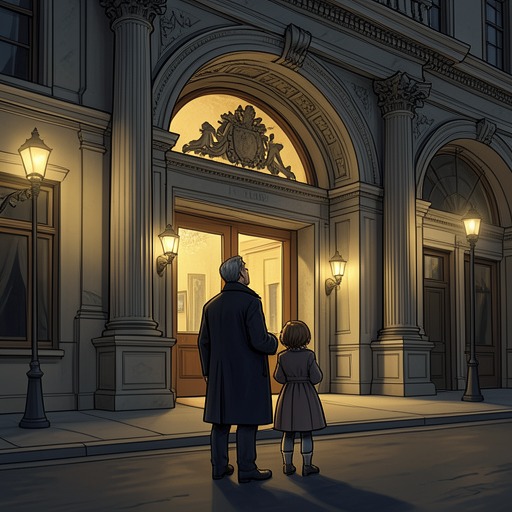
Louis first sees Armand after the performance in the Théâtre des Vampires, when the theater’s crowd has dispersed and he is still struggling with the passion and confusion left by the girl’s killing. Armand appears silently beyond the curtained entrance of the box, the auburn-haired vampire who had arranged the invitation. His stillness and remote, dreamy expression calm Louis even as they unsettle him. Louis recognizes that Armand has outwitted his heightened hearing and anticipation, and he is immediately drawn to a presence he cannot fully describe.
Armand leads Louis and Claudia down into the rooms beneath the theater. In his cell, amid books, a desk, two chairs by the fire, pictures, and a coffin, he introduces himself and explains that he sent Santiago with the invitation. He already knows their names and welcomes them to his house. His manner is contemplative, measured, and almost unnervingly motionless; Louis feels himself drifting into the same state of absorption whenever Armand speaks. The room’s severe simplicity also affects him. Compared with the hotel’s luxury, it seems meaningful rather than vulgar, while the sleeping mortal boy in the room remains an unresolved and disturbing presence.
Knowledge, Faith, and Desire
Louis’s first serious hope is that Armand can answer the questions that have governed his existence. He asks whether Armand leads the group, whether his authority comes from other vampires or from some satanic power, and whether vampires possess any knowledge of God or the devil. Armand says that he is the leader in practice, though not in the ordinary sense, and that no vampire he has known has had discourse with God or the devil. He also reveals that, after four hundred years, he is the oldest living vampire in the world.
This revelation destroys Louis’s expectation that his travels might uncover a hidden spiritual order. Armand’s age does not provide a supernatural truth; it confirms the absence of one. When Armand says that the only real evil left is the willful taking of an innocent human life, Louis’s despair deepens. Armand then rejects the language of satanic inheritance altogether, arguing that vampires make themselves into gods and devils because the only power that exists is inside themselves. His position breaks something in Louis. Louis cannot accept that immortal beings who rise nightly to feed on human blood possess no larger meaning, and he angrily insists that becoming a vampire makes him capable of believing any supernatural explanation, including the possibility that existence has no meaning at all.
The conflict is not merely intellectual. Louis is attracted to Armand as the teacher Lestat never was. He imagines that knowledge will pass through Armand transparently, allowing him to absorb it and grow. He longs to remain in Armand’s cell, with Claudia safe among the theater vampires and himself permitted to stay under any condition. The sleeping mortal boy becomes, in Louis’s imagination, an icon of love: not physical intimacy, since for vampires physical love culminates in the kill, but a form of attachment that promises protection, understanding, and spiritual release.
Mutual Attachment and the Threat of Separation
Armand recognizes the danger surrounding Louis and Claudia and warns Louis to stay away from the other vampires. He has temporarily restrained them, but refuses to exercise the full power that would be required to stop them permanently. Such an act would force him to defend his authority, create enemies, and bind him to the rule he does not want. He accepts the scepter the coven has given him only to keep its members at a distance; what he wants is a certain space and peace, or not to be there at all.
Louis’s attraction intensifies because Armand’s withdrawal resembles Louis’s own divided existence. Louis wants Armand’s protection, yet he also wants to remain with Claudia. Armand interprets Claudia’s arrival and Madeleine’s presence as signs that Claudia has released Louis from their old bond, while Louis insists that Claudia is his child rather than his paramour and that he does not know whether such a child can release the parent. The relationship therefore becomes a struggle between two forms of attachment: Louis’s responsibility for Claudia and his longing to surrender himself to Armand’s understanding.
Armand finally states plainly that he wants Louis more than anything in the world. He repeats the declaration when Louis doubts what he has heard, then tells him that Louis sees Claudia slipping away, fears the isolation that would follow her loss, and nevertheless does nothing. Armand calls Louis a mystery, while Louis admits that he loves Claudia but feels distant from her whenever he is with Armand. Armand identifies Claudia as an entire era of Louis’s life and argues that breaking with her would mean losing the only living being who has shared that span of eternity. Their exchange gives the relationship a tragic structure: Armand offers the possibility of a new life, but accepting him would require Louis to abandon or redefine the bond that has organized his existence.
Armand also tells Louis that he has found what he needs, although he remains attached to the Théâtre des Vampires. He keeps a separate house as a secret retreat, unknown to the other vampires, using it to isolate himself. The secrecy reflects both his autonomy and his inability to commit himself fully to any collective. Louis senses that Armand’s youthful face has remained unchanged across centuries, yet is not a mask; it is expressive, reflective, and powerfully attractive. The relationship is thus built on a paradox: Armand seems capable of reading and understanding Louis more deeply than anyone else, but he remains emotionally and politically elusive.
Armand as Mirror of Louis
Louis wants Armand to open a door onto a hidden world, imagining that Armand’s history, including the palace in Venice and his relation to damnation, will reveal what vampiric existence truly means. Armand tells him that the palace means nothing and that the doorway leads instead to Armand himself—to Louis’s coming to live with him as he is. Armand describes himself as evil with infinite gradations and without guilt, a formulation that fascinates Louis because it appears to offer the coldness and freedom he has sought.
Armand also explains that Louis can save him from despair. He has been waiting at the theater for someone of Louis’s sensitivity, pain, and focus, someone through whom he can make contact with the nineteenth century. Books and art can give him information, but Louis, in Armand’s view, is the spirit and heart of the age. Louis rejects the claim, insisting that he has never belonged anywhere or with anyone. Armand answers that this alienation is precisely the spirit of the age: Louis’s fall from grace and faith is the fall of a century. Their attraction therefore carries a historical dimension. Armand does not simply desire Louis as an individual; he sees him as a living passage into a modern world whose spiritual fracture Armand cannot otherwise experience.
Yet Armand’s interpretation also turns Louis into a mirror. Armand says that he must fight for Louis and asks whether such ruthless commitment is what Louis means by love. Louis doubts that he can satisfy Armand, just as he could not satisfy Claudia, Lestat, or his mortal brother Paul. Armand’s love appears generous because it recognizes Louis’s inner life, but it is also self-interested: Armand needs Louis to revitalize his own existence and connect him to an age he cannot reach alone.
Rescue, Failure, and Moral Conflict
When the theater coven imprisons Louis, Armand breaks through the sealed passage and opens Louis’s coffin. He rescues Louis alone, leading him through a corridor lined with other sealed doors and out into the alley beside the Théâtre des Vampires. Louis immediately realizes that Claudia has been left behind. Armand says that he cannot save her because the other vampires would rise against him and he would risk losing Louis as well.
Louis refuses to leave without Claudia. He knows that he must return to her or die trying, and he also understands that Armand, despite his protestations of powerlessness, will follow. Armand’s action reveals the limits of his love: he is willing to save Louis, but not to violate the political and moral boundaries he has imposed on himself for Claudia’s sake. Louis returns with him, but the rescue cannot prevent the execution. Later, Armand tells Louis that he could not have prevented it. Louis rejects this excuse. Armand had held sway over the coven, and his understanding surpassed theirs; what stopped him was not lack of power but refusal to violate his own conception of truth and authority.
The deaths of Claudia and Madeleine transform the relationship. Their remains are left as victims of a holocaust, and Louis feels both resolute and close to his own destruction. He accuses Armand of choosing passivity, arguing that Armand’s refusal to act repeats Louis’s own failures: allowing himself to become a vampire, allowing Claudia to be created, standing by while Claudia killed Lestat, and creating Madeleine despite knowing it was wrong. Armand’s detachment becomes, in Louis’s judgment, the core of the evil that has spread through all their lives.
Final Break and Significance
Louis’s final understanding is that Armand has not offered escape from damnation but a perfected image of it. Louis once imagined Armand as beautiful, powerful, and without regret, and desired to become what Armand represented. After Claudia’s death, he sees Armand as a destroyer, more ruthless and cunning than himself. The passion Armand awakened is extinguished because Louis recognizes that Armand’s coldness is not freedom from evil but another form of participation in it.
Louis tells Armand that he had sought love and goodness within living death, although such a union was impossible from the beginning. He had searched for vampires, God, the devil, and other names for meaning, but none could persuade him against what he already knew in his own mind and soul: that he was damned. Armand has shown him not salvation but the depth of coldness he would need to attain if he wanted to end his pain. In that sense, Armand becomes Louis’s mirror: what Louis sees in him is the possible final form of his own detachment.
Armand asks whether Louis requires anything else. Louis says no, and Armand walks away along the river. Louis does not see him again. Armand’s coffin remains, but Armand himself never returns to it; months later, Louis has it placed in the crypt beside his own before becoming uncomfortable with the relic and breaking it into pieces in the cemetery. The destruction of the coffin turns their relationship into an absence that Louis must physically dismantle. Afterward, Louis leaves New Orleans, carrying the unresolved sorrow of Armand, Claudia, Madeleine, and the dying Lestat. Their relationship begins as a promise that knowledge and intimacy might redeem immortal existence, but ends with Louis recognizing that no teacher can absolve him of choices he already understands as wrong.