Louis–Babette Freniere relationship
Interview with the VampireThe Louis–Babette Freniere relationship is one of Louis’s clearest attempts to use supernatural power in the service of human survival. He cannot prevent Lestat from killing Babette’s brother, but he can help her inherit the burden left by that death. Their bond therefore joins protection with concealment: Louis presents himself as an almost angelic adviser, while the violence of his existence remains hidden until the night he needs her help.
First Encounter and the Burden of Freniere Plantation
Louis becomes aware of Babette through the Freniere family’s dependence on its only son. The young man is expected to manage the plantation, negotiate marriages, assemble dowries, and protect a fragile economy that rests on the next year’s sugar crop. His five sisters love him intensely, but none has been educated to take over the estate. Babette is exceptional among them: Louis considers her as intelligent as her brother and wiser still, although social expectations have not prepared her to govern the plantation.
Lestat chooses the young Freniere as a victim and pursues him even after the duel that might have killed him. Louis understands what the brother’s death would mean for the women: not merely bereavement, but the collapse of their home and their descent into dependence. When Lestat kills Freniere in the marsh, Louis returns to the plantation before dawn and sees the sisters gathered in black, waiting like mourners for confirmation of the news. Babette alone already appears to have accepted the impossible future before her. Louis recognizes in her the strength required to assume the family’s burdens, and this recognition becomes the basis of his intervention.
Counsel, Apparition, and Human Agency
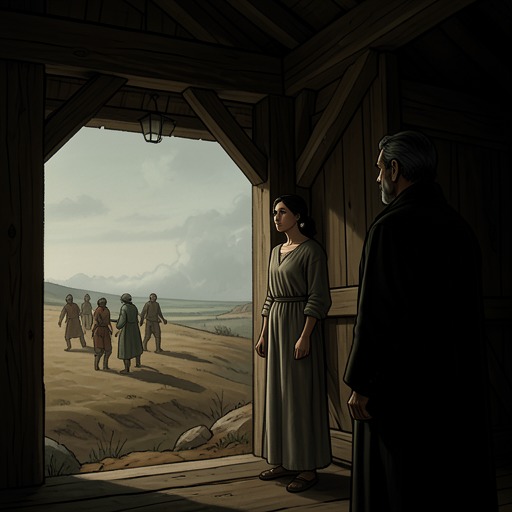
Louis deliberately reveals himself to Babette by allowing his reflective face to catch the light through a pane. He then withdraws into the darkness, permitting the other sisters to interpret the sight as a ghostly visitation while Babette, stronger and less willing to surrender judgment to superstition, comes out alone with a candelabrum. Louis refuses to disguise himself as an ordinary man. Instead, he speaks to her as a supernatural being with only minutes before dawn and tells her that her brother fought bravely but is dead.
The essential content of his counsel is practical rather than mystical. He tells Babette that the plantation can still be saved, that she must take her brother’s position despite convention and propriety, and that she must learn whatever knowledge she lacks. If she refuses, he warns, the land and family will be lost, leaving the women to live on a fraction of what their former life offered. Louis turns his visitation into a source of courage, urging her to take control of her own life rather than accept the social assumption that a woman cannot govern the estate.
Babette follows this advice. She becomes a scandal along the river coast by running the plantation without a man in the house, yet she holds it together, secures a substantial dowry for her younger sister, and marries the following year. Louis watches this development from concealment. He visits her without allowing himself to be seen and discovers that her happiness produces happiness in him. His feeling is neither the possessive attachment that defines his life with Lestat nor a simple act of charity. Babette becomes, in his words, an ideal human being: capable, morally serious, and strong enough to act within a hostile social order without surrendering her inward integrity.
Protection, Refuge, and the Ethics of Dependence
Babette’s success does not end her vulnerability. Social ostracism wears upon her, because wealth matters less to her than family, lineage, and belonging. Louis returns to her in the garden and advises her to resist withdrawal by giving a philanthropic ball for a religious cause. He proposes that she invite her deceased mother’s closest friends as chaperones and re-enter society through confidence and apparent purity. Babette regards the unknown adviser as an angel, but Louis refuses to explain what he is. His protection depends on preserving the distance between them.
When Pointe du Lac is destroyed, that distance collapses. After the plantation is burned and the enslaved people scatter, Louis has only a short time before daylight. He loads his coffin into a carriage and goes to Freniere plantation; Lestat follows, intending to continue toward New Orleans but accepting refuge there when the approaching dawn makes travel dangerous. Babette is awake and directing the response to the fire. She has sent carriages and workers toward Pointe du Lac and is recording the disaster in the plantation diary, while the escaped slaves’ stories are treated as foolishness. She understands that something dreadful has occurred, but she suspects murder rather than the supernatural.
Louis asks Babette for a room, a key, and a promise that no one will enter until nightfall. He reminds her that he helped her when she stood alone among dependent and weak people and that he has watched over her happiness ever since. The request is not merely an appeal to gratitude. With dawn paling, Louis admits that without shelter he will die. Babette gives him a ground-floor wine-storage room, and Louis barricades it after bringing in the coffins. She goes further than he asks: she locks the door from the outside, demonstrating that she has heard the slaves’ accounts and has chosen to contain the danger rather than expose it immediately.
Revelation, Horror, and the Collapse of Trust
The refuge lasts only until Louis and Lestat emerge. Babette confronts Louis with a lamp, and his appearance confirms the supernatural truth she had previously resisted. Lestat stands behind her, dangerous and impatient. When Babette falls into a trance-like stillness and calls Louis a creature from the devil, Louis is distressed not simply because she fears him, but because he believes she may begin to doubt the goodness of the counsel that shaped her life. He has wanted her to understand herself as strong and morally sound; the revelation threatens that balance.
Lestat seizes Babette by the wrists, drops her lamp, and drags her toward the open court while demanding a carriage and horses. Louis stamps out the flames and orders Lestat to leave her alone. He sends Lestat toward the stables and insists that Babette must be allowed to hear him, adding that Lestat must not kill. Babette responds with religious condemnation, telling Louis to get behind Satan and accusing him of having lived like a devil at Pointe du Lac. Her husband has seen the ruined house, the bodies of enslaved people throughout the orchards and fields, and the devastation that Louis cannot explain away.
Louis tells her that he came only to do her good and would not have brought her worry if he had possessed a choice, but he cannot give her the answers she demands. The relationship ends at this point in an unresolved moral fracture. The woman who once accepted Louis’s apparition as a source of courage now sees the same supernatural presence against the evidence of massacre and fire. His earlier acts of protection remain real, but they can no longer cancel the horror of what she has witnessed.
Place in Louis’s Emotional History
Louis later distinguishes the feeling he had for Babette from his love for the supernatural companions who dominate his existence. He acknowledges that he loved her to some measure, though not with the greatest love he had ever known. Her importance lies in the kind of humanity she embodies: practical courage, intelligence, dignity, and the ability to transform grief into responsibility. His visits to see whether she was happy show an attachment based on attention rather than possession, and his grief at losing her trust reveals how deeply he needed a human life to remain morally legible.
The relationship also illuminates Louis’s divided nature. He can protect Babette from social convention, guide her toward independence, and risk exposure to strengthen her; yet he cannot protect her from the consequences of his own violence. Unlike his bonds with Lestat or Claudia, the connection never becomes a shared household or a permanent reciprocal companionship. It remains a sequence of interventions separated by secrecy. Babette is therefore both a human beneficiary of Louis’s conscience and the witness before whom that conscience fails. Her rejection does not erase his love for her, but it proves that supernatural power cannot preserve innocence once its material consequences have become visible.