Louis–Claudia relationship
Interview with the VampireThe Louis–Claudia relationship begins in violence but develops into the most intimate and contradictory bond of Louis’s unending life. Louis first encounters Claudia as a feverish five-year-old clinging to her dead mother, then feeds on her until her heart refuses to stop. Lestat interrupts the killing, gives Claudia his blood, and makes her a vampire. From that night onward, Louis is simultaneously her creator, father, protector, companion, lover in the language of the narrative, and the person responsible for the condition that confines her forever to a child’s body.
Creation and Foundational Guilt
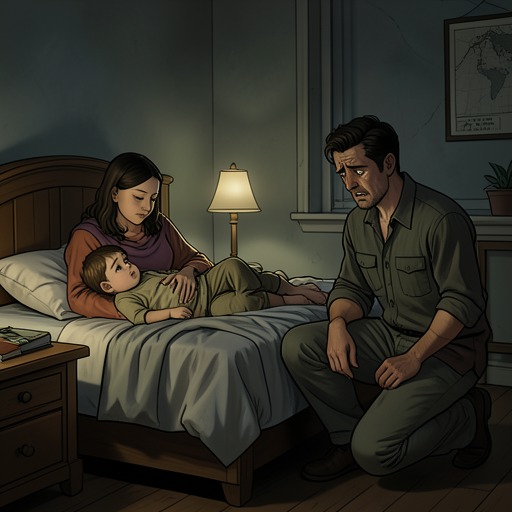
Louis’s attachment to Claudia is inseparable from guilt. At the bedside, he tells himself that death would be merciful, but recognizes that these thoughts are false: he wants her. He takes her into his arms and drinks from her, unable to endure the prospect of her awakening to suffering. When Lestat tears him away, Claudia is not dead, and Lestat completes the transformation by opening his wrist and making her drink. Claudia then drinks from a young slave boy, learning almost immediately that killing is the condition of her new life.
Lestat presents the transformed child as their daughter and places her in Louis’s arms. The gesture establishes a family structure that is also a trap. Claudia trusts Louis with the curiosity of a child, while Louis sees both the mortal child he tried to kill and the vampire whose eyes already contain an adult intelligence. He understands that she will retain her shape while acquiring the cold fire and powers of a vampire. The relationship therefore begins with an impossible asymmetry: Louis loves Claudia as someone he rescued, yet he has also taken her mortal life and made her dependent on him.
Years later, Louis returns with Claudia to the ruined house where he first found her. There he finally tells her that her mother had been dead for days, that Claudia had clung to the corpse for warmth and fear, and that he had fed on her. Claudia realizes that Louis was her first victim and that he tried to take her life before Lestat restored it. She tells him that he killed her and took her life; Louis admits that he did, while explaining that her heart beat so fiercely that he had to release her. When he recounts how Lestat gave her blood and how she began drinking human blood that very night, Claudia answers that she hates them both.
Family, Care, and Shared Life
After Claudia’s creation, Louis becomes her principal caretaker. He gathers her into his coffin each morning and tries to keep her away from Lestat, partly because Lestat threatens to starve or harm her and partly because Louis cannot imagine fleeing without her. Caring for Claudia gives him pleasure as well as responsibility. She appears quiet and almost emptied of her mortal childhood, but she is not without reason; she is unlike both men, at once a little child and a fierce, ruthless killer.
Louis teaches Claudia through books, music, and conversation. She reads Aristotle, Boethius, and newly imported novels, and she plays Mozart with an infallible ear, discovering melody and bass through concentrated practice. She becomes his pupil and companion, absorbing knowledge faster and faster while sharing with him a quiet understanding that excludes Lestat. Her violence has an equally disturbing double nature. She waits in the darkness for sympathetic adults to rescue her, then fixes her arms around their necks and kills them. The contrast between the apparently helpless child and the consuming predator becomes one of the relationship’s defining tensions.
Louis describes their intimacy in deliberately unstable terms. Claudia is his daughter, yet the narrative also calls them father and daughter, lover and lover. At dawn she lies beside him with her heart against his; she embraces him, presses her mouth to his, touches her eye to his until their lashes meet, and laughs with him as they whirl through the room. Lestat recognizes the closeness and does not openly challenge it, instead taking Claudia into the streets to share their distinct bond of hunting, seduction, and killing. Louis and Claudia thus form one emotional unit while Lestat remains both a member of the household and an excluded rival.
The bond is also maintained through repetition. Louis reads to Claudia, helps her dress, brushes her hair, and calls her a doll, while she alternates between silent dependence and unnerving autonomy. When she asks for her own coffin, Louis feels wounded because he has slept beside her for years as if she were part of him. Claudia finds him near the Ursuline Convent, embraces him with human desperation, and says she will remain with him if the coffin hurts him, but insists that she must have one because a child needs a coffin. Her demand marks a small domestic change with large emotional consequences: she wants an independent space even while still asking Louis to remain her emotional shelter.
The Child’s Body and the Adult Mind
The central structural problem of the relationship is that Claudia’s body never grows. Louis eventually understands that time has not carried her toward ordinary womanhood; she is to remain a demon child forever, just as Louis and Lestat remain physically the age at which they died. Her mind, however, develops. She speaks more, listens with adult patience, and gradually acquires eyes that seem fully aware. Her innocence disappears among neglected toys, replaced by sensuality, sharp judgment, intellectual appetite, and a capacity to command.
This mismatch changes the balance between them. Claudia can lounge in a tiny lace nightgown with the presence of an adult seductress, criticize Lestat’s predictions, demand more books, and identify a wealthy woman’s library as a place worth entering. Yet Louis can still put her on his lap, brush her hair, and call her a doll. She warns him that killing is more serious than music or books, then asks him to kill with her because he never lets her watch him do it. Her requests expose the conflict between the social role forced upon her and the consciousness she has acquired: she is treated as a daughter and displayed as a child, but she thinks and desires beyond both categories.
Claudia also learns to manipulate the appearance that has been imposed upon her. In Paris she develops a taste for rings, bracelets, perfume, gloves, and a jaunty walk that is no longer childlike. Louis fears that the lost-child persona she uses to attract victims will become something more openly wicked to passers-by. When she returns to their hotel carrying a china lady doll, she asks whether Louis still considers her a beautiful child. She crushes the doll in her hand, reducing it to glass, and then asks why he looks away from her. Her taunt about whether he thinks she will be his daughter forever makes explicit what Louis has tried to avoid: Claudia’s body remains childlike, but her self-consciousness and power have entered another stage.
Conflict, Separation, and Chosen Attachments
The relationship is repeatedly organized around pursuit and withdrawal. Louis protects Claudia from Lestat, but that protection also binds him to the household. Claudia’s needs make escape seem impossible, while Lestat uses the threat of harm to keep Louis close. Later, Claudia’s own growing independence makes Louis feel abandoned even when she remains physically near him. Her connection with Louis is therefore both secure and anxious: she seeks his care, tests his loyalty, demands that he act for her, and at moments tries to push him toward a life beyond their shared enclosure.
When Louis meets Armand, Claudia recognizes that he may leave her. Louis tells Armand that Claudia is his child, not his paramour, and admits that he does not know whether a child can release a parent from such a bond. Armand describes Louis as bound to Claudia, while Louis experiences the relationship as an obligation that cannot be measured by mortal language because both of them will live indefinitely. Louis’s attraction to Armand threatens the family structure, not simply because of romantic choice but because Armand represents knowledge and a form of existence in which Louis might no longer be divided by guilt.
At the hotel, Claudia confronts Louis after he has been with Armand. She embraces him, tells him she has everything she wants, and urges him to leave Paris with her and Madeleine. Louis refuses because he believes Claudia wants to recreate the former arrangement with Lestat, which cannot return. He says that Armand alone can give him the strength to become what he is and that, if he cannot go with Armand, he will die. Claudia answers that he could love even her, revealing how closely she understands the emotional power she has over him and how threatened she feels by his movement toward another attachment.
Madeleine, Betrayal, and the End of the Bond
Claudia’s need for an adult female companion leads her to Madeleine, a dollmaker whose own dead daughter has been reproduced in dolls. Claudia arranges for Louis to create Madeleine, but because Claudia lacks the physical size and strength to do it herself, she commands Louis to drink from the mortal woman. Madeleine is transformed, and Louis understands the act as a final severing of his remaining human feeling. Madeleine’s mortal death is not the immediate disappearance of her body, but Louis says that what dies that night is the last vestige of what was human in him. Claudia accepts the judgment and tells him that they are even, linking her earlier accusation against Louis to his present act on her behalf.
The new household gives Claudia a material sanctuary. Madeleine makes tiny furniture and clothing: a rocking chair, a table, an oil lamp, a china cup and saucer, a small book, low paintings, black gloves, a velvet gown, and a tiara. Claudia becomes the center of a miniature world built to fit the body she can never outgrow. Louis watches her as a fairy queen within this enclosed space, while Madeleine works with the feverish devotion of someone who has made immortality into continuous labor. The room transforms the physical limitation imposed upon Claudia into an aesthetic realm, but it also intensifies her separation from ordinary life.
Claudia’s alliance with Madeleine does not diminish Louis’s attachment; instead, it makes the family more complex and more precarious. Louis is still her guardian and emotional counterpart, but he is no longer her only companion. He is drawn toward Armand, while Claudia and Madeleine form a separate unit. Armand warns that danger surrounds them and that vampires associated with the Théâtre des Vampires may regard Claudia’s beauty with jealousy. Louis’s wish is to keep Claudia safe, even if doing so requires accepting dependence on Armand and remaining in a position where he is tolerated rather than free.
The relationship ends in physical loss but not emotional release. Madeleine and Claudia are burned, and Louis sees the remains beneath the rain: Madeleine’s blackened body still bears the stamp of her living face, while Claudia is reduced to ashes, her golden hair stirred by the wind. Louis cries out and attacks Santiago, then struggles against Armand as he is forced away from the small graveyard. The scene repeats the image of a dead mother and daughter that Louis once witnessed in the Rue Royale, turning the origin of Claudia’s life into the pattern of its destruction.
Meaning of the Relationship
Louis–Claudia relationship is a portrait of attachment formed through harm and sustained through mutual need. Louis’s care is genuine, but it cannot erase the fact that he created Claudia through predation and preserved the very condition that imprisons her. Claudia’s love is equally genuine, yet it contains dependence, calculation, resentment, and a demand to be recognized as more than the child Louis continues to see. Their intimacy repeatedly crosses the boundaries between family, companionship, eroticized language, tutelage, and shared criminality without settling comfortably in any one category.
The relationship also makes age a form of power. Claudia’s body grants her the appearance of innocence while denying her adult social agency; her vampire mind grants her knowledge and will while leaving her physically unable to act with the strength of the adults around her. Louis responds by caring for her, but his care can become paternal control. Claudia responds by cultivating intellect, style, seduction, and command, but each assertion of independence brings her back to the people whose blood and decisions made her what she is.
For Louis, Claudia is both the proof of his capacity for love and the evidence of his moral failure. He cannot abandon her, even when she threatens his freedom, because their bond is built from the original night when he tried to kill her, failed to let her die, and then watched her receive an immortal life through another’s blood. Her final destruction confirms the paradox at the heart of their relationship: Louis is unable to save the child he created, yet the grief of losing her becomes the clearest measure of how completely she had become his daughter, companion, beloved, and moral responsibility.