Madeleine
Interview with the VampireMadeleine is a Parisian dollmaker whose grief, craft, and longing for a lost child make her both the desired recruit and the tragic casualty of Louis and Claudia’s life. She enters the story as a mortal woman marked by bereavement, but her attachment to Claudia quickly becomes so powerful that she accepts vampirism and joins their household. Her creation gives Claudia a companion and practical protector, yet it also completes the emotional and moral crisis that leads to their destruction.
Identity and Background
Madeleine is encountered at the Hôtel Saint-Gabriel, where she appears composed and strangely fearless in the presence of Louis and Claudia. She wears a lavish green taffeta dress, and her dark-red hair, pale face, violet eyes, and childlike mouth give her an appearance that is at once calm, ornamental, and difficult for Louis to read. She has already been acquainted with Claudia, who has described her to Louis and arranged the meeting. Madeleine’s profession is central to her identity: she is a dollmaker, and her work is inseparable from the memory of a dead daughter.
That history is materialized in the doll Claudia gives her. The doll has raven hair and green eyes, is dressed with lace and ribbons, and resembles the child Madeleine lost. Madeleine has made or accumulated replicas of the dead girl, filling a doll shop with effigies that preserve the daughter’s image while acknowledging that the child cannot return. Her grief is therefore not only emotional but also artisanal: she repeatedly gives the dead a physical form, turning mourning into an inventory of objects.
Meeting Louis and Claudia
Madeleine’s first response to Louis is not ordinary terror. She studies him and Claudia with an excited, almost dispassionate fascination, asks how they appear to mortal eyes, and wants to know whether they seem beautiful or magical. The vampire kiss has left only a wound on her skin, so the boundary between mortal woman and prospective vampire remains briefly visible. Her interest is directed especially toward Claudia, whose small body and fierce eyes combine the appearance of a child with the power of an immortal predator.
Claudia’s conduct toward Madeleine is controlling but also desperately purposeful. When Louis refuses to create the new vampire, Claudia commands him to do it because she lacks the size and strength to perform the act herself. Madeleine becomes the instrument through which Claudia tries to repair the limitations imposed by her childlike body. Yet the encounter is not merely a scheme. Madeleine embraces Claudia when Claudia breaks down, holding her with a fierce tenderness despite being unable to understand the unnatural child she believes she loves. Their intimacy gives the household a new emotional center, even as Louis recognizes that love and hatred are already inseparable within it.
Transformation and New Household
Louis turns Madeleine after she declares that she loved her dead daughter and confronts the guilt consuming her. He instructs her to hold fast, focus on a distant light, and repeat that she will live. As he drains her, her heart slows toward death; he then gives her his blood, and she begins to drink from his arm with overwhelming force. The scene makes vampiric creation both an act of instruction and a struggle for bodily control. Madeleine must pass through mortal death before becoming immortal, while Louis experiences the act as a decisive surrender of what remains human in him.
After the transformation, Madeleine embraces the new existence with startling intensity. She burns the dead daughter’s dresses, bonnets, linen, and shoes, declaring that they mean nothing now. Her behavior is not a calm release from grief but an ecstatic displacement of grief into vampiric appetite and creative energy. She must repeatedly be led away from human victims because she is so satiated by earlier kills that she lifts people from the ground and crushes their throats with her fingers while drinking.
Her craftsmanship also changes under vampirism. With a chisel and knife, she makes a rocking chair sized for Claudia, followed by a matching table and other furnishings. The chair is proportioned so precisely that Claudia seated beside the fire appears almost like a woman rather than a child. Madeleine’s old dollmaker’s skill thus becomes a means of building a miniature domestic world for Claudia. Her work gives physical form to the family arrangement Claudia wants, while also reproducing the logic of her earlier mourning: dolls, furniture, clothing, and rooms become substitutes for a life that cannot develop naturally.
Relationship with Claudia and Louis
Madeleine’s devotion to Claudia is immediate and fierce. She protects Claudia when Louis and Claudia confront one another, holds her through tears, strokes her hair, and refuses to leave when Claudia orders her away. Claudia finally leads her from the room and uses the familiar doll as part of the process of calming and controlling her. Madeleine’s affection is genuine, but it is also founded on misrecognition: she sees an unnatural immortal child through the emotional categories of maternity and companionship.
Claudia’s relationship with Madeleine is correspondingly ambivalent. Madeleine supplies the strength and adult presence Claudia lacks, but Claudia also directs her, orders her movements, and uses her attachment to secure compliance. Their bond briefly appears to offer the equality Claudia has never had with Louis. Yet Madeleine cannot fully comprehend the laws, dangers, and conspiracies governing vampire existence. Her emotional openness makes her loving, but it also leaves her vulnerable to the theatrical and punitive system represented by the Théâtre des Vampires.
Louis regards Madeleine with pity, desire, guilt, and dread. He knows that her transformation is not a harmless experiment and expects the intensity of her new life eventually to collapse into a demand for freedom or reality. Instead, she feeds reality into her dreams, constructing an increasingly self-contained universe from vampire appetite and dollmaker’s craft. Louis therefore sees both the beauty and the madness of her creation. By turning her, he gains the companion Claudia needs, but he also accepts responsibility for bringing another mortal into the condition he himself finds morally and spiritually unbearable.
Death and Aftermath
Madeleine’s death follows the capture of Claudia and Louis by the Parisian vampires. She is confined with Claudia and hears the movement of the vampires around them, while Louis, trapped in his coffin, can only imagine rescue. When daylight ends, the coffins are carried away and the prisoners are sealed into a brick-lined place. Madeleine’s cries continue through the confinement, and Louis understands that the household has been rendered powerless by the very rules and spaces that govern vampire survival.
The execution leaves Madeleine’s body burned while Claudia is reduced to ashes. When Louis later sees the remains under the rain, Madeleine’s red hair is still mingled with Claudia’s golden hair, and the burned shape of her face and intact hand preserve the outline of the woman she was. The scene deliberately contrasts bodily persistence with annihilation: hair, dress, and the mark of a living face remain, while the life that animated them has been destroyed. Louis attacks Santiago in grief and must be dragged away by Armand, but he cannot recover either Madeleine or Claudia.
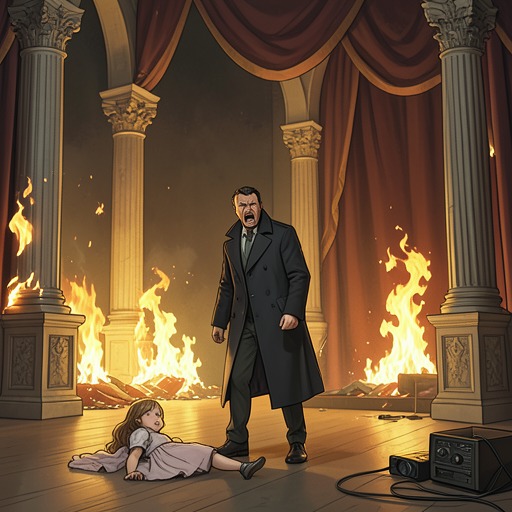
Madeleine’s death becomes part of Louis’s final break with the Théâtre des Vampires. He later prepares a carriage, seals the theater’s doors before dawn, enters Armand’s underground quarters, and drenches the cells, ballroom, stage, chairs, curtains, and lobby with kerosene before burning the establishment. Madeleine’s execution is therefore not only a personal loss but also the immediate moral and emotional force behind Louis’s retaliation against the coven. Her brief existence as a vampire ends in the same theatrical world that first offered her a place in the family, exposing the theater’s performance of death as an actual system of punishment.
Narrative and Thematic Significance
Madeleine stands at the intersection of mourning, performance, material craft, and constructed identity. Her dolls make grief visible, while the Théâtre des Vampires turns actual killing into spectacle for a human audience. Her own transformation reverses that arrangement: a mortal woman who makes representations of the dead becomes one of the dead who must perform a new life. The furniture she builds for Claudia extends the same pattern, creating a stage-set domesticity in which age, family, and adulthood can be temporarily rearranged.
Her presence also clarifies the limitations of Claudia’s rebellion. Claudia seeks a companion of her own kind and a household no longer organized around Louis’s authority, but Madeleine’s devotion cannot protect either of them from vampire law or from the coven’s control over hidden spaces. Madeleine’s tenderness gives Claudia what the vampire family has denied her, yet it also makes the pair more visible and more vulnerable. In the structure of Louis’s recollection, Madeleine is consequently both a rescue and a warning: she embodies the possibility of chosen attachment, and her destruction proves how little safety that attachment can provide in a world where immortality is governed by secrecy, hierarchy, and staged violence.