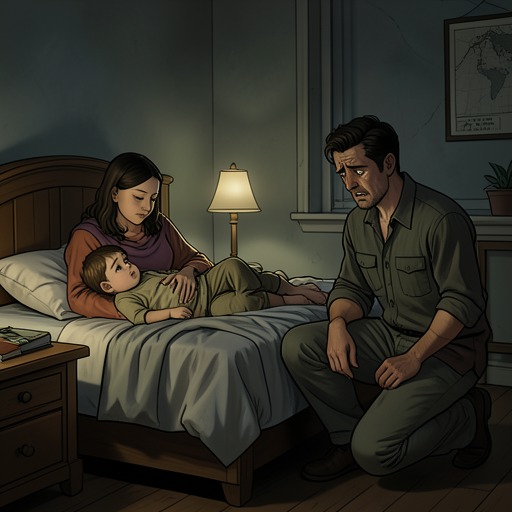
New Orleans yellow fever epidemic
Interview with the VampireThe New Orleans yellow fever epidemic is a recurring public catastrophe in Louis’s account of life with Lestat and Claudia. It supplies the human world’s visible model of contagion, weakness, corpses, and burial, even as the vampires move through that world as hidden predators. Its decisive significance lies in the contrast it creates: mortal death is presented as a collective emergency, while vampire killing is treated by Lestat as a private necessity and, eventually, as a source of power.
The Epidemic as the Setting of Vampire Formation
New Orleans is already suffering from yellow fever and plague when Claudia enters the household. Lestat takes her into foul cemeteries where the victims lie in heaps and the sound of shovels continues through the day and night. There he points to a decaying woman’s corpse and teaches Claudia that this is mortal death: a condition vampires will never suffer in the same way, because their bodies remain fresh and alive, but also a condition that should not restrain them from bringing death to others. The epidemic therefore becomes part of Claudia’s education. Death is not introduced to her as an exceptional horror; it is placed before her as the ordinary condition surrounding the city and as the basis of the vampires’ claim that killing is how they live.
The lesson also establishes a sharp difference between the epidemic’s victims and the vampire family. The dead in the cemeteries are anonymous, heaped together, and handled by workers whose shovels never cease. Claudia, by contrast, is a child whose senses awaken after mortal illness and whose beauty remains intact. She can play quietly with dolls and kill with the same composed concentration. The epidemic makes that contradiction visible: the city’s mortality produces scenes of decay, while vampirism preserves the appearance of life and converts the living body into food.
Fear, Diagnosis, and Competing Explanations
The epidemic is narrated alongside several competing ways of explaining bodily collapse. Louis’s own transformation begins after a vampire drains him almost to death, leaving him feverish, confused, and unable to understand what has happened. He initially supposes that drink has caused a stroke. A priest, hearing Louis’s account of his brother’s visions, explains the crisis through possession and the devil rather than through medicine or psychology. In this world, fever, delirium, violence, religious fear, and supernatural attack occupy neighboring categories, and responsibility changes according to which explanation is accepted.
The same instability appears during the later voyage across the Atlantic. A mysterious fever passes among passengers: weakness and soreness appear around the throat, marks sometimes surface there or elsewhere, old wounds reopen, and some passengers grow increasingly sleepy before dying in their sleep. Burials take place at sea. Louis avoids the passengers and eats alone, fearing fever and refusing the ordinary sociability of the ship, while Claudia watches them as potential prey and quietly identifies those likely to fall victim. The epidemic model thus resembles vampiric predation in its pattern of vulnerability, isolation, symptoms, and disappearance, yet the narrative keeps the two systems distinct: one is described as fever, the other as the hidden consumption of blood.
Plague, Corpses, and the Management of the Dead
The epidemic also shapes the treatment of corpses. In New Orleans, the dead are gathered in cemeteries and exposed to the continuing labor of burial. Elsewhere, Louis and Claudia encounter communities that respond to suspected vampires through staking, decapitation, burning, and the policing of graves. Morgan recounts seeing a dead woman staked through the breast and beheaded before her body is burned, because the villagers believe a plague of vampires threatens them. His companion Emily later vanishes through an open window and is found dead beneath peach trees, still clutching an empty cup; the villagers interpret her death as evidence that she has become a vampire and prepare to destroy her as well.
Louis rejects this explanation and objects to the villagers’ violence, insisting that Emily is dead rather than an active vampire. Yet the scene reveals how closely epidemic panic and vampire panic resemble each other. Both produce rumors, emergency measures, suspicion of hidden sources, and attempts to contain contamination through fire or exclusion. The villagers search their cemetery for the beings they fear, while Louis and Claudia search eastern European graveyards for vampires who might explain their own origins. In each case, the dead body becomes evidence in an argument about what has entered the community and how the danger can be stopped.
The Epidemic’s Effect on Claudia and Louis
For Claudia, the epidemic is part of the practical knowledge that makes her a vampire. Lestat’s cemetery lesson teaches her that mortality is a condition to be observed without human sympathy and that the vampire’s permanence gives killing a different moral status. She absorbs this instruction with inscrutable calm. Her lack of visible fear does not mean that she is merely imitating Lestat; Louis later recognizes that she is less human than either of them and possesses no ordinary sympathy for human existence.
For Louis, however, the epidemic intensifies rather than resolves his moral unease. The crowded city gives him an endless supply of strangers, allowing him to feed without remaining close enough to experience friendship, revulsion, or sorrow. He kills among streets, cabarets, balls, carriages, supper tables, and brothels, treating the swelling population as a forest in which he can lose himself. The city’s abundance becomes a kind of mercy because it lets him hide from the individual human being behind the pulse. The epidemic’s mass death therefore provides a grim social background for his detachment, while the sight of particular bodies continues to provoke pain.
That pain returns whenever death becomes intimate or prolonged. Louis never accepts Lestat’s claim that repeated killing will make death amusing. He watches the overseer die for nearly an hour during his own transformation and remains horrified by the handling and abandonment of the body. Later, when Madeleine undergoes mortal death before becoming immortal, Louis must explain to Claudia that her terror is the experience of dying as a human being. The epidemic supplies the surrounding culture’s image of death in heaps, but Louis’s narration repeatedly restores the individual body, the frightened witness, and the burden of responsibility.
Narrative and Thematic Significance
The New Orleans yellow fever epidemic links public health disaster to the private mythology of vampirism. It makes the supernatural legible through familiar signs—fever, weakness, blood, corpses, burial, quarantine-like separation, and collective fear—without reducing vampirism to disease. Instead, the epidemic exposes the competing authorities that attempt to name bodily catastrophe: medical suspicion, religious doctrine, village folklore, vampire knowledge, and Louis’s retrospective moral analysis.
Its strongest function is ethical contrast. Lestat uses the spectacle of mortal decay to instruct Claudia that vampires must kill, whereas Louis sees the same world of corpses as a reason to recoil from death. The epidemic turns mortality into a public landscape, but it does not make death impersonal for everyone. For Claudia it becomes doctrine; for Lestat, justification; for Louis, an image of the suffering he cannot escape. Even after the vampires leave New Orleans, the same questions return among the graveyards of eastern Europe: whether the dead remain conscious, whether the mind can survive bodily ruin, and whether a creature that feeds on others is a person, a disease, or a monster. The epidemic is therefore not merely historical scenery. It is the first large-scale human mirror in which the vampires’ own condition is reflected, distorted, and morally contested.