Santiago
Interview with the VampireSantiago is the Théâtre des Vampires’ most conspicuous embodiment of performance used as power. Known through Louis’s account as the trickster vampire, he first appears as a mocking, mechanically imitative predator in the streets of Paris and later becomes the coven’s public spokesman and chief agent of punishment. His theatrical manner is not ornamental alone: it allows him to control what others see, convert violence into entertainment, and make the theater’s law appear as an inevitable spectacle.
Identity and Introduction
Santiago enters Louis’s Parisian experience through a grotesque encounter beneath a gas lamp. At first he mirrors Louis’s posture, expressions, gestures, and even words with maddening precision. He repeats Louis’s movements as though Louis were facing a living reflection, then turns the imitation into intimidation by striking his own chest in rhythm with Louis’s heartbeat and laughing with an animal ferocity. When Louis asks whether he means harm, Santiago obliterates the question through mockery; when Louis calls him a trickster and buffoon, the playfulness hardens into hostility. Santiago can also move with such speed that he seems to materialize, pushing Louis off balance and throwing him down before withdrawing into an apparently empty street.
This encounter establishes Santiago as a vampire who treats another creature’s uncertainty as a stage on which to perform superiority. His mockery is simultaneously comic and predatory. He makes Louis watch his own gestures returned in distorted form, turning recognition into disorientation. The result is not merely a physical threat but a struggle over who controls the scene and who is reduced to an audience.
The Theater’s Performer
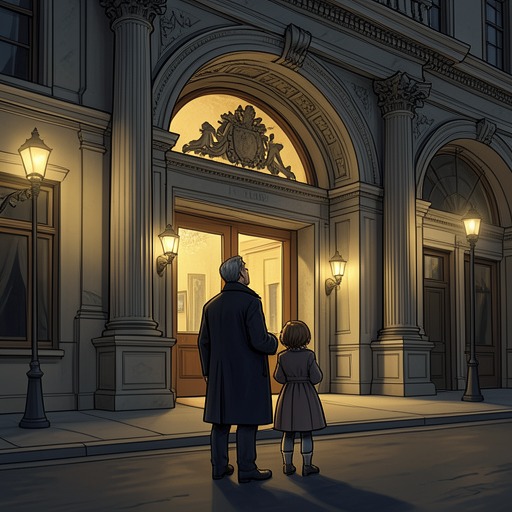
Santiago’s public identity becomes clearer when Louis and Claudia receive an invitation to the Théâtre des Vampires from Armand. The card directs them to bring the petite beauty, and the theater presents itself to ordinary Parisians as a fashionable entertainment venue. Behind its human audience, however, the vampires transform murder into staged ritual. Santiago is the leading figure in the opening performance: Death himself, dressed in black, wielding a silver scythe, and first concealing his face behind a painted skull mask.
The production begins with a fragile woodland illusion, medieval music, and an audience prepared to admire theatrical artifice. Santiago moves so rapidly that he seems to appear magically at center stage. He directs the audience’s attention through gesture, costume, rhythm, and the dramatic symbolism of the scythe. The old woman who approaches him in prayer becomes an object of comic pursuit, and the audience’s uncertain laughter grows into confident amusement as Death rejects and evades her. Santiago’s performance makes suffering safe for the spectators by framing it as entertainment, even as the vampires’ contempt for the vulnerable becomes increasingly visible to Louis.
When the play turns to the young mortal woman, Santiago abandons the skull mask and reveals a handsome white face beneath the stage light. The theatrical revelation exposes the truth that the supposed Death is simply a vampire, including the same leering figure who had confronted Louis in the Latin Quarter. Seven vampires surround the woman, while Santiago assumes the role of the elegant master of ceremonies. He tells her that they are death and insists that mortality is the one condition shared by every human being. His speech turns ordinary fear of death into a formal argument, while the surrounding vampires convert the woman’s terror into choreography.
The performance culminates in the woman’s actual killing. She is passed from one vampire to another before the enthralled crowd, and the painted forest returns after the feeding, leaving her naked in a black bier as though she were merely another stage image. Applause follows. The theater’s central mechanism is therefore a collapse of the distinction between representation and reality: the audience applauds a murder because the murder has been given the shape of drama. Santiago’s role is crucial because he supplies the framing device that permits spectators to consume brutality as aesthetic illusion.
Law, Accusation, and Institutional Power
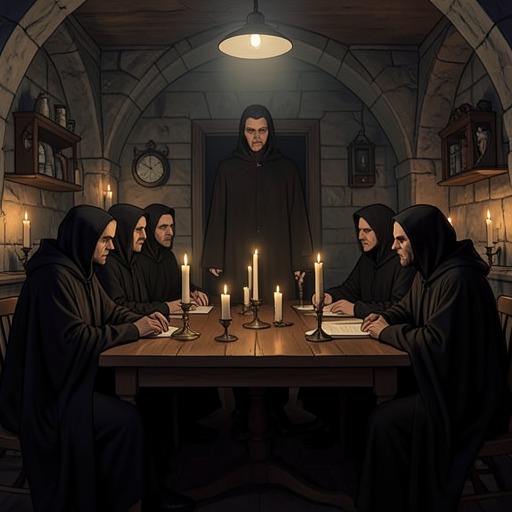
After the performance, Santiago participates in the subterranean social world beneath the theater, where frescoes of death and damnation surround the vampires. Armand remains remote, but Santiago is more openly theatrical and confrontational. When Claudia asks whether the coven recognizes any cardinal crime, Santiago seizes the question and turns it into a public interrogation. He approaches from behind Louis, places a hand on his shoulder, and taps Louis’s heart in time with its quickening beat before identifying the offense punishable by death: killing one’s own kind.
The accusation is aimed at Louis and Claudia because they have concealed the identity of the vampire who made them. Claudia laughs at the supposed revelation, treating the law as absurdly less frightening than the fact of their creation. Santiago’s response shows how the theater protects itself: it does not need to prove guilt immediately. It creates a threatening atmosphere, turns suspicion into communal knowledge, and makes the accused perform their innocence before an assembled audience. His gestures and timing give the law the force of spectacle.
Santiago’s authority also depends on the contrast between him and Armand. Armand’s stillness, reserve, and inward concentration make him difficult to read, whereas Santiago externalizes judgment through movement, insinuation, and public speech. Yet Santiago’s theatricality does not make him less dangerous. It is the visible surface of a system capable of surveillance, collective violence, imprisonment, and execution. His performance gives the coven a face that can laugh, provoke, and accuse while the institution closes around its victims.
Pursuit and Confrontation
When the coven attacks Louis, Madeleine, and Claudia, Santiago becomes one of the principal agents of their capture. Louis fights him directly and wounds his face, but the resistance is overwhelmed by numbers and persistence. Louis is forced from the rooms, dragged down the stairs, beaten, and taken by carriage to the Théâtre des Vampires while Madeleine sobs beside him. Santiago’s authority is therefore not confined to the stage or the salon; he can translate the theater’s rules into bodily control.
At the theater, Santiago thrusts Louis forward before Lestat. The encounter reveals that Lestat has survived and that Santiago knows the coven’s proceedings well enough to present the prisoner and negotiate over his fate. Lestat demands Claudia, while Louis appeals to him for protection. Santiago remains part of the surrounding machinery that treats the captives as objects to be assigned, judged, and destroyed. His earlier theatrical accusation now becomes direct coercion: the law against killing one’s own kind has been converted into a sentence carried out by a group that itself organizes killing as entertainment.
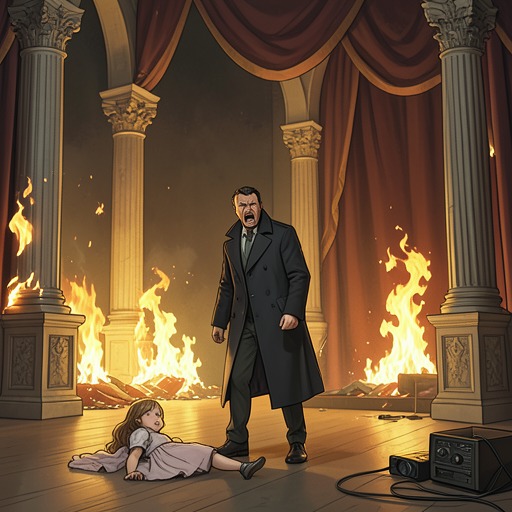
Santiago’s power is finally challenged when Louis burns the theater. As flames spread through the stage, curtains, chairs, draperies, and the underground ballroom, Santiago comes down the stairs through smoke and fire. He is choking, his eyes watering, and he recognizes Louis as the author of the destruction. Even in this moment, his rage is expressed as a theatrical confrontation: he advances with supernatural speed, attempting to make himself invisible in motion, while Louis waits with the scythe.
Death and Narrative Significance
Louis strikes Santiago’s neck with the scythe. Santiago rises despite the wound, forcing Louis to strike again; then the head is severed, blood runs from the torn neck, and the head falls beneath the flaming rafters. Louis kicks it along the passage before escaping into the rain and the approaching light. Santiago’s death is a literal reversal of his stage persona. The scythe that he had displayed as an emblem of theatrical Death becomes the instrument of his actual destruction, and the performer who once controlled the audience’s gaze becomes an inert object pushed across the floor.
His destruction is not presented as an isolated revenge killing. Louis burns the Théâtre des Vampires after the coven executes Claudia and Madeleine, intending the fire, the sun, or the human rescuers to destroy those still hidden inside. Santiago is the only member Louis personally decapitates, making him the clearest individual target of the theater’s collapse. The burning of the building therefore destroys both a place and a system: its performances, subterranean spaces, costumes, laws, and hierarchy are consumed together.
Santiago’s later significance is sharpened by the narration’s structure. Louis tells the story to a human boy who hears of passion, love, violence, and despair as though they formed an adventure beyond ordinary human life. The boy finally asks for the power to become a vampire, and Louis responds by attacking him. Santiago’s career helps explain the danger of that desire. The theatrical vampire world can make immortality appear glamorous, but its glamour depends on turning suffering into a show and concealing institutional cruelty behind style. Santiago is the figure who most clearly joins those two sides: he is an entertainer because he is an enforcer, and an enforcer because the coven has learned to make violence pleasurable to watch.