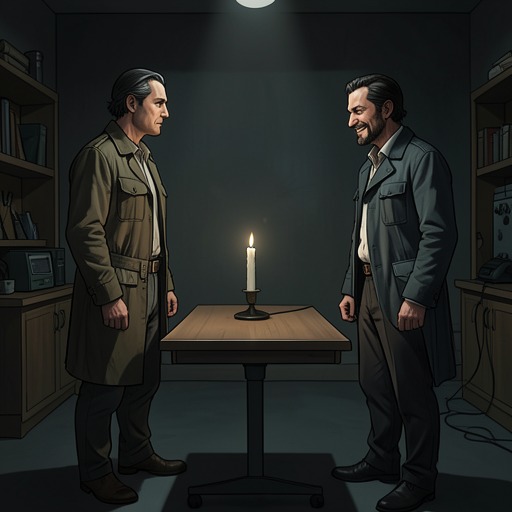
St. Charles Avenue
Interview with the VampireSt. Charles Avenue becomes the decisive threshold of Louis’s return to New Orleans: on its broad sidewalks before dawn, he recognizes a vampire moving through the city and follows him in the hope that the stranger knows where Lestat is. The avenue therefore links memory, urban observation, and renewed desire, turning Louis’s homecoming into a search that leads from public streets to a concealed household and, ultimately, toward the living past he had tried to leave behind.
Setting and Return
St. Charles Avenue appears after Louis and Armand return to New Orleans in late spring. Louis has come back because Armand revealed that Lestat survived the burning of the Théâtre des Vampires and had secured passage to New Orleans with the help of two vampires made by the same master. The revelation revives Louis’s wish to see Lestat, and the familiar city receives him with an extraordinary sense of homecoming: warm, flat pavements, old oaks, and the continuous living sounds of the night restore an ease he had not expected to feel.
The avenue belongs to a New Orleans that has changed while retaining visible traces of Louis’s earlier life. He can still find old mansions in the Garden District, once the Faubourg Ste.-Marie, and he recognizes the former town house on Rue Royale where Lestat, Claudia, and he had lived. Yet St. Charles Avenue offers something different from these sites of memory. It is not merely a preserved relic of the past; it is an active nocturnal route along which another vampire moves, making the city a living field of signs and possible connections.
The First Sighting
Louis sees a sleek, white-faced young vampire walking alone on the broad sidewalks of St. Charles Avenue in the early hours before dawn. He immediately concludes that the vampire may know Lestat and might lead him to him. The stranger does not notice Louis, whose long experience allows him to identify members of his own kind in large cities without exposing himself to their gaze.
The encounter is shaped by the wider consequences of the Théâtre des Vampires fire. Armand has learned through brief visits with vampires in London and Rome that the destruction of the theater is known throughout the vampire world and that both Louis and Armand are regarded as outcasts. Louis refuses to become involved in the battles surrounding that reputation, but his position outside the established community makes observation and pursuit his available methods. On St. Charles Avenue, he watches rather than announces himself.
From Public Street to Hidden House
Louis follows the young vampire on repeated occasions, although the vampire often leads him only to theaters or other entertainments in which Louis has no interest. The pattern changes on a particularly warm evening when the vampire is walking quickly and appears distressed. When he turns from St. Charles Avenue into a narrow street that becomes shabby and dark, Louis believes that the destination may finally reveal something important.
The vampire enters one side of a small wooden duplex and kills a woman quickly, without apparent pleasure. He then gathers the woman’s child from a bassinet, wraps the child gently in a blue wool blanket, and carries the baby into the street. After traveling only a block or two, he stops at a vine-covered iron fence surrounding a large, overgrown yard. Beyond it stands an old, apparently doomed house with peeling paint, rust-caked galleries, and high empty windows. The route from St. Charles Avenue thus carries Louis from an open urban thoroughfare into a deteriorated, secluded space where violence, caretaking, and vampire secrecy converge.
Discovery and Narrative Significance
Louis follows by climbing the old fence and entering the garden, then approaches the long front porch. Through a floor-length window he sees the young vampire beside another vampire in a parlor whose windows are shut despite the heat. A fire burns in the grate, an oil lamp illuminates the wailing child, and the second vampire—stooped, shivering, and wrapped in a shabby blue robe—complains that everyone leaves him. The scene gives Louis a new lead while also confronting him with a disturbing domestic arrangement: the infant remains present after the mother’s death, and the vampires’ hidden life occupies a decaying human house rather than a theatrical or aristocratic setting.
St. Charles Avenue is consequently more than a geographical marker. It is the point where Louis’s return becomes active investigation. The avenue’s broad, familiar public space allows him to remain unseen; the turn into poorer, darker streets exposes the concealed violence beneath the city’s ordinary movement; and the old house supplies the first concrete sign that Lestat may still be near. In the structure of Louis’s account, the avenue joins the nostalgia of New Orleans to the uncertainty of renewed pursuit, showing that homecoming does not close the past but opens it again.