The morality of killing
Interview with the VampireThe morality of killing is the ethical problem at the center of Louis’s account of vampiric existence. It concerns more than whether killing is permitted: it asks how a predator classifies its victims, how appetite can disguise itself as judgment, and whether beauty, pity, or disgust can survive an act that destroys another life. Louis first describes his preference for animal blood as an aesthetic discipline, a way of approaching death gradually; later, he recognizes that this preference was already moral because every aesthetic decision expresses a hierarchy of values. His conclusion becomes increasingly severe: human life possesses an irreplaceable value, and no appeal to beauty, necessity, love, or supernatural nature can remove the responsibility of taking it.
Definition and Initial Distinction
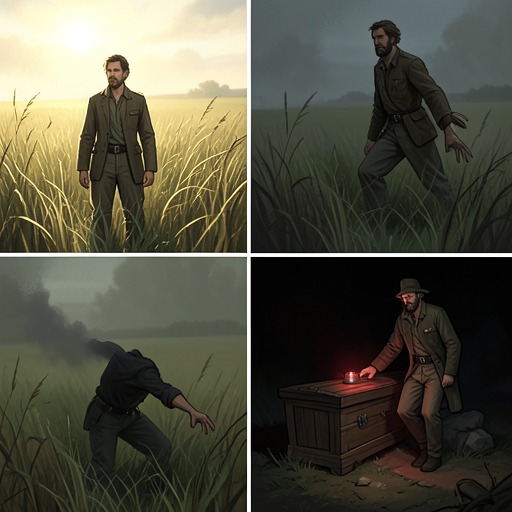
Louis initially tells the boy that he would have described his choice to kill animals rather than people as aesthetic rather than moral. On the night when Lestat urges him to feed, Louis searches the streets for rats instead of killing a human being. He believes that animal death offers pleasure and knowledge in stages, allowing him to reserve the experience of human death for a more mature understanding. This reasoning creates a temporary partition between appetite and conscience: animals are treated as an introductory form of the kill, while human beings represent a more serious and frightening threshold.
That distinction is inseparable from Louis’s fear of damnation. After accepting Lestat’s transformation, he assumes that becoming a vampire has already placed him in the position of Judas, a creature who has crossed into betrayal and cannot return. The choice of animal blood therefore functions as a hedge against the question of whether his nature is evil. He does not yet claim that the choice makes him innocent; instead, he postpones the larger moral judgment by treating the kill as an experiment in perception and sensation. His language reveals the weakness of that strategy, because the desire to understand death is itself being used to organize and justify the destruction of living beings.
Aesthetic Choice as Moral Choice
Louis later rejects the opposition between aesthetics and morality. He argues that an artist who abandons a family for art, or Nero who plays the harp while Rome burns, has still made a moral decision, even when society condemns it. The conflict lies between the artist’s morality and the morality of society, not between aesthetic judgment and moral judgment. In this account, beauty does not stand outside ethics. Aesthetic preference always serves some conception of a higher good, whether that good is defensible to others or not.
This argument also explains why Louis’s original defense of animal feeding cannot remain merely formal or aesthetic. To select rats, dogs, or other animals is to establish a boundary around human life, even if Louis does not yet understand that boundary as a principle. Lestat teaches him the practical details of animal feeding by catching a field rat, draining it into a wine glass, and presenting the blood almost as if it were burgundy. The crystal glass, the candlelight, and the delicate tasting ritual turn predation into a form of consumption governed by taste and class. Yet the ritual does not erase violence; it gives violence an appearance that Louis can initially endure.
Lestat’s broader household practice exposes the instability of such civilized appearances. He uses luxury, etiquette, hospitality, and expensive furnishings to make vampiric life run smoothly, while continuing to hunt mortals. He can entertain visitors at Pointe du Lac with gentleness and polish, even when he later kills them. The same social world that values fine glassware, imported wines, and courtesy therefore accommodates predation, provided that the violence remains controlled and does not violate the manners of the household. The morality of killing is shown to operate through distinctions of setting, behavior, and social identity as much as through the bare fact of death.
The Human Face of the Victim
The abstract question becomes unbearable when Louis encounters a five-year-old girl beside her mother’s decaying body. He is already suffering from an extreme physical thirst, yet he knows that rats are plentiful and that he could leave the room to feed elsewhere. The child’s face, thin body, tears, and desperate belief that her mother can still be helped confront him with a living person rather than an anonymous source of blood. Her vulnerability produces pity, but pity does not cancel hunger; instead, it makes the act morally intelligible and morally horrifying at once.
Louis kills the child while telling himself that the act will be brief and painless. His words are an attempted consolation, but they also reveal that he understands the child as someone capable of suffering. He hears her heart beating with fierce resistance, a rhythm unlike that of an adult or an animal, and the intensity of that life makes the kill more powerful rather than less. The child is not reduced to food by the narration: her body, fear, exhaustion, and refusal to die remain present within the act. Louis’s pity therefore becomes evidence against his own hope that vampiric nature can be morally neutral.
Lestat then turns the scene into a lesson in appetite and manipulation. He brings the surviving child to the hotel after killing the other woman and urges Louis to finish what began in the earlier room. The child is placed on a pillow, her freshness contrasted with the surrounding corpses, and Lestat insists that Louis wanted her and that his earlier failure was weakness. Louis resists because he remembers both the child’s beating heart and the horror of the mother’s corpse, but he finally yields when desire overcomes the possibility of refusal. His later recognition that the excuses he formed for killing her were lies marks a decisive collapse of the distinction between necessity and chosen violence.
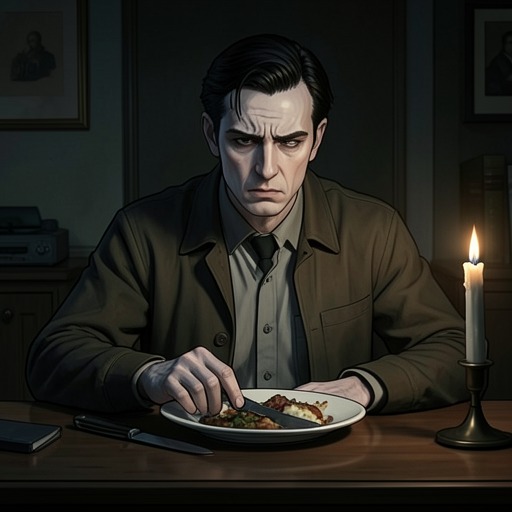
The dining imagery surrounding these scenes is ethically important. Lestat pretends to eat at a supper table, drinks human blood after presenting it as intimacy, and treats the bodies of victims as objects to be arranged or discarded. Children are prepared for killing as though they were a gift, and their food, plates, wine, and sleeping bodies become part of a grotesque domestic ritual. The familiar forms of hospitality and nourishment do not civilize the kill; they demonstrate how easily etiquette can conceal consumption and how class manners can make predation appear orderly.
Responsibility, Religion, and Competing Explanations
Louis’s understanding of moral responsibility is shaped by earlier religious and social judgments. After his brother’s death, he cannot forgive himself for having mocked the brother’s visions and refused to treat his conviction with kindness. The family, police, and priest all interpret the death through competing forms of blame. The priest declares that the brother was possessed by the devil and that the devil threw him down the steps, converting an uncertain death into a religious explanation that absolves some human responsibility while condemning the dead man.
Louis reacts violently against this explanation. The priest’s contempt for the brother reflects the egotism Louis recognizes in himself: both men dismiss an experience because it does not fit their preferred categories. The priest accepts possession as a familiar and manageable explanation, whereas Louis cannot tolerate the possibility that sanctity may have passed close to him. His rage culminates in wrecking the room and nearly killing the priest. The episode establishes a pattern that recurs in his later thinking: moral judgment is never detached from the categories through which people decide what another person is allowed to be.
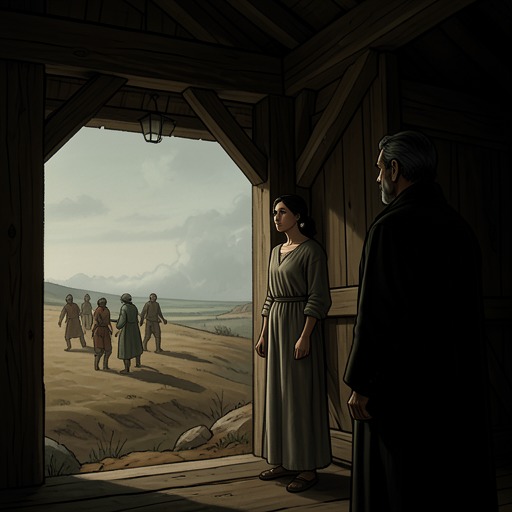
The same conflict appears in the story of the Englishman who witnesses a corpse being exhumed, staked, and beheaded because it is suspected of vampirism. The man sees violence presented as purification and calls the people who perform it savages, even while imagining himself and Louis as civilized men joined by shared blood and nationality. His horror reveals that the condemnation of killing depends partly on who claims the right to kill and on which institution authorizes the act. Religious, communal, and vampiric explanations compete to name the corpse as a threat, but each explanation also licenses a different form of violence.
Within the vampire theater, the conflict becomes an explicit internal law. Santiago tells Louis and Claudia that the crime for which a vampire will be hunted and destroyed is killing one’s own kind. The rule does not prohibit killing mortals; it protects the vampire community and its secrecy rather than human life. The theater’s vampires discuss kills as performances, criticize one another for wasting opportunities, and treat cruelty as entertainment. Their collective code therefore exposes a moral inversion: killing is tolerated or even celebrated when directed outward, while solidarity among vampires becomes the highest protected value.
The Limits of Moral Escape
Louis’s debate with Armand gives the morality of killing its most direct philosophical form. Armand asks how evil is achieved and whether a person becomes evil through a single sin or through a gradual scale of offenses. Louis answers that, whether or not God exists, human beings are the creatures of highest consciousness in the universe and uniquely understand time and the value of every minute of human life. For him, real evil is the taking of a single human life. The fact that a victim might have died tomorrow, the next day, or eventually does not lessen the loss, because the present life contains all that can be possessed.
This position rejects both religious simplification and vampiric fatalism. The priest reduces Louis’s brother’s death to demonic possession; the vampires of the theater reduce mortal death to entertainment and technical opportunity; Lestat treats killing as a practical necessity and a source of pleasure. Louis’s argument refuses all three reductions. A life cannot be morally discounted because it is temporary, because its death is aesthetically compelling, or because the killer’s nature has made violence physically compelling.
Yet Louis does not present himself as an observer who has solved the problem. His own actions repeatedly contradict his principles. He feeds on animals while claiming to postpone human killing, kills the child after recognizing her suffering, and remains entangled with vampires whose methods he despises. His moral consciousness is therefore not evidence of purity but of divided existence. He continues to hunger, and the very intensity with which he understands the victim’s life can deepen the experience of the kill. Conscience does not place him outside violence; it makes him experience violence as knowledge, desire, and condemnation at once.
Consequences for Identity and Relationship
The morality of killing determines Louis’s relationships because it measures the kind of creature each relationship permits him to become. Lestat’s practical instruction teaches survival, travel, finance, and the use of social luxury, but it also teaches Louis to regard feeding as an ordinary component of immortal life. Lestat can be generous to family and guests while being vicious toward victims, demonstrating a morality based on proximity, possession, and household privilege rather than universal responsibility. Louis’s dependence on him makes the lesson difficult to reject: Lestat is both captor and teacher, and the practical knowledge he provides helps bind Louis to the very ethics he resists.
Claudia intensifies rather than resolves the problem. She can question the rules of the vampire theater and manipulate its rituals, yet she also arranges two orphaned boys as a present for Lestat, presenting their vulnerability as a means of restoring peace. The scene turns reconciliation into a shared act of consumption. Claudia’s intelligence and emotional complexity do not free her from the morality of killing; instead, they show how ethical language, affection, resentment, and appetite can be mobilized together.
After Claudia’s death, Louis tells Armand that the love and goodness he sought in living death were impossible from the beginning. He had continued searching for other vampires, for God, for the devil, and for alternative names that might explain his condition, but none could dislodge the judgment he carried within his own mind and soul. Armand’s power and beauty once seemed to offer a model of existence without regret. Louis eventually understands that Armand is not an escape from the destroyer he fears becoming but another form of the same destructive condition, more ruthless and cunning than his own.
The final consequence is not a stable doctrine but a hardened self-knowledge. Louis tells Armand that the passion Armand believes he sees has been extinguished, leaving only a mirror of Armand himself. The morality of killing thus becomes a theory of transformation: repeated violence does not merely produce guilt over individual acts; it changes the emotional structure of the killer. Love, curiosity, and the desire for goodness are gradually measured against the knowledge that they coexist with deliberate destruction. Louis’s tragedy lies in recognizing that truth while continuing to inhabit the body and appetite that made the truth unavoidable.