The vampire as fallen angel
Interview with the VampireThe vampire as fallen angel names the novel’s effort to understand vampirism through religious imagery without granting that imagery a stable supernatural explanation. Lestat presents vampires as “dark angels” who roam the earth beyond the limits of hell, while Louis experiences their immortality as both elevation and damnation. The image therefore holds together contradictory conditions: godlike power and dependence on human blood, freedom from mortality and enslavement to instinct, terrifying detachment and an almost unbearable capacity for sympathy.
The Angelic Claim and the Predatory Nature
Lestat gives the fallen-angel image its most seductive form when Louis is exhausted by the pain of killing and longing for a morality he can no longer inhabit. In the darkness near the river, Lestat tells him to do what his nature requires and treats the vampire’s hunger as a truth that must be accepted rather than resisted. He calls vampires immortal beings comparable to “dark angels,” not confined to hell but wandering across the earth and its kingdoms. He further joins their violence to divine violence, arguing that God takes both the richest and the poorest and that vampires likewise kill without regard to human distinctions.
This rhetoric transforms predation into a cosmic identity. Lestat does not merely encourage Louis to feed; he offers him a metaphysical justification in which vampiric appetite becomes an imitation of divine power. His declared desire for a child leads them to the ward of starving orphans and plague victims, where the wounded girl Louis once encountered lies among other children. The sacred language thus becomes inseparable from the vulnerable human body. The vampire’s supposed angelic freedom is purchased through the blood of beings who cannot understand or resist what is happening.
The same contradiction governs Louis’s response. He is drawn toward the promise that killing will end his longing, but he cannot accept the loss of conscience that Lestat presents as liberation. His suffering marks him as a vampire who remains inwardly attached to human moral feeling. The fallen angel is therefore not simply a monster elevated into divinity; it is a divided creature whose power intensifies the pain of ethical awareness.
Damnation, Doubt, and the Search for Origins
Louis’s journey through Europe develops the image into a question about origins. After the destruction of the household in New Orleans, he and Claudia travel through central and eastern Europe seeking older vampires who might explain what they are. Claudia studies accounts describing vampires whose remains are burned, staked through the heart, and decapitated, while planning a route toward Varna and the Carpathians. Their quest assumes that antiquity may preserve a theology or history capable of giving meaning to their condition.
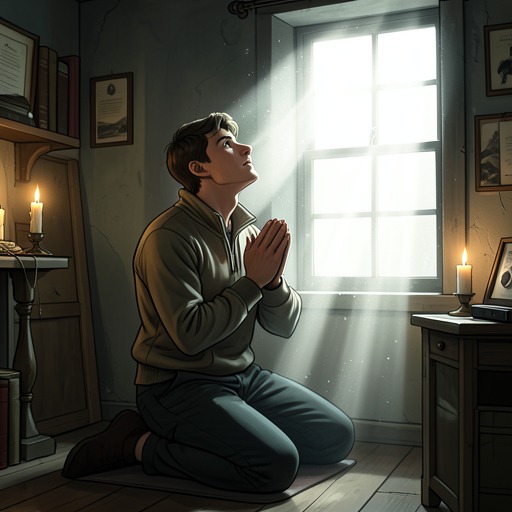
The voyage across the Atlantic turns that search inward. Alone at the ship’s porthole, Louis watches the stars meet the sea and imagines a revelation that might identify whether his existence belongs to God or Satan. The possibility of knowing Satan offers a terrible kind of consolation because it would at least establish a final allegiance and end uncertainty. Yet the thought immediately becomes horrifying: damnation would provide no rest, and neither heaven nor hell seems more than a tormenting possibility. The vampire as fallen angel thus occupies a theological threshold, separated from ordinary human nature but denied certainty about the realm into which it has fallen.
The eastern European search destroys rather than confirms the expectation of hidden wisdom. In Transylvania, Hungary, Bulgaria, and surrounding villages, the vampires Louis and Claudia find are usually mindless corpses, creatures with vacant eyes, rotted clothing, and no secrets to reveal. One woman flees through the forest in a blood-stained burial gown, her fingers still caked with grave dirt, but offers only despair. These revenants expose the limits of the angelic metaphor: immortality does not necessarily produce consciousness, knowledge, or spiritual elevation. The vampire may be a fallen angel, but it may also be only a corpse animated by hunger.
Armand’s Rejection of Satanic Descent
In Paris, the theological image reaches its decisive challenge through Armand. Louis and Claudia enter the Théâtre des Vampires after receiving an invitation signed by Armand, and the theater makes vampirism into public spectacle. The performers stage Death in a painted forest, surround a mortal woman, and kill her before an audience that responds with gasps, laughter, sighs, and applause. Their masks, costumes, music, and theatrical gestures turn actual feeding into an aesthetic performance, while the human spectators mistake reality for illusion.
The spectacle intensifies Louis’s sense that the vampire resembles a fallen angel. The leading performer appears as Death, first masked by a skull and carrying a silver scythe, then revealing a beautiful white face. Seven vampires circle the woman, presenting themselves as an elegant supernatural order while consuming her in full view of the crowd. Yet Louis’s sympathy for the victim prevents him from accepting their detachment. The theater shows what angelic power looks like when emptied of mercy: graceful, beautiful, and socially protected, but also capable of converting suffering into entertainment.
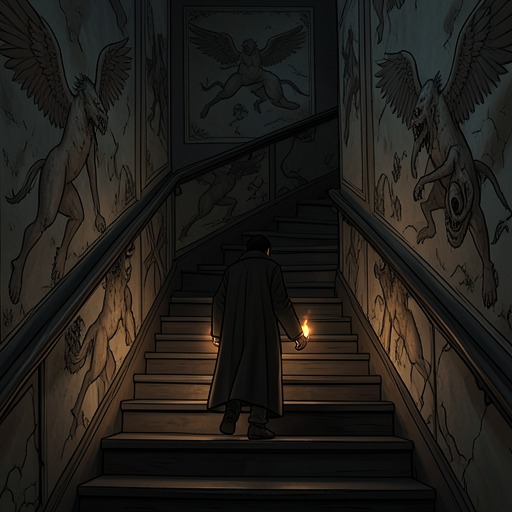
Armand leads Louis and Claudia below the theater into a subterranean room containing books, a desk, a fire, a coffin, and immense religious paintings, including scenes of death and fallen angels. The imagery seems to promise a final interpretive framework, but Armand refuses to provide one. He says that Satan does not give him power as a leader or as a vampire and rejects the notion that vampires are children of Satan. If God created the world and also created Satan, Armand reasons, then Satan’s power comes from God; in that sense, vampires are not Satan’s children but God’s children as well.
Armand’s argument removes the external mythology Louis has been seeking. He claims no knowledge of God, no knowledge of the devil, and no experience of any vampire who has spoken with either. After four hundred years, he presents himself as the oldest living vampire he knows, yet even that immense age has yielded no revelation. The ancient vampire is not a fallen angel who remembers heaven. He is an immortal creature facing the same silence as Louis.
Inner Power and the Collapse of Myth
Armand’s strongest correction is that the only power available to vampires is within themselves. He tells Louis that the ideas of God’s children and Satan’s children arise from disappointment and bitterness, from the human need to turn unexplained existence into a system of gods and devils. This claim does not reassure Louis. It attacks the very structure by which he has tried to interpret his transformation.
Louis responds that he is evil because he has killed repeatedly and will kill again, because he accepted Denis as a victim even without knowing whether the boy would survive. Armand counters that evil may have degrees and variations just as goodness does. Louis cannot accept the comparison. For him, evil is an empty gulf entered with the first sin, without consolation; Armand sees this absolute judgment as another form of despair rather than a discovered truth.
The dispute reveals two versions of the fallen angel. In Louis’s version, the vampire’s supernatural existence demands a supernatural meaning, even if that meaning is damnation. In Armand’s version, the vampire is neither an emissary of Satan nor evidence of a divine plan. It is an immortal body forced to create or endure its own meaning. The religious vocabulary remains indispensable because it expresses the scale of the crisis, but the novel repeatedly denies that the vocabulary supplies an answer.
Beauty, Performance, and the Return to the World
The fallen-angel image is also inseparable from beauty. Louis’s arrival in Paris gives him a near-happiness he had forgotten was possible. Paris appears whole, monumental, and historically enduring in contrast with the fragile, threatened vitality of New Orleans. The city’s art, architecture, theaters, and boulevards briefly allow him to forget the damned and searching creature he has become. Yet beauty does not redeem him; it draws him more deeply into the problem of how an immortal predator can respond to human creation.
His visit to the Louvre marks a further shift. He had hoped art might offer transcendent pleasure capable of obliterating pain and even selfhood, but after Claudia and Madeleine’s destruction he sees paintings as severed from the human hands that made them. They become dead objects, comparable to preserved dolls, immortal bodies, and children turned to stone. The fallen angel’s distance from humanity is no longer merely theological. It becomes an altered way of seeing, in which human feeling and artistic beauty can be admired while remaining cut loose from the mortal lives that produced them.
Louis leaves Paris with Armand for Egypt, seeking tombs, pyramids, buried kings, and knowledge hidden beyond scholars’ accounts. He abandons the plan to prepare graves for Claudia and Madeleine in Montmartre Cemetery because their rooms at the Hôtel Saint-Gabriel remain so orderly that they seem capable of returning. The refusal to complete the burial preserves the dead as an unresolved presence rather than integrating them into a finished ritual of mourning.
When Armand later reveals that Lestat survived the Théâtre des Vampires and returned to New Orleans, Louis’s suppressed attachment to him reawakens. Louis and Armand go back to the city, where familiar oaks, streets, mansions, roses, and the old town house restore a sense of home. The return does not heal the vampire’s division, but it shows that the fallen angel is still capable of attachment to place, memory, and another immortal being.
The Fallen Angel as an Unresolved Human Figure
The concept culminates in the recorded interview’s confrontation between Louis and the boy. The boy hears a story of passion, longing, beauty, and immortality, then asks Louis to make him a vampire. His request exposes the seductive surface of the fallen-angel image: to a mortal listener, the vampire seems to possess the power to see, feel, and live forever. Louis, however, reacts with anger because the request treats his existence as an adventure rather than as a condition marked by guilt, loss, and despair.
Louis’s attempt to communicate the meaning of vampirism fails, and he concludes that he has failed completely. The boy’s desire confirms the persistence of the myth he has spent the narrative dismantling. To the mortal imagination, the vampire remains an exalted fallen angel; to Louis, the same figure is a creature whose beauty and power cannot cancel its dependence on killing. The concept therefore remains deliberately unresolved. It does not establish that vampires are angels, devils, or divine children. It names the unstable space between those possibilities, where immortality magnifies both transcendence and ruin, and where the search for cosmic meaning finally returns the vampire to the loneliness of the self.