Vampire Secrecy Rule
Interview with the VampireThe Vampire Secrecy Rule is the governing practice by which vampires hide their existence from mortals and protect their small, vulnerable community from discovery. It shapes domestic life at Pointe du Lac, regulates Louis and Claudia’s conduct in Paris, and turns concealment into a test of loyalty within the Théâtre des Vampires. The rule depends on disguises and controlled appearances, but its deeper force comes from fear: vampires are few, distrustful of conflict, and prepared to punish conduct that exposes them or destabilizes their secrecy.
Definition and Purpose
The rule requires vampires to maintain a mortal appearance and to prevent humans from learning what they are. When Lestat instructs Louis after his transformation, he explicitly forbids him from telling his mother and sister that he is a vampire. Louis must continue providing for them while concealing the reason for his altered habits. Lestat presents secrecy as a practical necessity rather than a moral ideal: Louis must kill quickly, attend to the plantation, and preserve the household’s outward normality while sharing a sleeping room with Lestat for greater daytime security.
The same principle governs movement through public spaces. When Louis and Claudia are invited to the Théâtre des Vampires, they feed beforehand so that their skin will not appear too white and their eyes will not look too clear in the human crowd. The theater is entered through an invitation card, yet the lobby and auditorium are filled with ordinary people who do not recognize the vampires among them. Their presence is therefore a controlled performance: the vampires can occupy a public institution only by making their supernatural bodies pass as human.
Concealment in Domestic and Colonial Life
At Pointe du Lac, concealment initially operates through routine and property. Louis and Lestat continue to appear as plantation owners, even though the plantation’s labor produces little and functions largely as a cover while Lestat’s acquired money is invested in land, apartments, and town houses in New Orleans. Their household preserves the appearance of ordinary aristocratic management while vampire activity occurs behind it.
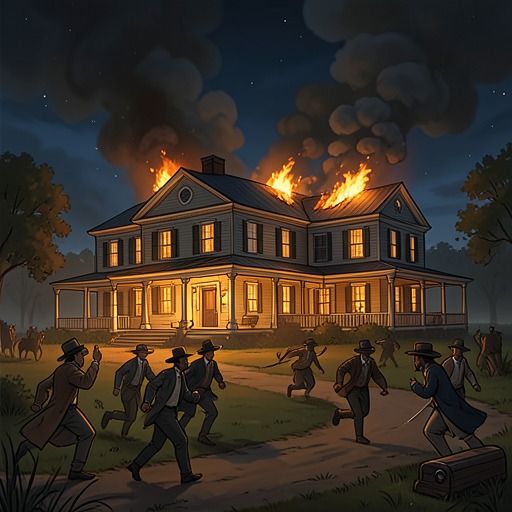
That performance begins to fail because the enslaved people observe details that cannot be reconciled with mortal life. They see Louis and Lestat dining from empty plates and raising empty glasses, witness the ghostly pallor of their faces, discover that Lestat sleeps in a coffin, and notice Louis emerging repeatedly from Paul’s ruined oratory. The deaths of enslaved people, cattle, and horses are attributed to them, along with floods and thunder interpreted as weapons in a divine battle. The household’s secrecy therefore collapses not through a single confession but through accumulated observation.
The reaction of the enslaved community demonstrates that secrecy is also a struggle over interpretation. They do not merely suspect that Louis and Lestat are unusual; they conclude that the pair are devils whose power is inescapable and that they must be destroyed. Louis recognizes that the plantation’s masquerade has become dangerous and tells Lestat that their game of playing planter is over. The rule consequently forces a change of location and lifestyle: the vampires must abandon the plantation’s public identity and move into town before rumor spreads along the entire coast.
The Rule in the Vampire Community
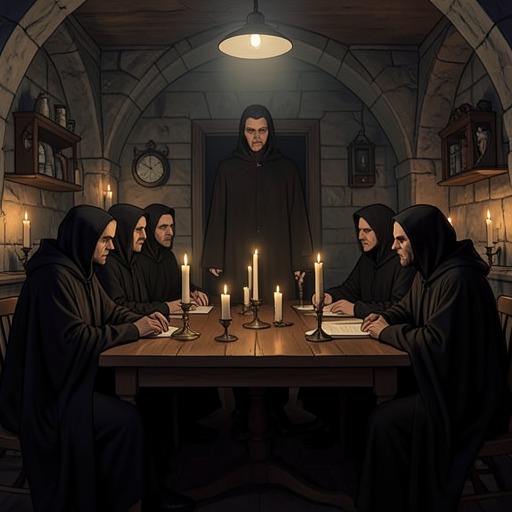
In Paris, secrecy becomes an internal political law. Armand explains that vampires are few, live in terror of strife among themselves, and choose fledglings carefully so that new vampires will respect the others. The Théâtre des Vampires contains fifteen vampires, a number guarded jealously. Louis and Claudia are distrusted because they are too silent, feel too much, think too much, and arrive with an unexplained child vampire whose maker and circumstances they refuse to identify.
Their silence is treated as evidence. Armand tells Louis that the community sees flaws and mystery in the pair: Claudia can never grow or become self-sufficient, while Louis’s emotional intensity contradicts the detachment expected of a vampire. The secrecy that protects vampires from mortals thus becomes a mechanism of suspicion among vampires themselves. A concealed origin is not neutral; it suggests that Louis may have killed the vampire who made him, and Santiago uses that possibility to justify hostility.
Armand’s advice reveals the discipline required to survive this system. He tells Louis to remain away from the others, to use his inner power to make his face a mask, and to think of the word “beware” whenever he meets Santiago or another vampire. He also warns Louis not to leave the Hôtel Saint-Gabriel, because doing so would give the others the evidence of guilt they want. Secrecy here means not only hiding from human sight but controlling expression, movement, and visible anxiety under the scrutiny of one’s own kind.
Theater, Performance, and Exposure
The Théâtre des Vampires turns secrecy into spectacle. Its human audience believes it is watching a dramatic performance about Death, but the performers are actual vampires and the victim is an actual mortal woman. The stage therefore disguises literal predation as theater. Masks, painted scenery, music, and choreographed gestures create a frame in which the audience can see the truth without recognizing it as truth.
The production begins with Death moving through a painted forest, followed by vampires who pursue a human woman. Seven vampires gradually reveal their faces as they close around her. The audience responds with gasps, laughter, sighs, and applause, treating the killing as an artistic illusion. When the woman protests that she does not want to die, the master vampire answers that all mortals share death. The language of performance converts murder into entertainment, while the audience’s conventional expectations protect the vampires from understanding.
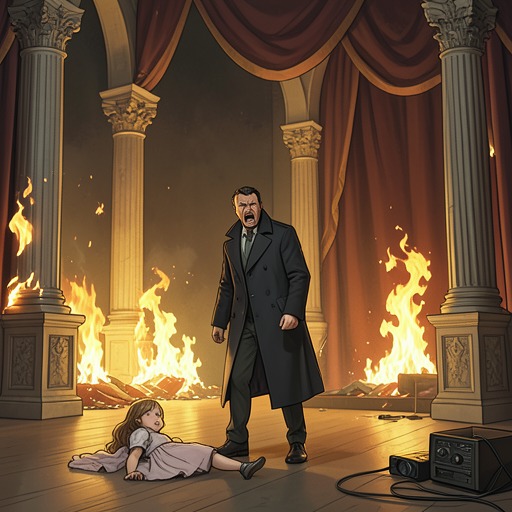
After the girl is consumed, the painted forest returns and the vampires withdraw, leaving her body in the staged wood. Applause follows, and the crowd resumes its sophisticated conversation as though nothing extraordinary has occurred. Louis, however, experiences the boundary between performance and reality as unbearable. He still tastes the girl’s blood and hears, in memory, the beat of her heart. The usher cleaning chairs below becomes an immediately available human victim, and Louis recognizes that killing him would be easy, but Claudia restrains him with a warning to have patience. The scene exposes the rule’s central paradox: secrecy succeeds because the truth is displayed openly under the cover of art.
Enforcement, Conflict, and Consequences
The secrecy regime is enforced through collective suspicion and the threat of violence. Santiago declares that killing one’s own kind is the crime for which a vampire will be hunted and destroyed, while Armand explains that killing other vampires is exciting precisely because it is forbidden under penalty of death. The rule against exposure therefore exists beside a broader system of internal prohibitions, and both are maintained by the possibility that the group will unite against an offender.
This threat determines Armand’s conduct when Claudia is imprisoned. He rescues Louis but initially refuses to save Claudia, explaining that he lacks the power to oppose the others without provoking them. To return for her is to risk losing Louis as well. Louis rejects the logic of individual escape and goes back into the theater, because leaving Claudia behind would violate the relationship that defines his existence. Armand follows him, but the rescue reveals how secrecy fragments solidarity: Armand can protect one vampire without being able to challenge the institution for another.
The rule also explains why Louis cannot simply declare himself innocent or appeal to ordinary human justice. Earlier, after Paul’s death, Louis conceals the argument that preceded the fall because he refuses to reveal Paul’s visions. His family, servants, police, and priest interpret his silence as evidence of guilt. The priest supplies a religious explanation, claiming that the devil threw Paul down the steps, and Louis violently rejects the reduction of Paul’s experience to possession. Across these episodes, secrecy produces competing explanatory systems: human observers turn concealed events into rumor, religion, or accusation, while vampires treat concealment as necessary survival.
Narrative Significance
The Vampire Secrecy Rule defines the social architecture of the novel’s supernatural world. It makes the vampire simultaneously visible and unknowable: a figure who can dine before servants, perform on a public stage, enter a crowded theater, or walk through a city while remaining unseen as a vampire. The rule depends on ordinary objects and gestures—empty plates, coffins, invitations, masks, controlled faces, and restricted doors—to sustain an extraordinary identity.
Its force is also ethical and psychological. Louis repeatedly experiences secrecy as isolation rather than safety. He cannot tell his family what Paul’s death means, cannot explain his own transformation, cannot disclose the truth about Claudia’s creation, and cannot freely speak about Lestat before the Paris vampires. Armand’s warning that Louis and Claudia are dangerous because they feel and think too much shows that secrecy demands emotional concealment as much as physical disguise.
The rule finally governs the narrative’s own structure. Louis tells his history to a mortal boy through a recording, offering the very disclosure that vampire society forbids. The boy hears the secrecy broken open as an intimate story and responds not with horror but with a demand to become a vampire himself. Louis’s account thus demonstrates both the power and the danger of revelation: what is meant to expose the misery of immortal life instead fascinates the listener. The secrecy rule survives because knowledge itself can become an invitation, and because the truth, once staged before an audience, may be mistaken for a beautiful performance rather than recognized as a warning.