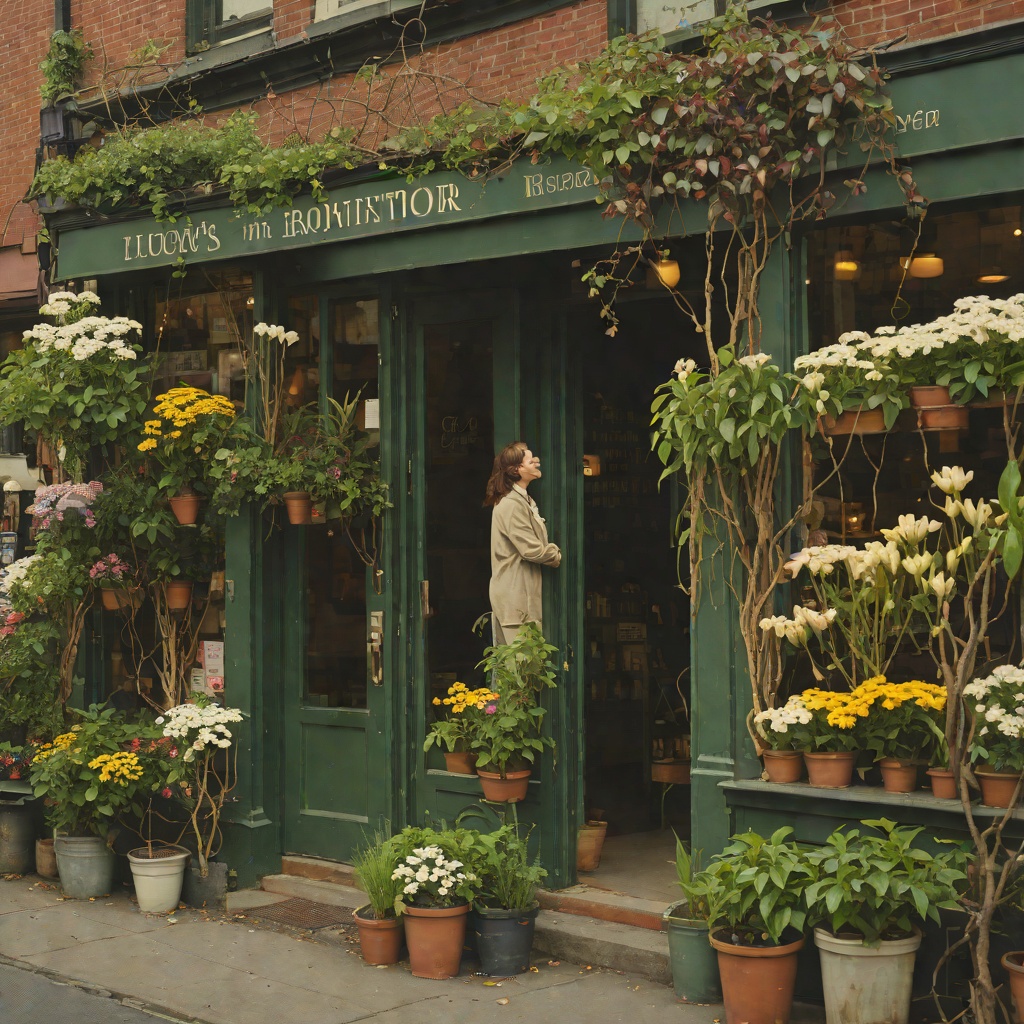
Make it stop card and lilies
It Ends with UsThe Make it stop card and lilies are a small but structurally important object-combination in Lily Bloom’s story: Ryle Kincaid buys a vase of purple lilies from Lily Bloom’s new floral shop and pairs them with a card bearing the words “Make it stop.” The purchase appears to celebrate Lily’s achievement, yet the message turns the flowers into a coded expression of an attraction that Ryle cannot simply contain. Its later significance lies in the irony of that combination. The lilies are beautiful, conventional, and outwardly affectionate; the card names an urge that is more urgent, less controlled, and increasingly difficult for either of them to treat as harmless romance.
Appearance and Immediate Context
The object enters the narrative at the opening of Lily Bloom’s business, when Ryle Kincaid arrives and asks whether he is the first official customer. Allysa Kincaid tells him that he must actually buy something to qualify, so Ryle walks to one of the displays and selects a vase full of purple lilies. Lily notices the choice’s irony because lilies are also her own name’s floral echo, making the purchase feel more personal than an ordinary customer transaction even before the card is read.
Ryle’s purchase also establishes a tension between commercial routine and private feeling. He counts out his money, reminds Lily that a new business traditionally frames its first dollar, and leaves her with the first sale she will preserve on the wall. His congratulations are genuine, but the exchange is also teasing: he knows that his dollar will remain materially attached to the life of her store. The flowers therefore carry two kinds of value at once. They are merchandise that makes Lily’s business official, and they are a personal selection made by a man whose attention has already become difficult for her to dismiss.
The Card as Delayed Message
After Ryle leaves, Allysa opens the envelope and reads the front of the card aloud: “Make it stop.” The phrase initially has no clear referent. It sounds less like a conventional floral greeting than a command, plea, or confession, and the narrative briefly withholds the information needed to decide which. That delay makes the card an interpretive device: the flowers seem to promise affection, while the wording suggests that the feeling attached to them has become an intolerable pressure.
Lily takes the card and turns it over. The explanation is both mundane and revealing: Ryle has written the address of the floral shop on the back. The mistake exposes what the message was already implying. Ryle did not send the lilies to an unknown recipient; he bought them for Lily, then accidentally directed them back to the place where she works. Allysa’s laughter treats the error as foolishness, but the error also collapses the distance between customer and recipient. The shop, the flowers, the card, and Lily herself become parts of one circuit of desire.
The object’s central irony is that the message and the bouquet pull in opposite directions. The lilies are a recognizable sign of admiration, while “Make it stop” refuses the calmness expected of a greeting card. Together they render attraction as both gift and burden. Ryle’s gesture is affectionate because he is proud of Lily for pursuing her dream, yet the card’s wording anticipates the difficulty of separating romantic longing from emotional distress.
Ryle’s Explanation and Romantic Function
Ryle later explains that he sent the flowers because he was genuinely proud of Lily for following her dream, while also acknowledging that he thinks about her constantly and has repeatedly felt the urge to send her flowers. He connects the gesture to his earlier return to her door, explaining that he searched for her because no one in his life had previously remained so insistently in his thoughts. In this account, the lilies are not an isolated impulse. They are a physical trace of an attachment that has been building before Ryle fully understands what it means.
The card consequently functions as a compressed version of Ryle’s romantic trajectory. He has earlier stated that the thought of marriage repulses him, that he has no desire for a wife or children, and that he wants success above all else. The lilies contradict that declared self-image without erasing it. They show an attraction that presses against his stated rejection of intimacy, while “Make it stop” gives the contradiction a verbal form. The object is therefore a sign of the movement from resistance toward attachment: Ryle’s actions begin to reveal a desire his explicit principles have tried to exclude.
The gesture also participates in the novel’s romance structure without becoming a simple promise of safety. Flowers initiate closeness, but the card refuses uncomplicated sentiment; it makes the desire sound involuntary and even alarming. The object’s material gentleness thus becomes a form of foreshadowing. What appears to be a playful, memorable first sale also introduces the pattern in which tenderness and danger will occupy the same emotional field.
Recurrence of the Stop Motif
The words on the card gain force when read beside later scenes in which Lily repeatedly asks Ryle to stop. During the kitchen incident, Ryle’s arm suddenly strikes her and knocks her backward into a cabinet handle. The violence is first encountered as an abrupt physical interruption of laughter and domestic activity: one moment she is laughing at the mess, and the next she is on the floor with pain near her temple. The earlier card’s command retrospectively acquires a darker resonance because “stop” becomes associated not only with unwanted desire but with the need to halt bodily harm.
The motif returns after Ryle pushes Lily down the stairs. When she tells him that she did not fall, he answers, “You fell down the stairs.” The denial turns the object’s ambiguous command into part of a larger conflict over who gets to name what has happened. Lily’s insistence that he pushed her confronts the story he supplies, while the card’s apparently simple wording now sits within a pattern of pressure, concealment, and forced reinterpretation.
After Ryle reads Lily’s journals, the object’s symbolic field becomes still more disturbing. He traces the wooden heart tattoo on her skin and bites her hard enough to make her scream; she tries to pull away and pleads, “Ryle, let me go,” followed by “Please. Walk away.” The remembered card and the later pleas form an uncomfortable verbal and structural echo. At first, the command appears to describe Ryle’s inability to stop thinking about Lily. Later, the need to make something stop belongs to Lily’s immediate struggle to end his physical control over her.
Narrative Significance
The Make it stop card and lilies embody the narrative’s refusal to keep romance and violence in separate symbolic compartments. The purple lilies help establish Lily Bloom’s shop, preserve Ryle Kincaid’s role as its first paying customer, and communicate pride in her new enterprise. The card, however, introduces an unstable emotional grammar: desire is expressed as an imperative to end itself. That contradiction allows the object to operate simultaneously as courtship, misdirected confession, and early warning.
Its meaning also changes through repetition. A phrase that initially creates comic mystery because Ryle has written the shop’s address on the back later resonates with Lily’s accounts of assault, denial, and requests for release. The object does not cause those later events, but it gives the reader an early verbal pattern through which the relationship can be reread. In that sense, the flowers are not merely a romantic prop. They are a compact narrative instrument: a beautiful public gift carrying a private message whose meaning darkens as the story reveals how urgently Lily will need the violence to stop.