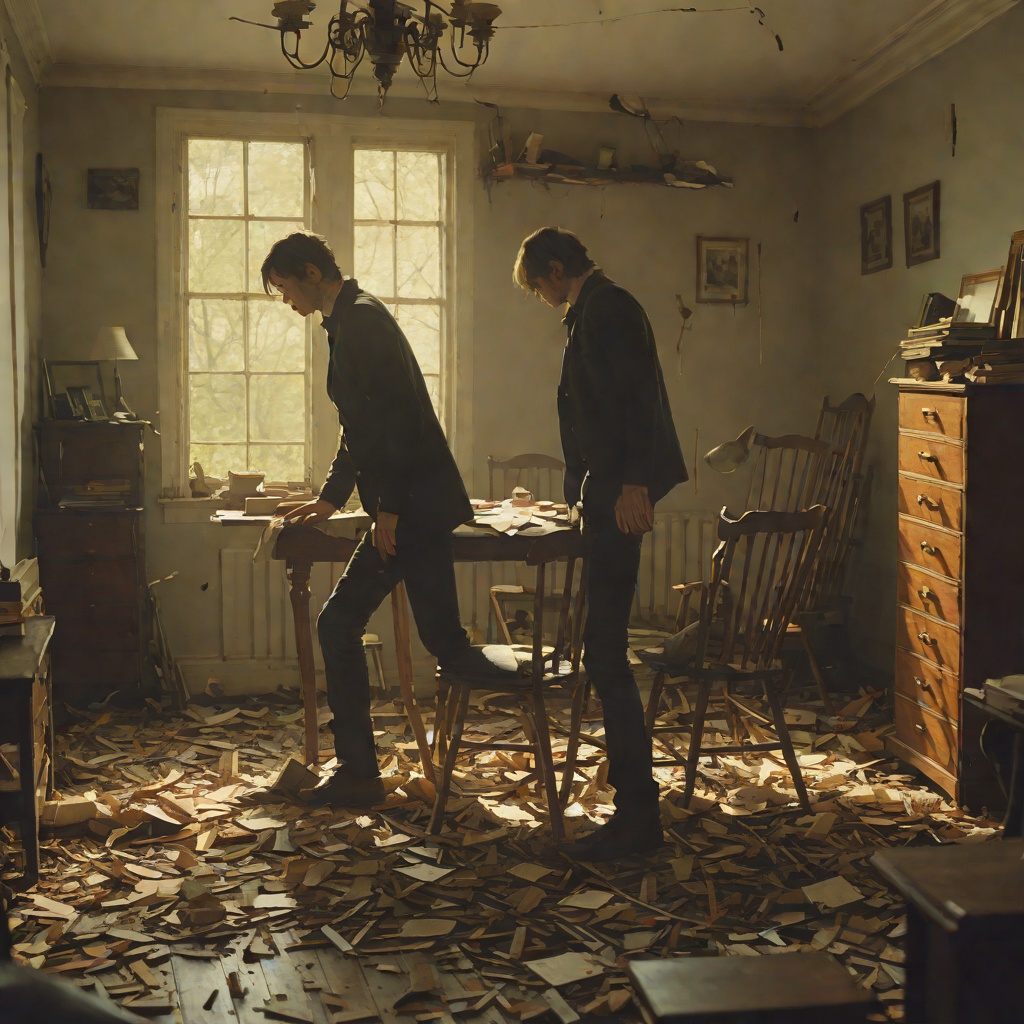
Ryle pushes Lily in the kitchen
It Ends with UsThe kitchen incident is the novel's first act of domestic violence, the moment when Ryle Kincaid's arm "came out of nowhere" and slammed against Lily Bloom, knocking her off balance so that she hit her face on a cabinet door handle as she came down. It is a scene of startling suddenness: one second Lily is laughing at the mess they are about to have to clean up, the next she is on the floor, her hand pressed against the corner of her eye, pain shooting through the spot right near her temple. The event lasts only fifteen seconds, but as Lily reflects, "Fifteen seconds. That's all it takes to completely change everything about a person." It is the first crack in the foundation of her marriage, and it sets in motion a pattern that will define the rest of the book.
The Immediate Aftermath and Ryle's Apology
Ryle's reaction is immediate and frantic. He slams the oven shut and shoves his burned hand under cold water, muttering curse words, before the violence erupts. After Lily falls, he is beside her in an instant, his hand on her back, rubbing, as he tries to pull her arms from her head. "Goddammit, Lily," he says, "It's not funny. This hand is my fucking career." His first instinct is to defend himself, to frame the incident as a consequence of her laughter rather than his action. Then the apology comes: "I'm so sorry. I just . . . I burned my hand. I panicked. You were laughing and . . . I'm so sorry, it all happened so fast. I didn't mean to push you, Lily, I'm sorry." He pulls her against him and kisses the top of her head, but Lily does not hear his voice. Instead, she hears her father's voice: "I'm sorry, Jenny. It was an accident. I'm so sorry." The echo is immediate and devastating — the same words, the same apology, the same promise that this was not intentional.
Lily's Ultimatum and the First Reconciliation
In the aftermath, Lily tends to Ryle's burned hand, securing a bandage around it. She tells him, "I know, Ryle. It was terrible. You pushed me. You made me question everything I thought I knew about you. But I know you feel bad about it. We can't take it back. I don't want to bring it up again." Then she delivers an ultimatum: "But Ryle? If anything like that ever happens again . . . I'll know that this time wasn't just an accident. And I'll leave you without a second thought." Ryle stares at her for a long time, his eyebrows drawn apart in regret, and then leans forward to press his lips against hers. "It won't happen again, Lily. I swear. I'm not like him. I know that's what you're thinking, but I swear to you . . ." He knows exactly what she is thinking — that he is becoming her father — and he swears he is not. The reconciliation is sealed with a declaration of love: "Lily," he says, brushing his thumb over hers, "I'm in love with you." She whispers back, "I love you, too," and calls it "the most naked truth I've ever spoken to him." The incident is folded into their intimacy, the love declared in its wake making the violence seem like an aberration rather than a beginning.
The Pattern of Recurrence and Escalation
The kitchen incident is not an isolated event. It establishes a template that repeats and escalates throughout the novel. The next time, Ryle pushes Lily down the stairs. When she tries to explain what happened, she is met with the flat assertion, "You fell down the stairs." But she did not fall — he pushed her, again. The pattern is one of denial and minimization, with Ryle's violence framed as accident or as Lily's fault. Later, after reading her journals, Ryle attacks Lily in a scene that begins with him tracing his finger over the heart tattoo on her shoulder, then sinking his teeth into her so hard she screams. The escalation is physical and psychological, each incident chipping away at the trust the apologies rebuild. Ryle himself acknowledges the pattern when he confesses, "I get angry. I black out. I've been in therapy since I was six years old. But it is not my excuse. It is my reality." He describes the moment he pushed her down the stairs: "I was upset and angry. And sometimes when I feel that much emotion, something inside of me just snaps. I don't remember the moment I pushed you. But I know I did." The confession is meant to explain, but it also reveals the depth of the problem — the violence is not fully within his control.
The Cycle of Violence and the Echo of Jenny Bloom
The kitchen incident is explicitly linked to the cycle of violence that defined Lily's parents' marriage. Lily's mother, Jenny Bloom, later explains the pattern to her daughter: "The first time your father hit me, he was immediately sorry. He swore it would never happen again. The second time he hit me, he was even more sorry. The third time it happened, it was more than a hit. It was a beating. And every single time, I took him back. But the fourth time, it was only a slap. And when that happened, I felt relieved." She describes how "every incident chips away at your limit. Every time you choose to stay, it makes the next time that much harder to leave." The author's note confirms that the kitchen incident is drawn directly from the author's own family history: "The first incident between Ryle and Lily in the kitchen is what happened the first time my father ever hit my mother. She was cooking a casserole and he had been drinking. He pulled the casserole out of the oven without using a pot holder. She thought it was funny and she laughed. The next thing she knew, he had hit her so hard she flew across the kitchen floor." The fictional scene is a near-verbatim transposition of a real event, and Lily's choice to forgive Ryle mirrors her mother's choice to forgive her father — a choice made because "his apology and regret were believable. Or at least believable enough that giving him a second chance hurt less than leaving with a broken heart would have."
Thematic Significance: The Naked Truth of Love and Violence
The kitchen incident forces Lily to confront the uncomfortable truth she has carried since childhood. As a girl, she found herself looking forward to the nights her parents fought, because she knew that if her father hit her mother, "the two weeks that followed would be great." She admits, "I spent most of my life hating him for being such a bad person, but I'm not so sure I'm much better. Maybe we're both bad people." Ryle's response — "There is no such thing as bad people. We're all just people who sometimes do bad things" — becomes a central philosophy of the novel, one that Lily struggles to hold onto as the violence escalates. After the stairwell incident, she tries to rationalize: "It was an accident. He thought I was cheating on him. He was hurt and angry and I got in his way." She sobs because she feels more pain for Ryle, knowing what he went through as a child, than for herself. She tells herself, "If I'm emulating my mother's behavior, then that would mean Ryle is emulating my father's behavior. But he isn't. I have to stop comparing us to them." The kitchen incident is the moment this comparison becomes unavoidable, and it is the moment Lily begins the long, painful process of deciding whether love can coexist with violence. When Ryle later learns she is pregnant and sinks to his knees before her, placing a steady palm against her stomach, she reflects, "Just because someone hurts you doesn't mean you can simply stop loving them. It's not a person's actions that hurt the most. It's the love. If there was no love attached to the action, the pain would be a little easier to bear." The kitchen incident is the origin of this paradox — the first time Lily learns that the deepest pain comes not from the blow itself, but from the love that makes the blow bearable, and therefore repeatable.