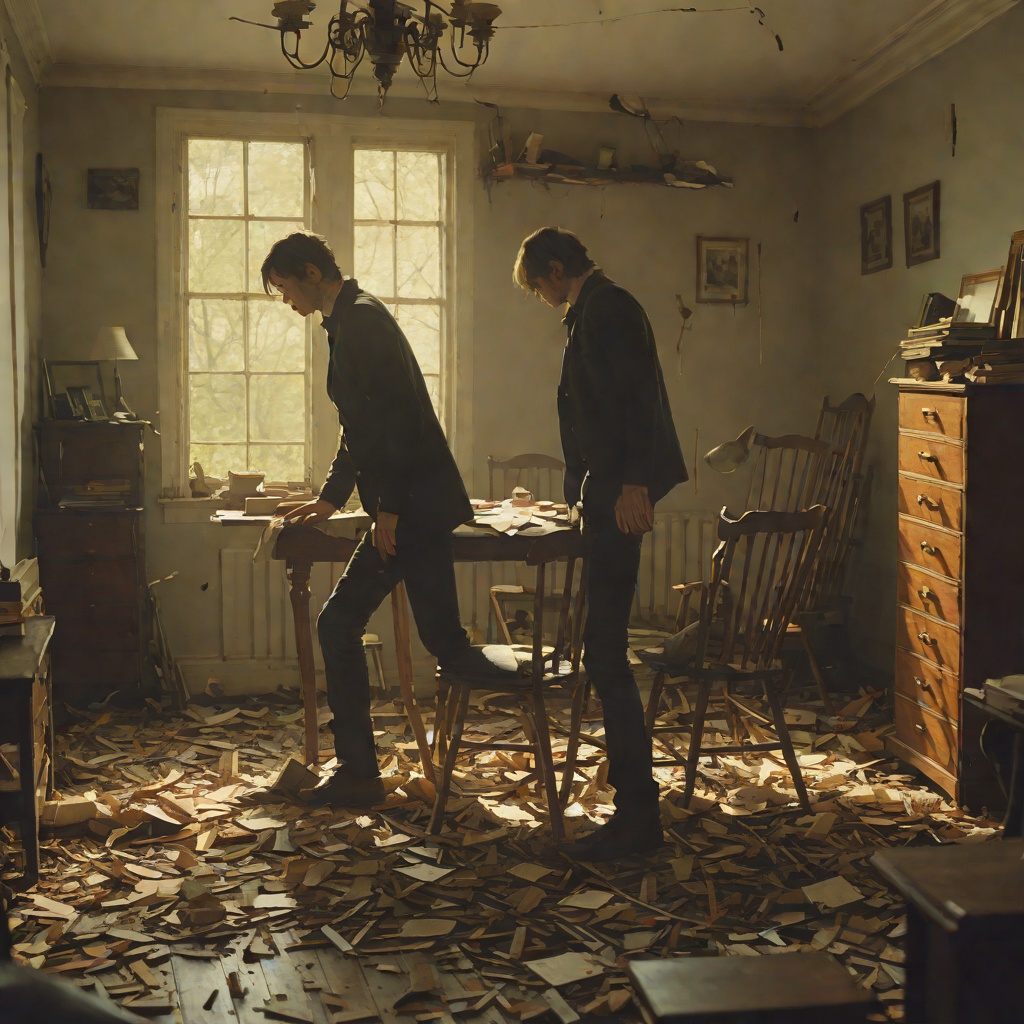
mushroom chicken casserole
It Ends with UsThe mushroom chicken casserole is a home-cooked dish whose brief appearance marks the catastrophic turn of an apparently affectionate evening between Lily Bloom and Ryle Kincaid. Prepared in a glass pan while Lily wears only an apron, it begins as part of a flirtatious domestic performance; after it burns and breaks across the kitchen floor, the scene shifts from shared laughter to physical violence. The casserole therefore functions not merely as food but as the concrete object around which intimacy, disorder, injury, and denial become entangled.
Preparation and Domestic Play
Lily is almost finished preparing the casserole mixture when Ryle enters the kitchen. She pours it into a glass pan and places it in the oven without turning around, deliberately extending the flirtation created by her apron and her exaggerated movements. Ryle’s response is physical but playful at first: he reacts to her suggestive display, then pinches her, grins, and holds two bottles of wine. The casserole is consequently introduced within an atmosphere of mutual desire, alcohol, and relaxed domestic complicity rather than formal danger.
That setting matters because the dish belongs to a fantasy of ordinary couplehood. Lily is cooking for Ryle, Ryle is arriving with wine, and the kitchen appears to offer the familiar pleasures of a shared home. Yet the scene also contains a subtle imbalance: Lily’s performance is being watched, and the evening’s looseness is intensified by three glasses of wine and unusually strong alcohol. The casserole remains an apparently transparent household object, useful only as dinner, until its failure makes the material surroundings impossible to ignore.
Burning and Breakage
When Ryle says that he is hungry, Lily suddenly remembers the casserole. She laughs at the mistake, and Ryle rushes into the kitchen after her. He opens the oven and waves away smoke, revealing that the meal has been ruined. The dish’s failure first produces comedy. Lily becomes dizzy after standing too quickly, grabs the counter for balance, and watches Ryle pull the pan from the oven.
Ryle does not use a pot holder. The casserole falls from his hand, and the glass shatters across the floor with mushroom-and-chicken splatter. Lily lifts her feet to avoid the broken glass and food, then begins laughing at the absurdity of the accident. The dish has changed from a promised meal into a dangerous mess that must be cleaned, but Lily still experiences the moment as ridiculous rather than threatening. Her laughter is intensified by the wine, the ruined dinner, and Ryle’s avoidable mistake.
From Household Accident to Assault
The casserole’s breakage immediately precedes the scene’s decisive value shift. Ryle slams the oven shut, puts his hand under cold water, and mutters curses. Lily continues laughing as she looks toward his injured hand and the mess on the floor. Then, in a single second, Ryle’s arm strikes her from nowhere. The force knocks her backward, and she hits the corner of her eye near her temple on a cabinet-door handle.
The physical arrangement of the kitchen makes the casserole’s remains part of the danger. Broken glass, spilled food, the open oven, and Lily’s unstable footing form the immediate environment in which an accidental mishap becomes an assault. The object does not cause Ryle’s violence, but its collapse supplies the scene’s concrete threshold: before it breaks, the couple is performing intimacy and laughing together; after it breaks, Lily is on the floor, injured and confronted by Ryle’s bodily threat. The ordinary kitchen object becomes conspicuous precisely because it has ceased to function as an ordinary object.
Denial and the Pattern of Violence
The casserole scene also establishes a recurring pattern in Lily and Ryle’s relationship. A violent act is followed by an attempt to control its meaning. Later, after Ryle pushes Lily down the stairs, he tells her that she fell. Lily immediately recognizes the contradiction: she did not fall; he pushed her. The same struggle over interpretation that follows the kitchen assault appears again in the stairwell, where Ryle’s account seeks to turn deliberate violence into an accident.
Ryle eventually describes his anger as something that can make him black out. He insists that this is not an excuse but his reality, while also admitting that he did not remember the moment he pushed Lily. His explanation gives a psychological account of the violence without removing his responsibility. The sequence connected to the casserole thus becomes part of a larger cycle in which tension, explosion, remorse, confession, and renewed intimacy coexist. Ryle later tells Lily that he is in love with her, and she answers that she loves him too, calling the admission the most naked truth she has spoken to him. Emotional attachment does not erase the assault; instead, it helps explain why the violence becomes difficult to separate from the relationship itself.
Material Witness and Narrative Significance
The mushroom chicken casserole remains significant because its physical sequence is so sharply legible: mixture, glass pan, oven, smoke, careless removal, shattering, splatter, laughter, and injury. Each stage narrows the distance between domestic normality and danger. The meal is not a symbolic substitute for the abuse; it is the precise household circumstance through which the abuse becomes visible. Its broken form records the collapse of Lily’s assumption that an affectionate evening can remain safely ordinary.
The object also anticipates Lily’s later effort to understand violence as cumulative rather than isolated. Jenny Bloom explains that every incident pushes a person’s limit farther, until a lesser assault can feel reassuring because it is not as severe as the previous beating. In that context, the casserole scene is the first rupture in a pattern that later includes the stairway push and the attack after Ryle reads Lily’s journals. Each incident is followed by emotional pressure, explanations, or pleas, making the damaged relationship appear repairable even as the threshold of harm keeps moving.
The casserole’s final significance lies in its indifference to the stories imposed on it. Ryle can treat the kitchen incident as a mistake, and Lily can initially laugh at the ruined food, but the broken glass and the injury remain concrete facts. The object exposes the difference between an accident involving a pan and a violent act involving a person. Once the casserole is shattered, the kitchen can no longer sustain the harmless domestic fiction with which the evening began.