Abby Thorpe’s disappearance and rescue
It Must Be Love: A Mustang Prairie RomanceAbby Thorpe’s disappearance and rescue is the first major crisis to bring Jack Thorpe’s private grief, parental fear, and distrust of Trixie Beaumont into direct collision. When Abby fails to appear at Busy Bees or board the afternoon bus, an ordinary small-town routine becomes a terrifying search. The emergency ultimately reveals not a kidnapping or injury but Abby’s voluntary retreat to Under the Skirt, where Trixie has welcomed her, taught her to make clothing, and helped her recreate an image connected to her deceased mother, Marissa Thorpe.
The Disappearance and Jack’s Fear
Jack receives the news from Christy, the Hive Mom, who tells him that Abby never arrived for Busy Bees and was not on the bus at the end of the day. He immediately calls Ty and changes clothes while forcing his feet into shoes, too agitated to wait passively. Ty orders him not to drive and arrives in a patrol car, explaining that the deputies are already circulating information about Abby’s appearance. Luna and Shirl have also gone on alert, extending the official search into the informal protective network of Mustang Prairie.
Jack’s fear is intensified by the town’s reputation for safety. He knows that bad things rarely happen in Mustang Prairie, but that reassurance cannot overcome the knowledge that a child can still be hurt, become sick, be kidnapped, or disappear for a more terrible reason. While waiting for Ty, he imagines Abby calling for him and wondering why he has not come. The thought connects the present emergency to Marissa Thorpe’s death: losing his daughters has been his greatest fear since bringing Abby and Andie Thorpe home from the hospital, and widowhood has made that fear worse rather than more manageable.
The Search Through Mustang Prairie
Ty recruits Dylan to help with the search, using Dylan’s big-city experience while deputies and townspeople spread the information. Jack enters the patrol car as a passenger, unable to do more than pace, speculate, and insist on reaching his daughter. At the diner, Shirl embraces him, gives him coffee and blackberry pie, and assures him that everyone who can help is already looking. Jack accepts the food and her thanks without sharing her certainty; he hopes Shirl is right, but does not yet believe Abby is safe.
Andie soon arrives with Dylan carrying her Little Buzzers uniform. She asks whether Abby has been found, trusting Dylan’s assurance that Abby must be somewhere nearby. When Andie remembers that Abby often sneaks away to Trixie’s, she leads Jack across the street. Jack does not know who Trixie is, and the discovery that his daughter has gone to a lingerie shop produces a sudden, ominous suspicion. The display is filled with scraps of silk and lace, and Jack’s alarm turns the unfamiliar business into a threat before he has learned what has happened there.
Under the Skirt and the Misunderstanding
Inside Under the Skirt, Jack follows Andie and the search party past garments intended for adult women. Soft music comes from the back of the store, where Abby’s excited voice can be heard. The sound confirms that Abby is alive, but Jack remains furious because he believes Trixie has kept another person’s child in a place he considers wholly inappropriate. He pushes through the lace-and-velvet curtain and demands an explanation, accusing Trixie of holding children in what he calls a “dungeon of perversity.”
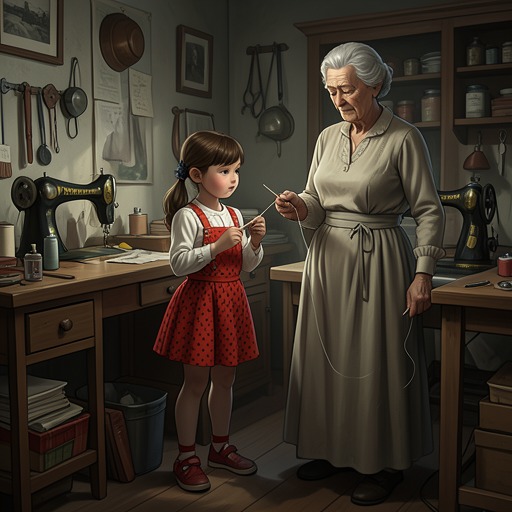
The accusation is built on a fundamental misunderstanding. Abby is not trapped or endangered; she is absorbed in making a garment. She proudly tells Jack that she has just finished a shrug, the first thing she has ever made, and asks whether it is cool. Trixie has been treating Abby as a capable participant rather than a baby, encouraging her interest in sewing while remaining aware that Jack must approve her continued visits. The rescue therefore changes the apparent meaning of the scene: what Jack sees as reckless concealment is, from Abby’s perspective, a place of creative attention and trust.
The Mother’s Image and Abby’s Memory
Abby’s reason for returning to Under the Skirt is tied to Marissa. She has found a photograph in the basement and wants a hat like the one her mother wore. Because Jack refuses to let her come to the store, Abby is uncertain that she can finish the project alone, but Trixie promises that they will work it out after clearing the matter with her father. The photograph turns the disappearance into more than a childish detour. Abby is seeking a tangible way to approach a mother she lost, using clothing and an image to make memory present.
Trixie later helps Abby complete the hat, adding pom-poms and taking photographs of Abby and Andie. While searching for a suitable background, she notices Marissa’s face in the photograph: sparkling hazel eyes and dark hair that neither daughter inherited. The girls pose on the porch, and Trixie’s attempt to preserve the moment brings her into intimate physical proximity with Jack when she turns and collides with his paint-splattered chest. The photograph becomes a bridge between the children’s present life and their mother’s remembered appearance, while Trixie’s participation places her inside that family memory before Jack is ready to accept her there.
Aftermath and Changed Boundaries
The discovery of Abby at Under the Skirt resolves the immediate danger but leaves Jack confronting the boundaries he has tried to impose around his daughters. His initial response treats the lingerie shop as inherently unsuitable for children, yet Abby’s presence there has produced neither harm nor secrecy for its own sake. She has found a place where Trixie Beaumont speaks to her as a person capable of learning, making, and remembering. That contrast helps explain why Abby continues to seek Trixie out even after Jack forbids her visits, later ignoring him for much of a month when he insists that a shop filled with sexy lingerie is no place for a girl her age. The disappearance thus becomes an early fault line in the Jack–Trixie relationship: his protective instinct is genuine, but it is also shaped by grief, suspicion, and his fear that another adult might enter the emotional world of his children without his control.
Abby’s attachment to Trixie eventually becomes visible to Jack through the objects and memories Trixie has helped create. At Christmas, Andie tells her father that the girls like Trixie because she makes them pretty things, smells good, and talks to them as though they are big kids rather than babies. More importantly, Trixie has given Abby good memories of Marissa. The statement changes the meaning of the earlier crisis: Trixie is no longer merely the woman whose shop attracted Abby away from school arrangements, but someone helping the children preserve and reshape their mother’s presence. The hat, photograph, and later the painting Blue Skies all belong to a wider pattern in which art and crafted objects carry family feeling across absence. Jack recognizes that Trixie’s care has entered the girls’ emotional history, even as his own unresolved marriage remains a barrier between them.
The event also foreshadows the recurring pursuit-and-withdrawal pattern between Jack and Trixie. Trixie admits that she is glad Jack once tore into her because it helped her declare that she was done crushing on him, though the narration acknowledges that she does not yet truly mean it. Jack, meanwhile, cannot remain emotionally detached: he notices her at community gatherings, reacts with jealousy when she touches Ty, and later accepts that his mother is right that Trixie may need the truth about the tension and resentment surrounding his marriage to Marissa. His hesitation is not erased by Abby’s rescue, but the crisis gives Trixie a legitimate, enduring connection to his household. When Jack’s daughters later urge him to apologize to Trixie and point out that he holds her hand when he thinks they are not looking, they confirm that the relationship has already become part of family life, whether or not he is prepared to name it.
Significance of the Rescue
Abby Thorpe’s disappearance and rescue follows the shape of a pursuit-and-rescue plot while revising its expected threat. The search begins with the possibility of injury, illness, kidnapping, or death and ends in a creative domestic space where a child is safe, occupied, and emotionally engaged. The reversal does not make Jack’s fear foolish; it shows how bereavement has made ordinary uncertainty feel catastrophic. His fear of repeating the loss associated with Marissa drives the search, while Trixie’s sewing and memory work reveal a different form of protection—one based on attention, participation, and the preservation of family stories.
For Abby, the event is a movement toward agency. She does not simply wander away; she pursues a project connected to her mother, asks for help when it exceeds her abilities, and returns to a place where her interests are taken seriously. For Trixie, caring for Abby establishes that her work with clothing is also relational labor: the shop becomes a site where the Thorpe girls can make objects, recover memories, and test a new bond. For Jack, the rescue begins the difficult recognition that safeguarding his daughters cannot mean sealing them away from every unfamiliar person or place. The crisis therefore does more than reunite a father with his child. It initiates the incorporation of Trixie into the Thorpe family’s emotional and material life, even while Jack’s grief and fear continue to resist that change.
Significance of the Rescue
Abby Thorpe’s disappearance and rescue follows the shape of a pursuit-and-rescue plot while revising its expected threat. The search begins with the possibility of injury, illness, kidnapping, or death and ends in a creative domestic space where a child is safe, occupied, and emotionally engaged. The reversal does not make Jack Thorpe’s fear foolish; it shows how bereavement has made ordinary uncertainty feel catastrophic. His fear of repeating the loss associated with Marissa Thorpe drives the search, while Trixie Beaumont’s sewing and memory work reveal a different form of protection—one based on attention, participation, and the preservation of family stories.
For Abby Thorpe, the event is a movement toward agency. She does not simply wander away; she pursues a project connected to her mother, asks for help when it exceeds her abilities, and returns to a place where her interests are taken seriously. For Trixie Beaumont, caring for Abby establishes that her work with clothing is also relational labor: Under the Skirt becomes a site where the Thorpe girls can make objects, recover memories, and test a new bond. For Jack Thorpe, the rescue begins the difficult recognition that safeguarding his daughters cannot mean sealing them away from every unfamiliar person or place. The crisis therefore does more than reunite a father with his child. It initiates the incorporation of Trixie Beaumont into the Thorpe family’s emotional and material life, even while Jack’s grief and fear continue to resist that change.
Significance of the Rescue
Abby Thorpe’s disappearance and rescue follows the shape of a pursuit-and-rescue plot while revising its expected threat. The search begins with the possibility of injury, illness, kidnapping, or death and ends in a creative domestic space where a child is safe, occupied, and emotionally engaged. The reversal does not make Jack Thorpe’s fear foolish; it shows how bereavement has made ordinary uncertainty feel catastrophic. His fear of repeating the loss associated with Marissa Thorpe drives the search, while Trixie Beaumont’s sewing and memory work reveal a different form of protection—one based on attention, participation, and the preservation of family stories. For Abby Thorpe, the event is a movement toward agency: she pursues a project connected to her mother, asks for help when it exceeds her abilities, and returns to a place where her interests are taken seriously. For Trixie Beaumont, caring for Abby establishes that her work with clothing is also relational labor, making Under the Skirt a site where the Thorpe girls can create objects, recover memories, and test a new bond. For Jack Thorpe, the rescue begins the difficult recognition that safeguarding his daughters cannot mean sealing them away from every unfamiliar person or place. The crisis therefore does more than reunite a father with his child; it initiates Trixie Beaumont’s incorporation into the Thorpe family’s emotional and material life, even while Jack Thorpe’s grief and fear continue to resist that change.