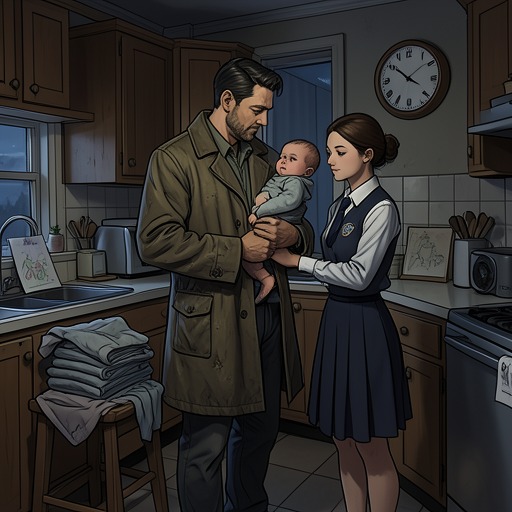
Andie Thorpe
It Must Be Love: A Mustang Prairie RomanceAndie Thorpe is the youngest daughter in Jack Thorpe’s family and one of the clearest emotional anchors in the household. At six, she combines shyness and reserve with an exuberant curiosity that makes ordinary activities feel newly vivid. Her presence also gives the surrounding adults a measure of what healing might look like after Marissa Thorpe’s death: not the erasure of the past, but the gradual return of affection, play, routine, and trust.
Identity and Family Background
Andie is introduced during the search for Abby Thorpe, when she enters the diner with Dylan behind her, carrying her Little Buzzers uniform because she is not yet old enough for the Bees. Her immediate concern is whether Abby has been found, and her innocent confidence that Abby must be nearby reflects both her dependence on the adults and her faith in the family’s ability to protect its own. When she accidentally reveals that Abby often sneaks away to Trixie Beaumont’s shop, her apology is immediate and tearful, but the disclosure also establishes how naturally Trixie has become part of the girls’ everyday world.
Jack’s response to Andie is intensely tender. He embraces his favorite little six-year-old and notices that her bouncing golden curls and hazel eyes remind him of Marissa every day. That resemblance makes Andie a living point of connection between Jack’s present responsibilities and the wife he lost. His fear of losing his daughters had been greatest since bringing Abby and Andie home from the hospital, and Marissa’s death has made that fear worse. Andie therefore represents both the child Jack must protect and the memory he cannot escape.
Life in the Thorpe Household
Andie helps restore domestic rhythm to a home marked by grief and strain. When Jack asks whether she still loves him, she answers by singing that she loves him all the way to the grocery store. Her exuberance contrasts with her father’s exhaustion: Jack sometimes feels old and worn out, but walking through the store while Andie babbles about everything makes him feel young and vibrant again. Her quietness does not mean passivity. She is described as an observer with a zest for life, and that combination lets her absorb the tensions around her while still reaching toward pleasure.
She also participates in household work with a seriousness that exceeds her age. When Jack proposes tacos, Andie asks whether they will include real salsa and begins preparing the ingredients as Abby taught her. The effort requires several trips to the crisper drawer, but she persists until the food is laid out on the table. The scene presents her as a child learning competence through imitation and shared family practice. Cooking is not merely a chore; it is one of the small rituals through which the Thorpe family tries to become functional again.
At another gathering, Andie arrives with a plate of cookies made with Trixie. She climbs onto Trixie’s lap, waits for Trixie’s mock evaluation of the recipe, and responds with a bright, gap-toothed smile when the cookies pass inspection. The orange and sprinkles become part of the playful exchange, while Trixie’s teasing suggestion that the recipe be kept from Shirl turns the child’s baking into a miniature social performance. Andie then hugs Trixie and returns to the other children, helping demonstrate that Trixie has not simply attracted Jack; she has won the girls’ confidence through ordinary, affectionate participation.
Relationship with Trixie Beaumont
Andie’s attachment to Trixie is direct, trusting, and practical. She runs toward Trixie at the sidelines of a gathering, alongside Abby and Sadie, making the girls’ preference unmistakable even as Jack notices Trixie’s effect on him. Later, she and Abby volunteer at Trixie’s community work, arriving in lopsided hats with blonde pigtails and immediately accepting an assignment at the glitter station. Trixie gives them responsibility rather than treating them as babies, asking whether they need a glitter tutorial; Andie and Abby confidently reject the offer and repeat the simple method of gluing, glittering, and shaking.
That respect matters to Andie. At Christmas she explains that she and Abby like Trixie because Trixie makes them pretty things, smells good, and talks to them as though they are big children rather than infants. The statement identifies the basis of the bond more precisely than adult romantic language could: Trixie recognizes the girls’ agency, gives them creative objects and tasks, and lets them occupy a larger role in the household. Andie adds that Trixie gave her good memories of Mom, making Trixie an unexpected participant in the family’s continuing remembrance of Marissa.
Andie’s relationship with Trixie also appears through imagination and costume. She announces that she is a cheerleader and twirls prettily, while Jack suspects that the warm sweater may have influenced her costume choice. The child can move between performance and comfort without treating the difference as a contradiction. In Trixie’s orbit, clothing, craft, and play become ways for Andie to explore identity while remaining securely connected to her family.
Emotional Insight and Influence on Jack
Although Andie is young, she perceives more of Jack’s emotional life than he expects. When Jack’s mother suggests that he tell Trixie the truth about his past, the conversation frames Trixie as someone forced to compete with the memory of Marissa. Andie’s role in this emotional triangle is not analytical in adult terms, but her presence keeps the problem concrete: Jack’s choices affect the home in which his daughters are trying to grow up.
Her most decisive intervention comes when she tells Jack that he needs to apologize to Trixie. She presents the advice as obvious, explaining that girls like it when boys apologize for hurting their feelings. When Jack asks who has hurt her feelings, she answers with the self-assurance of a child who considers herself nearly a teenager, then places his face between her hands and tells him to apologize to Trixie. Her counsel is funny because it is childlike, but it is also morally accurate: Jack’s evasions have caused harm, and affection cannot substitute for accountability.
Andie then reveals that she and Abby have noticed Jack holding Trixie’s hand when he thinks no one can see. The observation punctures his attempt to keep his feelings hidden from the girls. Her final encouragement, delivered after she embraces and kisses him, turns her from observer into catalyst. She does not manipulate the adults’ relationship so much as insist that the emotional truth already visible in the household should be acknowledged.
Imagination, Growth, and Narrative Significance
Andie’s imagination gives the family a language for possibility. While Jonquil Spring discusses the origins of vampire stories, Andie asks about aliens, wide-eyed and excited by the prospect that humanity may not be alone. Her question is small but characteristic: she repeatedly looks beyond the immediate domestic world without abandoning it. Curiosity becomes a form of vitality, especially in a family whose adults remain burdened by death, failed intimacy, and fear of repetition.
Her growth is also registered through costumes and celebrations. At Halloween she identifies herself as a cheerleader, while Abby calls herself a fashion model; the sisters use dress and role-play to try on more grown-up identities. At Thanksgiving, Andie is among those gathered early to learn the family’s traditions, helping turn a holiday meal into a full-house event that includes Jack’s parents, Sadie, Dylan, Luna, Mr. Scanlan, Jonquil, and Trixie. The gathering matters because it restores a communal version of the family life Jack feared he had lost.
Andie’s importance is therefore larger than her role as the youngest child. She embodies the household’s movement from isolation toward a chosen and extended family. Her affection keeps Jack connected to ordinary life; her memories help preserve Marissa without freezing the family in mourning; and her instinctive acceptance of Trixie helps make Trixie’s place in the household emotionally legible. Through Andie, the narrative presents healing as something built from repeated gestures—cooking, baking, dressing up, sharing holidays, making crafts, and finally telling the truth about love.