Artist's Row
It Must Be Love: A Mustang Prairie RomanceArtist's Row is the small gallery district of Mustang Prairie associated with art, memory, and creative renewal. Trixie Beaumont remembers it from childhood as the place where her mother, Peri Moon, once sold paintings, jewelry, and large sculptures; when Trixie returns there after Christmas, the district becomes both a physical site of family history and a catalyst for her own artistic and entrepreneurial imagination.
Setting and Character
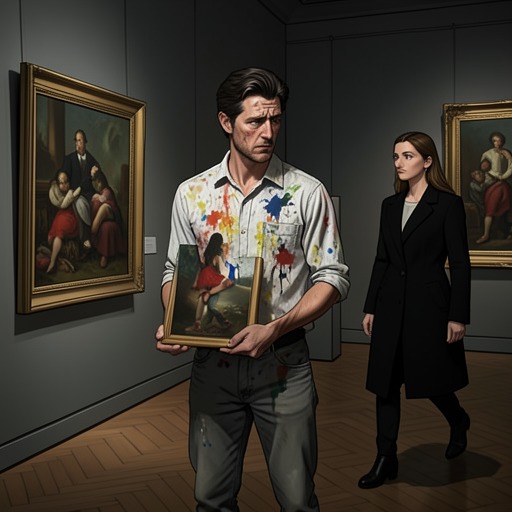
Artist's Row lies along a tiny street that Trixie vaguely remembers from childhood. Its identity is defined less by a single landmark than by a concentration of galleries and studios displaying watercolors, clay work, gourds, oils, sketches, and sculptures made from alternative materials. The range of media gives the district a heterogeneous, handmade atmosphere and allows Trixie to move through several forms of creative expression rather than encountering art as a single commercial style.
The district is also tied directly to Trixie's family history. Her mother, Peri Moon, once sold paintings, jewelry, and several large sculptures there. This recollection makes Artist's Row more than a shopping street: it is a surviving trace of Peri's artistic life and of Trixie's own childhood. The place allows Trixie to encounter her past through objects and spaces rather than through a formal family account.
Trixie's Return
Trixie visits Artist's Row only a few days after Christmas, during a walk through Mustang Prairie undertaken without a specific destination. She has not explored the town on foot since returning except on trips to The Stick Shift or Ground Up, so the walk itself marks a temporary release from routine. Passing the still-decorated shops on Fourth Street, she turns onto the smaller street she remembers as Artist's Row and enters each gallery, browsing and introducing herself to the owners.
The visit has an immediate restorative effect. Trixie feels calmer as she surrounds herself with beauty and creative work, and some of the pieces make her fingers itch to take out a sketchpad and begin drawing again. Artist's Row therefore functions as an active source of inspiration: it does not merely preserve the past but prompts Trixie toward renewed making. The district connects memory to future work, especially at a point when her creative and emotional life require fresh direction.
Galleries and Encounters
One gallery has a colorful southwestern-style awning and a familiar sandalwood scent. These details produce recognition before the gallery owner is fully revealed, linking sensory experience to place-memory. The owner, Blythe Danforth, recognizes Trixie as Peri's daughter and remarks that she is now grown and beautiful. Their encounter confirms Trixie's connection to the district while also showing that Artist's Row retains a communal memory of her family.
Blythe tells Trixie that she is preparing a show for a local artist, Jack Thorpe. The exhibition is a small hometown show, despite opposition from Jack's agent or manager. Blythe offers Trixie an early look, and Trixie accepts even though she knows that seeing Jack's work may intensify feelings she is trying to control. The gallery thus becomes a point where Trixie's personal history, romantic conflict, and artistic admiration converge.
Jack Thorpe's Exhibition
Jack's paintings impress Trixie through their use of color and brushwork to convey layers of emotion. She finds the work more beautiful than expected and wonders whether Jack's experience of losing or living with Marissa Thorpe has deepened his art. Her response combines aesthetic judgment with intimate knowledge of his life, making the paintings inseparable from the emotional history she associates with him.
Blythe then draws Trixie into a dark alcove to show her a particular work, suggesting that Trixie may recognize its subject. This staged reveal gives Artist's Row a threshold quality: Trixie enters looking for inspiration and family memory but is led toward a more personal encounter with Jack's artistic world. The district's galleries transform private experience into visible form, while Trixie's reaction shows how art can preserve, reinterpret, and complicate relationships.
Narrative Significance
Artist's Row links three creative economies in Trixie's life: Peri Moon's earlier art, Trixie's developing lingerie-design career, and Jack Thorpe's professional painting. Trixie's business begins with sketches, logo ideas, and the planned Sexy Separates by Trixie line; it later grows through design work, workshop organization, seamstress interviews, and a public fashion show. Artist's Row gives that entrepreneurial development a cultural and familial context, placing Trixie's designs within a broader local tradition of making and display.
The district also parallels Trixie's preference for transformation and storytelling. At Under the Skirt, she enjoys changing the window display with silky fabric in autumnal colors because the task combines constant change with narrative. At Artist's Row, she encounters the same principles in another medium: works made from paint, clay, fabric, and unconventional materials become stories of identity, memory, and feeling. The location's decisive significance is therefore its ability to turn remembrance into creative movement, allowing Trixie to see Mustang Prairie, her mother, Jack, and her own ambitions as parts of a continuing artistic landscape.