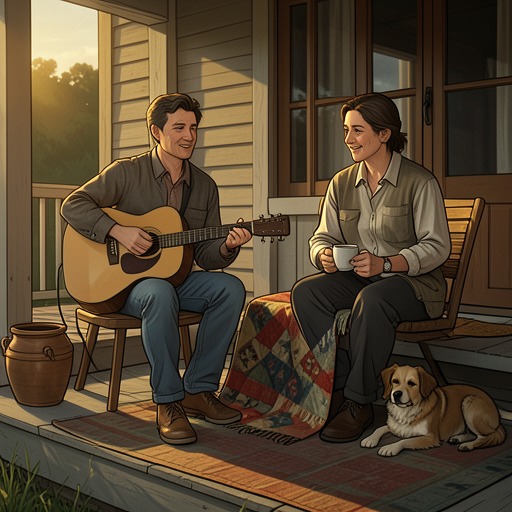
Dylan
It Must Be Love: A Mustang Prairie RomanceDylan is a former police officer, bar owner, and returning resident of Mustang Prairie whose presence links professional authority with the intimate social life of the town. He is repeatedly the person who turns concern into action: he joins the search for Abby, challenges Jack when Jack treats Trixie carelessly, helps sustain community events, and offers Trixie’s family and friends a dependable gathering place. His decisive personal movement is away from the violence and vigilance of city police work and toward a chosen life of friendship, hospitality, and renewal in Mustang Prairie.
Identity and Return
Dylan’s life before Mustang Prairie was defined by law enforcement, urban violence, and the discipline of remaining alert. After leaving the force and the city, he became the full-time owner of The Lounge, sometimes working behind its bar and gradually accepting the town as his permanent home. The change is not merely occupational. He no longer reaches automatically for a gun when a patron enters, and he has begun taking nighttime walks instead of moving through a world organized by sirens and danger. Yet his old habits persist in smaller forms: he repeatedly reminds Sadie to lock her doors and carry mace. His identity therefore remains divided between the cop he was and the civilian he is trying to become.
Dylan had known Mustang Prairie since childhood, although he left at fifteen after his father’s attempt at an academic life failed and the family returned to its money-making business. Unlike the rest of his family, Dylan never forgot the town. He remembers its tree-lined streets, its ordinary homes, the residents’ habit of welcoming newcomers with casseroles, and the way townspeople supported him on the football field without demanding that he follow his father’s path. His return restores an earlier sense of recognition: residents visit The Lounge and his house to welcome him, congratulate him on his distinguished career, and thank him for helping put Jebediah Wainwright behind bars. Their praise makes him proud but uneasy, because he wants to be valued as a person rather than only as the officer he used to be.
The Lounge and Community Life
The Lounge is Dylan’s business, but it also functions as a social crossroads. When he first considers the bar as an investment after retirement, he discovers that ownership is more demanding than expected. Nevertheless, the establishment becomes a steady business and later a busy gastropub, especially after Dylan hires Malcolm, a chef who understands the difference between soup and bisque. The bar supplies food, music, flirtation, conversation, and the informal circulation of news that binds Mustang Prairie together.
Dylan’s relationship to the town is visible in the way he participates in gatherings rather than merely hosting them. At Sadie’s barbecue, he helps build and use a brick-enclosed grill and prep area, accepts beer and sausages from Jack, and works among a yard filled with friends and family. The gathering has no strangers; it is a picture of communal intimacy, with Dylan’s labor helping create the setting in which the town can recognize itself as a connected group. Later, The Lounge becomes the site of Sadie’s singing and of the fashion show that launches Trixie’s Sexy Separates line. Dylan proudly reports that business is thriving and anticipates an even larger crowd because Sadie is performing that night. His venue thus supports both everyday sociability and the public realization of Trixie’s creative ambitions.
Dylan also participates in the town’s practical mutual aid. Trixie’s knitting and sewing classes expand beyond their original room after the online registration fills, and the classes prepare volunteers to help with Eric’s costume drive. The drive replaces a limited purchase of finished costumes with a collective effort using fabric and accessories to make wings, wands, capes, and tiaras for children who might otherwise receive nothing. Dylan’s broader role in the community is consistent with this model: he helps maintain the physical and social spaces through which people exchange labor, information, protection, and celebration.
Loyalty, Intervention, and Conflict
Dylan’s loyalty is most conspicuous during the search for Abby. After Ty asks Jack for information about what Abby wore when she left for school, Dylan joins the operation and proposes dividing the search along Fourth Street so that he and Ty can work from opposite ends and meet in the middle. He reassures Jack that they will find her, while Ty directs the exhausted father toward The Stick Shift so that he can wait somewhere safe. Dylan’s help is concrete rather than ceremonial: he leaves the vehicle, searches the town, and uses his experience to share the burden of the crisis.
His loyalty to Trixie is equally direct, though it takes the form of scrutiny when Jack’s behavior threatens her. When Jack admits that he wants to ask Trixie out but does not know what he wants from the relationship, Dylan asks, “To what end?” The question forces Jack to confront the difference between desire and commitment. Dylan recognizes that Jack is attracted to Trixie but reluctant to offer the security or seriousness that his actions may imply, and he refuses to let Jack disguise uncertainty as romance.
Dylan is even blunter when Jack describes the sexual relationship in The Lounge. He suggests that Trixie may not want to be Jack’s hookup partner, while Ty names Jack’s position as a friend-with-benefits arrangement: Jack wants sex but does not want to date or commit. Dylan’s intervention gives language to the imbalance that Trixie experiences. Jack may deny that he intended such an arrangement, but Dylan understands that intention does not erase the consequences of how Jack behaves.
When Jack fails to invite Trixie to his art opening, Dylan makes the social meaning of that omission unmistakable. He tells Jack that Trixie was not invited and apparently did not even know about the show until the day before, although nearly everyone else in town knew. The statement is delivered without the joking tone Dylan often uses, and Jack understands that Dylan is condemning the slight. Dylan’s position is not neutral friendship between two men; it is protective allegiance to a woman whom Jack has hurt.
At the later confrontation, Dylan’s influence remains present even when he is not the person speaking. Ty warns Jack that pursuing Trixie may be unwise because Jack gave her the brush-off at the art show, while Sadie tells Jack that he treated Trixie callously and used her awareness of her longstanding crush. Dylan’s circle therefore acts as a moral counterweight to Jack’s self-justifications. The friends do not allow Jack to convert regret into entitlement or to assume that wanting Trixie again automatically gives him access to her.
Friendship with Sadie
Sadie is Dylan’s closest friend and the relationship unsettles the categories by which he once organized women. In his former life, he divided women into relatives and women he wanted to take to bed; coworkers were not exempt from attraction, but he avoided sleeping with them because he would not create workplace drama. In Mustang Prairie, Sadie becomes something new: an extraordinarily attractive woman with whom he can laugh, watch sports, and play guitar without immediately turning friendship into sex.
That friendship is not emotionally simple. Dylan recognizes Sadie as both his best friend and his greatest source of unfulfilled desire. He tries to suppress the attraction because friendship matters more than his habitual pattern of pursuit, but Sadie’s teasing, physical confidence, and familiarity make the effort difficult. Their exchanges at The Lounge are playful and intimate: she negotiates permission to use the space, calls him “man candy and bartender Dylan,” and leaves him smiling despite himself. Her ability to make him laugh, combined with his refusal to reduce her to a sexual opportunity, marks one of the clearest changes in his relational life.
Sadie’s importance extends beyond private feeling. She sings at The Lounge, helps make Trixie’s fashion show successful, and supplies information about the town’s emotional currents. Dylan’s friendship with her gives him access to knowledge that he uses to confront Jack, while his own protectiveness gives Sadie a reliable ally. Their bond exemplifies the novel’s recurring movement from isolated desire toward a wider network of chosen attachment.
Change and Narrative Significance
Dylan’s central arc is a deliberate attempt to start over without pretending that the past has vanished. He acknowledges that some habits do not die easily, yet he also insists that he is no longer only a cop. Mustang Prairie offers him a life in which vigilance can be redirected into care, professional competence into protection, and authority into participation. The town’s welcome, his business, and his friendship with Sadie give him a place where he can become “a real person” rather than someone surviving the dark underside of urban life.
His effort at renewal is expressed through a stark internal image: darkness should fade into grey and then into white, allowing him to learn how to live in the light and do things correctly. The image does not erase his history; it frames recovery as gradual transformation. Dylan’s return is therefore neither a simple homecoming nor an escape from responsibility. It is a decision to inhabit a different moral environment and to let ordinary relationships reshape him.
As a supporting character, Dylan stabilizes the novel’s found-family structure. He offers a bar, a search partner, a skeptical friend, a defender of Trixie’s dignity, and a companion who can share music and sports with Sadie without collapsing the friendship into possession. His role also broadens the story’s account of belonging: home is not only where a character comes from, but the community in which past damage can be acknowledged and future conduct can be chosen. Dylan’s movement from police officer to resident and bar owner makes him one of the clearest embodiments of Mustang Prairie’s promise of second chances.