Eric
It Must Be Love: A Mustang Prairie RomanceEric is the interim mayor of Mustang Prairie and a useful bridge between Trixie Beaumont’s private ambitions and the town’s public resources. Though he is also presented as an attractive, flirtatious man, his decisive importance lies in what he makes possible: he gives Trixie access to municipal rooms, publicity, supplies, and civic projects, helping her move from imagining a clothing line to building a visible business and a community practice around making things together.
Identity and Public Role
Eric assumes the mayoral office temporarily after the elected mayor, Charlie Withers, takes a leave of absence because his wife, Mavis, has received a cancer diagnosis. The circumstances make his position provisional rather than triumphal. He corrects Trixie when she calls him mayor, insisting on the title “Interim Mayor,” yet his conduct increasingly resembles that of a settled civic representative: he manages town resources, arranges public programming, and becomes responsible for projects intended to benefit Mustang Prairie’s children and families.
His political identity is balanced by a distinctly informal manner. He jokes with Trixie about her red polka-dot dress and teases her about her lingerie designs, but he is not merely a comic admirer. When Trixie tells him she wants to establish a sewing or knitting class, he explains the registration process, arranges for his assistant to advertise it on the town website, and reduces the practical problem to a manageable set of conditions: she must pay a small room-rental fee and leave the space as she found it. His authority becomes useful because he translates an uncertain idea into an actionable civic arrangement.
Support for Trixie’s Enterprise
Trixie arrives at City Hall after months of considering a clothing line, experimenting with names, sketching logos, and even contacting a graphic designer, while still hesitating to act. Her pitch combines commercial ambition with local identity: she imagines garments bearing the phrase “Made in Mustang Prairie.” Eric’s response is encouraging but not solemn. He promises to keep an eye on her, then gives her the information needed to begin. When she leaves, her nervousness has changed into the sensation that she has taken a genuine step toward making the dream real.
Eric also serves as an informal market tester for Trixie’s designs. She shows him a sketch partly to provoke his unabashedly physical taste and partly to discover whether the design has force. His stunned attention and enthusiastic reaction reassure her that the concept has appeal. The exchange is playful, but it gives Trixie something more substantial than flirtation: confirmation that her visual ideas can command attention outside her own imagination.
His material support becomes more direct when he supplies a huge fifty-gallon plastic bin filled with yarn for Trixie’s second sewing class. The donation matters because Trixie does not want the class to exhaust her finances. With patterns for hats, gloves, scarves, blankets, and baby items, the class expands beyond lingerie into practical crafts, attracting girls, older women, friends, and relatives from across the town. Eric’s assistance therefore supports both sides of Trixie’s development: her improvement as a maker and her emergence as someone able to teach others.
Civic Projects and Community Network
Eric’s most substantial collaboration with Trixie is the costume drive. Rather than spend a fixed budget on a limited number of finished costumes, he proposes purchasing fabric and accessories so townspeople can make wings, wands, capes, tiaras, and other additions themselves. The plan changes the project from simple distribution into collective production, allowing more children to receive costumes while drawing on the skills Trixie is cultivating through her classes.
The program grows quickly. Trixie’s class fills its original room, forcing a move to a larger space after online registration reaches its limit. Eric has promised sewing machines, and the expanded class becomes a source of labor for the costume drive. The arrangement links municipal administration, volunteer teaching, donated materials, and local participation: Eric provides institutional access while Trixie supplies creative direction and practical organization.
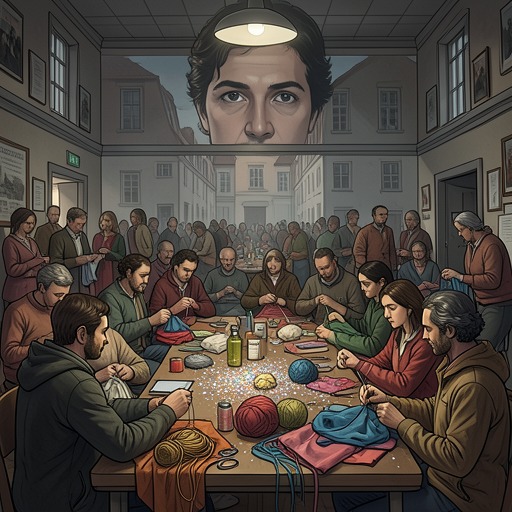
On the day of the drive, Eric reserves two large rooms and helps create the physical infrastructure for the work. The setup includes eight sewing tables, a semicircle of chairs for knitting and hand sewing, a rear “Glitter Station,” and a snack table. Trixie expects much of Mustang Prairie to pass through the rooms, and the event is deliberately made welcoming enough for seniors as well as other residents. Eric’s contribution is thus not limited to approval. He helps turn a civic budget into a place where people can meet, work, and make Halloween possible for children who might otherwise be left out.
Eric’s relationship with Trixie also exists within a wider social network. At a community gathering, Jack Thorpe notices Eric’s attention directed toward Kiki Ramirez, while Trixie’s own friendship network and Jack’s family move easily through the same spaces. Later, Jack finds Trixie sitting and laughing with Eric at Under the Skirt, interpreting their familiarity as intimate. Eric himself has no reason to understand the concealed history between Jack and Trixie, and his ordinary friendliness unintentionally intensifies Jack’s jealousy. In this way, Eric’s openness becomes part of the romantic misunderstandings surrounding Trixie without making him an active rival.
Temperament and Relationships
Eric is physically confident and socially comfortable, described as a handsome man with a Polynesian and Chicago Irish background, golden-brown skin, light-brown eyes, and the physique of an MMA fighter. Trixie recognizes his appeal but does not feel romantic excitement toward him, treating him as partly a friend and partly attractive scenery. Eric, for his part, responds to her lingerie work with conspicuous appreciation, especially when Ty jokes with Trixie about sexy underthings. His appetite for flirtation supplies comic energy, but it does not replace his civic reliability.
His rapport with Trixie depends on teasing, correction, and mutual directness. He repeatedly distinguishes his interim status from the permanent title she casually gives him, while she answers by treating the distinction as a formality. Their banter allows Trixie to challenge male authority without surrendering access to it. Eric can be amused by her clothes and designs, but he also takes her project seriously enough to provide rooms, publicity, yarn, machines, and funding structures.
The same blend of charm and institutional power can produce friction. Trixie worries when Eric arranges for someone to help her purchase costume-drive supplies, wondering whether he distrusts her handling of the money. She is hurt by the possibility, even while deciding that the work matters more than her uncertainty. Eric’s system introduces oversight, but the larger pattern of his actions demonstrates trust through support rather than through unregulated access. His role is therefore not simply to praise Trixie; it is to place her ambition inside accountable community structures.
Narrative Function and Significance
Eric represents the practical civic infrastructure that allows Mustang Prairie’s informal networks to become durable projects. Trixie’s creativity begins with clothing, display, and personal style, but Eric helps it acquire classrooms, public listings, municipal rooms, materials, and a town-wide purpose. The result is a movement from private self-expression to collective making, with lingerie design, craft education, and costume production occupying connected points on the same trajectory.
His presence also complicates the story’s treatment of gendered looking. Eric is openly interested in bodies and lingerie, and Trixie uses that interest when testing whether a design has impact. Yet she is not reduced to the object of his gaze. She controls the designs, chooses the setting, manages the classes, negotiates with City Hall, and converts attention into entrepreneurial momentum. Eric’s useful response is to recognize her work as both provocative and commercially viable.
By the time Trixie’s Sexy Separates by Trixie launch becomes a full fashion show at Dylan’s bar, the enterprise rests on a community network of models, music, photography, friendship, and local publicity. Eric is not the star of that runway, but his earlier support helps explain how Trixie’s dream could reach a public stage at all. He functions as an ally whose contribution is measured less by dramatic revelation than by repeated acts of access: a room, a website notice, yarn, machines, a budget, and the confidence to begin.