Grief and Healing after Marissa’s Death
It Must Be Love: A Mustang Prairie RomanceGrief and Healing after Marissa’s Death is the emotional process through which Jack Thorpe, his daughters Abby Thorpe and Andie Thorpe, and eventually Trixie Beaumont live with the consequences of Marissa Thorpe’s death. Marissa remains present not as a simple idealized absence but as a continuing force in family fear, memory, conflict, and affection. Healing begins when grief can be spoken, shared, and incorporated into new acts of care without requiring anyone to erase the dead or deny the damage left behind.
Death, Fear, and the Family’s Wound
Jack’s grief is inseparable from his responsibility as a single father. After bringing Abby Thorpe and Andie Thorpe home from the hospital, he had already feared losing his daughters; after Marissa Thorpe’s death, that fear intensified. When Abby disappears, the reassurance offered by Ty and Shirl cannot fully reach him. Others promise that Abby will be found safe, but Jack is not sure enough to believe them. He can only hope while drinking coffee at the diner, and the crisis exposes how bereavement has transformed ordinary parental anxiety into an almost permanent expectation of catastrophe.
That fear also governs Jack’s response to Andie Thorpe. Her golden curls and hazel eyes remind him of Marissa every day, making the child both a beloved daughter and a living conduit to the woman he lost. Marissa’s likeness is not confined to physical resemblance. When Abby asks whether she looks like her mother, Jack remembers how often Marissa had complained that people viewed her through that comparison. The question reveals how the children inherit not only a face or a family story, but also the burden of being read through the identity of the dead.
The narrative complicates the family’s public version of Marissa’s death. Jack eventually tells Trixie that Marissa had an aneurysm behind the wheel and died before the car struck a tree. Their marriage had been close to divorce, and they had argued immediately before she left, accusing him of needing to take care of the children for once. Because the accident followed that argument, outsiders believe a simpler story than the one Jack carries: that the marriage was fortunate and intact until an unforeseeable tragedy ended it. His grief therefore includes bereavement, guilt, anger, and the isolation produced by an unspoken truth.
Memory in Images and Objects
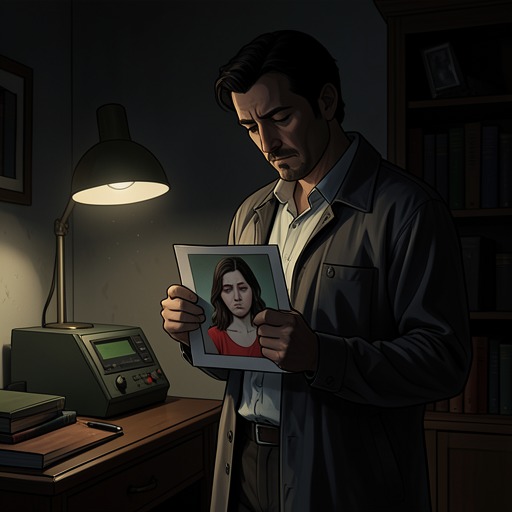
The family preserves Marissa through material forms that can be touched and revisited. In the basement, Abby finds a photograph of her mother wearing a hat and asks Trixie to make one like it. The request transforms grief into a creative task. Trixie helps Abby complete the hat, then photographs Abby and Andie in it, linking the sisters’ present to Marissa’s remembered appearance without treating imitation as replacement.
The photograph becomes especially significant when Trixie notices Marissa’s face while choosing a place to take the picture. The image carries specific features—sparkling almond-shaped hazel eyes and silky chocolate hair—yet the children do not inherit all of them. The resulting photograph gives Abby a memory she can actively possess. She places it beside the photograph of Marissa, so that the mother’s image is not sealed in the past but joined to a new scene of sibling life, craft, and affection.
Abby later tells Jack that Trixie has given her good memories of Marissa. Trixie’s presence does not displace the dead woman; instead, it helps the child approach her mother’s memory without being weakened by it. This is why Trixie tells Abby to let her mother’s memory strengthen rather than weaken her. The advice describes the larger movement of healing: remembrance becomes a resource for identity when it is connected to present encouragement, not used as a standard the living can never meet.
Jack’s own artistic life follows a parallel path. He tells Trixie that painting seemed to have deserted him after Marissa’s death, but that it has finally returned. He explains that the girls’ grief was so palpable that it hurt him more than anything else. His recovery as an artist is therefore not separate from the children’s healing; his creative block registers the emotional condition of the household, and the return of painting suggests that the family has begun to survive rather than merely endure.
Care, Illness, and the Reorganization of Trust
The story repeatedly places grief beside physical vulnerability. When Trixie steps on a nail, falls from a ladder, and twists her ankle, Jack responds with immediate practical care. He carries her to his car, arranges for someone to collect the girls, takes her to the hospital, and remains while she receives a tetanus shot, antibiotics, and a bandage. The doctor identifies the injury as a mild sprain and orders her to stay off the foot for the rest of the week. Jack’s insistence that she follow those instructions echoes the protective vigilance that has shaped his life since Marissa’s death.
This scene does not make Jack’s care uncomplicated. His fear of losing people has become entangled with his need to control danger, while Trixie resists being treated as helpless. Nevertheless, the episode shows care as an embodied practice rather than an abstract feeling: noticing blood, securing transport, arranging childcare, and staying through medical instructions. Against the suddenness of Marissa’s fatal aneurysm, the hospital scene offers a different medical outcome—injury recognized, treated, and expected to heal—while preserving the family’s awareness that bodies remain vulnerable.
Family rituals similarly make recovery visible. Thanksgiving gives Jack a full house for the first time since his daughters were babies, with his parents, Sadie, Dylan, Luna, Mr. Scanlan, Jonquil Spring, Abby Thorpe, Andie Thorpe, and Trixie gathered around the household’s traditions. Trixie arrives only ten minutes before the meal and appears to be avoiding Jack, so the gathering contains both communal warmth and romantic strain. Even so, the crowded celebration contrasts with the absence produced by Marissa’s death: the family is no longer defined solely by who is missing, but by who has come to help sustain it.
Speaking the Marriage That Others Misunderstand
Jack’s mother challenges his belief that marriage itself is the problem. She distinguishes her long relationship from Jack’s marriage to Marissa, arguing that a marriage can contain conflict while still resting on genuine liking and a desire for the other person’s good. In her account, Jack and Marissa had once been deeply in love, but Marissa resented his success. Her intervention forces Jack to examine the difference between mourning a person, mourning an earlier version of a relationship, and fearing a repetition of marital failure.
The history he recounts makes the conflict concrete. Jack and Marissa went to Chicago for higher education, attended different schools, and moved into an apartment after freshman year. Jack began painting and, shortly after his twenty-second birthday, sold his first four paintings at a prominent gallery. Marissa initially encouraged him and found additional exhibitions, but her support waned before Abby was born. She enjoyed the money and parties associated with his success while resenting the attention, praise, and press directed toward him. Jack’s grief is thus bound to an unresolved marital narrative: he lost Marissa before either of them could resolve the resentment that had brought them close to divorce.
Trixie becomes the person who can hear this account without treating Marissa as either saint or villain. Jack admits that he had tried to keep the truth from her and recognizes that withholding it was wrong. Their joined hands mark a change in his relationship to grief: the secret no longer remains locked inside the widower’s private version of events. Speaking does not absolve him, restore Marissa, or erase the painful marriage, but it makes intimacy with Trixie possible on more honest terms.
From Ghostly Comparison to Continuing Life
Marissa’s memory initially acts like a ghost between Jack and Trixie. Jack’s mother notes that Trixie had once followed him from a distance, then withdrew when he became involved with Marissa. She tells him that Trixie may need the truth because competing with a ghost is difficult. The metaphor captures the central obstacle in Jack and Trixie’s relationship: Trixie is not merely approaching a grieving man but entering a family whose emotional boundaries were formed around a dead mother and a marriage whose public image conceals its private fractures.
Jack’s attraction to Trixie also unsettles his grief. After their almost-kiss, he cannot concentrate on his work and finds that he can see nothing but her, even while struggling with his chandelier. His thoughts of her include sexual desire, dreams, and fantasies, but also admiration for the way she treats his daughters—firmly, affectionately, and with encouragement. Desire therefore becomes one sign that life is returning, though Jack initially experiences that return as dangerous and intrusive rather than liberating.
After sleeping with Trixie, Jack retreats and says he cannot make promises because his life is already full and chaotic. He recalls how motherhood and his art career became a wedge in his marriage, and he concludes that he does not want that kind of drama again. His withdrawal shows grief operating as anticipation: the failed marriage is not only a past wound but a model he fears repeating. Trixie’s distance and his disappointment then reproduce the separation that both of them are trying, imperfectly, to survive.
The children help interrupt that pattern. Abby tells Jack that he should apologize to Trixie, and Andie points out that he holds Trixie’s hand when he thinks no one can see. Abby explains that the girls like Trixie because she makes beautiful things, speaks to them as capable people rather than babies, and has given them good memories of their mother. Her understanding reframes Trixie’s place in the household: she is not a rival to Marissa but someone who helps the girls carry Marissa forward.
Jack’s gift of the original Blue Skies painting completes the movement from guarded memory toward shared emotional recognition. Blue Skies is Trixie’s favorite painting, and receiving the original leaves her in tears while strengthening her love for Jack. The painting turns art into a vessel for grief and attachment at once. It does not ask Trixie to forget Marissa or Jack to stop mourning; it gives their present relationship an object capable of holding tenderness, loss, and the possibility of a future.
Grief and Healing after Marissa’s Death therefore presents recovery as an ongoing reorganization of family life rather than a cure. Marissa remains visible in faces, photographs, hats, holidays, arguments, and the history of Jack’s painting. Yet the same memories that once sharpened fear and blocked intimacy gradually support confidence, caregiving, artistic renewal, and emotional honesty. Healing occurs when the living can acknowledge the dead without surrendering the right to continue loving, creating, parenting, and forming a new home.