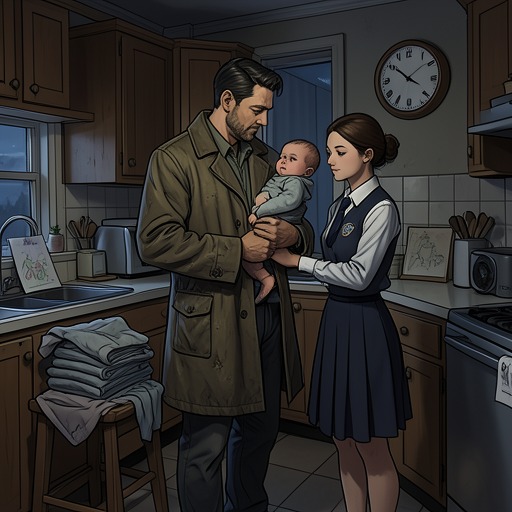
Jack Thorpe–Abby Thorpe relationship
It Must Be Love: A Mustang Prairie RomanceThe Jack Thorpe–Abby Thorpe relationship anchors the family’s emotional life: Jack Thorpe is a widowed father whose devotion to Abby Thorpe is inseparable from fear, while Abby is an increasingly independent daughter who still wants his recognition and affection. Their bond moves from anxious protection and open friction toward mutual trust. Abby’s practical skills, memories of her mother, and clear-eyed understanding of Jack’s attachment to Trixie Beaumont ultimately make her an active force in repairing the household rather than merely a child being protected within it.
Identity and Family Background
Jack’s fatherhood is defined by loss. After Marissa Thorpe’s death, he brings Abby and Andie Thorpe home from the hospital and carries an intensified fear that something might happen to them. That fear becomes visible when Abby fails to appear at Busy Bees and does not board the bus. Jack immediately imagines every possible danger, including injury, illness, kidnapping, or something worse, and connects the panic to the earlier pain of losing Marissa. His instinct is not simply to locate Abby but to reach the child who might be calling for him and wondering why he has not come.
The crisis also shows how strongly Jack relies on the wider Mustang Prairie community to help him parent. Ty takes charge of the search and refuses to let Jack drive, while Shirl brings him coffee and blackberry pie and assures him that everyone who can help is looking for Abby. Jack cannot share their confidence, but their response places his private terror inside a communal family network. When Andie arrives with Dylan, she treats Abby’s disappearance as a problem the adults will solve, and Jack reassures her that Ty and Dylan will bring her sister home. His care therefore combines intense vigilance with an effort to keep the younger child from inheriting the full force of his fear.
Protection and Growing Independence
Jack’s protectiveness frequently becomes a source of conflict. He objects to Abby spending time at Trixie’s lingerie shop, calling it an unsuitable place for a girl her age and angrily confronting Trixie when he discovers children in the back room. From Jack’s perspective, the shop represents adult sexuality and an uncontrolled environment; from Abby’s perspective, it is a place where she can learn, create, and be treated seriously. The disagreement leaves Abby pretending that Jack does not exist for much of a month. Her exaggerated sighs, stomping departure, and cool communication of basic needs are signs not of broken affection but of a child testing how much independence she can claim against a father who still sees danger everywhere.
Abby’s independence is practical as well as emotional. She learns to make salsa from Trixie’s instruction and explains that Trixie encouraged her to know how to prepare her favorite things so she would not have to rely on anyone else. The lesson lands on Jack as an unintended rebuke. He has been trying to keep his daughter safe, but Abby is learning that competence is one form of safety. At the Mustang Prairie Community Center, she tells Jack that she can enter alone for her ninety-minute knitting and sewing class. She still embraces and kisses him, assuring him that Trixie will not let anything happen to her, but the reassurance reverses their usual positions: Abby is the one asking her father to trust the adults and relationships she has chosen.
Jack’s discipline remains affectionate rather than punitive. When Abby jokes about dropping out of school to work in fashion, he answers that he will not charge her rent if she stays in school, but that quitting would mean paying rent and doing her own laundry. The exchange turns responsibility into family humor. Jack wants Abby to understand the financial and practical realities behind Trixie’s work, yet he also makes clear that his demands arise within love. Abby runs to him, wraps her arms around his waist, and reminds him that he loves her; Jack lifts her and kisses her forehead, acknowledging that the bond beneath the argument is secure.
Marissa’s Memory and Trixie’s Place
Abby’s relationship with Jack is continually mediated by memory of Marissa. Jack sees Marissa in Abby’s hazel eyes, and objects associated with his late wife repeatedly bring grief into ordinary moments. Abby finds a photograph in the basement and asks Trixie to help her make a hat like her mother’s. She worries that she cannot finish it alone because Jack will not let her come to the store, but Trixie promises to work it out while telling her to clear the project with her father. When Jack appears, he recognizes the fabric as the hat he won for Marissa at the Halloween Festival shortly after they met. Abby’s craft project therefore becomes an act of family remembrance, and her excitement helps restore the conversation between father and daughter after their period of estrangement.
The completed hat deepens that connection. Trixie photographs Abby and Andie beside the image of Marissa, noticing how the old hat and the girls’ new picture place mother and daughters in visual conversation. Jack catches Trixie when she collides with him while searching for a better setting, and although tension remains between the adults, Abby’s happiness has already transformed the object from a relic of grief into a living family memory. Later, Abby tells Jack that Trixie has given her good memories of Marissa. Jack remembers how brightly she responded to the photograph and recognizes that Trixie has not displaced Marissa; she has helped Abby preserve and reinterpret her mother’s presence.
Trixie also reaches Abby through making. She gives her a complete knitting kit and tells Sadie to explain that Abby’s skills should not lapse. Abby responds with an enthusiasm missing during the previous month, repeatedly thanking Trixie and immediately imagining what she will make with the yarn and needles. The gift supports the independence Jack fears and values at once. It gives Abby a creative practice, confirms that Trixie sees her as capable, and creates a bridge between Trixie’s work and the Thorpe household.
Jack is slow to accept this bridge. He worries that Abby is becoming too close to Trixie, even while observing that Abby trusts her. His anxiety is part of a larger emotional triangle in which Marissa’s memory, Jack’s unresolved grief, and Trixie’s growing intimacy with the girls all compete for space. Jack’s mother tells him that Trixie has long carried feelings for him and that Trixie should not have to compete with a ghost. Abby’s bond with Trixie makes the issue impossible to keep abstract: the woman Jack tries to exclude has already become meaningful to his child.
Conflict, Reconciliation, and Emotional Insight
The relationship’s central conflict is not a lack of love but Jack’s inability to separate protection from control. His harsh reaction to Trixie injures Abby indirectly because Trixie is a trusted adult who encourages her competence. Abby’s withdrawal forces Jack to recognize that his anger has not merely defended a boundary; it has made his daughter miserable. His response is initially awkward and domestic. He cooks with Abby and Andie, accepts their plan to make cookies for Trixie, and participates in a night that is unusual because the girls stay up late to do something together rather than watch a movie. Shared work at the kitchen table becomes a modest repair of the intimacy that his fear had disrupted.
During that baking night, Abby asks why Jack has not dated since Marissa died. The question sounds casual, but Jack understands that it contains a deeper concern. Abby is watching the emotional life of the household and noticing the absence of any future beyond grief. Her question asks him to explain not only his solitude but also the rules governing love after loss. Jack’s reluctance to answer reflects his belief that another relationship could threaten the family’s stability, even as his silence leaves the family organized around Marissa’s absence.
By Thanksgiving, the household is visibly fuller. Jack’s parents remain in town, Sadie and Dylan bring side dishes, Luna arrives with ham, Jonquil Spring comes early with Abby and Andie to learn the holiday traditions, and Trixie appears only ten minutes before the meal. Jack notices Trixie’s avoidance and interprets it as deliberate, but Abby’s later intervention cuts through his passivity. She tells him that apologizing is what boys should do when they hurt a girl’s feelings, then directly instructs him to apologize to Trixie because she and Andie know he likes her. Abby is not merely observing Jack’s romantic life; she is using her understanding of him to demand emotional honesty.
Her knowledge unsettles Jack because it reveals that his attempts at secrecy have failed. Abby has noticed that he holds Trixie’s hand when he thinks no one is watching. She also explains why Trixie matters to the girls: Trixie makes them beautiful things, speaks to them as older children rather than babies, smells good, and has given Abby meaningful memories of Marissa. This testimony turns Abby from the object of Jack’s protective decisions into an interpreter of the family’s emotional truth. Her final encouragement for Jack to go to Trixie becomes a child’s blunt but perceptive push toward reconciliation.
Narrative Significance and Development
The relationship develops through a repeated movement between alarm and trust. Jack’s first response to danger is urgent control: he calls Ty, refuses to remain passive, and imagines catastrophic outcomes. Abby’s response to emotional restriction is withdrawal, followed by demonstrations of competence through cooking, sewing, knitting, and creative remembrance. Neither position is static. Jack learns that allowing Abby relationships beyond himself does not mean abandoning responsibility, while Abby learns that challenging him can coexist with affection, humor, and physical closeness.
Their relationship also gives family objects a narrative function. The photograph of Marissa, the hat recreated from memory, the knitting kit from Trixie, and the cookies made for Trixie all materialize changing loyalties and forms of care. Abby does not ask Jack to forget Marissa. Instead, she helps him understand that remembrance can include new people and new rituals. The hat preserves her mother’s image; Trixie’s craft transforms that image into a shared activity; and Abby’s defense of Trixie makes room for a future without treating the past as disposable.
By the later Christmas sequence, Abby’s advice carries enough authority to move Jack toward an apology. The father who once saw Trixie’s shop as a threat is confronted by a daughter who understands that Trixie’s presence has strengthened, rather than weakened, the girls’ connection to their mother and to their own abilities. The Jack Thorpe–Abby Thorpe relationship therefore becomes one of the story’s mechanisms of emotional recovery: Abby’s independence exposes the limits of Jack’s fear, while Jack’s steadfast care gives her the security from which that independence can grow.