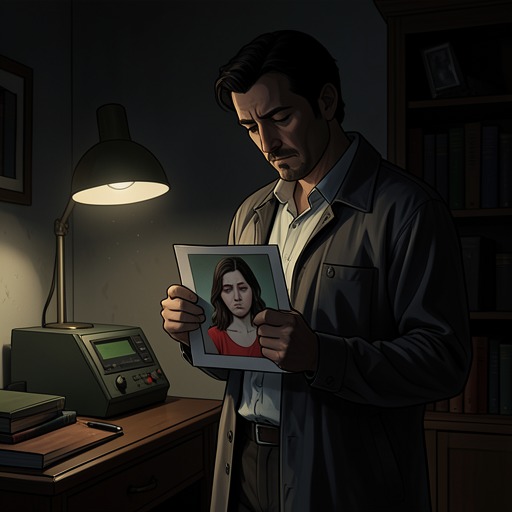
Marissa Thorpe's fatal car accident
It Must Be Love: A Mustang Prairie RomanceMarissa Thorpe's fatal car accident is the decisive absent event in Jack Thorpe's emotional life. Marissa died when an aneurysm struck her behind the wheel, before her car hit a tree, yet the surrounding community accepted the crash as the whole story. The concealed medical cause and the unresolved state of Jack and Marissa Thorpe's marriage shape his grief, his resistance to renewed commitment, and the delayed recognition that his relationship with Trixie Beaumont is not a repetition of his first marriage.
Circumstances Before the Crash
Jack and Marissa's marriage had once appeared deeply happy, but its balance changed after Jack's painting career began to succeed. They had moved to Chicago for higher education, then taken an apartment after their freshman year. Jack began exhibiting his work in small local shows, and Marissa initially encouraged him, locating additional opportunities and supporting his ambitions. Shortly after Jack's twenty-second birthday, he sold four paintings at a prominent gallery exhibition. The success seemed to promise that he could support the family as it grew, but Marissa's encouragement gradually weakened, and her resentment of his professional recognition became a source of continuing conflict.
Jack later explained that Marissa loved the money and parties associated with his career but disliked the attention, admiration, and press directed toward him. By the time of her death, their relationship was not the uncomplicated romance remembered by outsiders. Jack told Trixie that they had been close to divorce and had been arguing when Marissa left, after accusing him of needing to take care of the children for once. The argument became part of Jack's private burden: the last exchange between them was marked by bitterness, while everyone else continued to believe that their marriage had been fortunate and intact.
The Accident and Its Withheld Cause
The fatal medical crisis occurred while Marissa was driving. Jack's account makes the sequence precise: she suffered an aneurysm behind the wheel and died before the car struck a tree. The collision therefore became the visible explanation of her death, while the aneurysm remained the hidden cause. Jack described this as the lie everyone believed, not because the crash itself was fabricated, but because it concealed the bodily event that had actually killed her.
That distinction changes the meaning of the accident within the family narrative. The death was not simply a sudden roadside tragedy; it was also a medical event whose cause was known to Jack but absent from public understanding. The distinction preserved the appearance of a straightforward accident while leaving Jack alone with the circumstances surrounding it, including the unresolved quarrel and the knowledge that Marissa had died before impact.
Grief, Marriage, and Family Consequences
Marissa's death froze the contradictions of the marriage rather than resolving them. Jack remained attached to her and continued to experience himself as someone who had lost the only love he understood, but he also remembered jealousy, career conflict, and the approach of divorce. His mother recognized that he treated all future marriage as though it would reproduce the failures of his relationship with Marissa. She argued that his parents' long marriage had survived difficulties because they genuinely liked each other and wanted the best for one another, whereas Jack and Marissa's love had become distorted by resentment over his success.
The accident also reorganized Jack's responsibilities as a father. He became the surviving parent for Abby Thorpe and Andie Thorpe, while Marissa's absence remained present in the girls' family memories and in Jack's protectiveness. The household could still gather for familiar traditions: at Thanksgiving, Jack's parents, Sadie, Dylan, Luna, Mr. Scanlan, Jonquil Spring, Abby, Andie, and Trixie assembled around the preparation and meal. Yet the fullness of that gathering existed alongside the missing wife and mother, making family continuity both comforting and painful.
Marissa's memory also became a persistent relational presence for Trixie. Jack's mother told him that Trixie had once kept close enough to watch him while he was with Marissa, then withdrew like a ghost when the sight became too painful. She urged him to tell Trixie the truth, observing that it was difficult for anyone to compete with a ghost. In this sense, Marissa's death continued to structure the living relationships around Jack: Trixie was not merely confronting a widower's sadness, but an idealized and publicly misunderstood marriage that still occupied emotional space.
Disclosure and Aftermath
Jack initially tried to keep the full history from Trixie. After they became intimate, he warned her that he could not make promises because his life was already full and chaotic. Trixie understood that he remained in love with his wife and did not want anything serious. She refused to remain in a relationship with no possibility of a future, especially one that required her to compete with a dead woman, and began distancing herself from him.
The turning point came when Jack finally told Trixie about the marriage's deterioration and Marissa's death. He disclosed the near-divorce, the argument before Marissa left, the aneurysm, and the fact that she died before the car reached the tree. The confession corrected the public version of events while also exposing Jack's own emotional history. Telling Trixie was therefore both factual revelation and an act of trust: he acknowledged that withholding the truth had been wrong and allowed her to see the marriage as damaged and complicated rather than sacredly perfect.
Trixie's withdrawal made the consequences unmistakable. At Jack Thorpe's Mustang Prairie art exhibition, he repeatedly looked toward the entrance expecting her and eventually tried to call her when she did not appear. He realized that her absence was not disbelief in his art but the result of his having broken her trust and hurt her. The exhibition thus becomes an aftermath scene for Marissa's death as well as for Jack's artistic return: the old loss has shaped his fear of intimacy, and that fear now threatens a living relationship.
Narrative Significance
Marissa Thorpe's fatal car accident operates as a hidden cause whose effects spread across the rest of the story. It explains Jack's grief, his suspicion of marriage, his reluctance to promise anything to Trixie, and his tendency to measure new intimacy against an idealized past. Because the public understands only the tree collision, the narrative initially presents a simplified account of widowhood; the later disclosure restores the missing medical and marital context.
The accident also gives physical form to the story's concern with delayed recognition. Jack does not immediately understand what Marissa's death has done to his identity or how strongly his fear governs his treatment of Trixie. Only after Trixie pulls away does he confront the difference between preserving the memory of a failed marriage and remaining loyal to a dead past. His eventual declaration to Trixie that he loves her follows that recognition. The event cannot be undone, and Marissa's loss is not erased, but its meaning changes: instead of serving as proof that love and marriage end in pain, it becomes the wound Jack must name before he can choose a different future.