Mustang Prairie Community Center
It Must Be Love: A Mustang Prairie RomanceMustang Prairie Community Center is the central public setting for Mustang Prairie’s craft education and costume-making initiatives, and one of the clearest spaces in which the town’s social network becomes visible. Under Trixie Beaumont’s direction, the building turns sewing, knitting, donated supplies, food, and volunteer labor into opportunities for connection and assistance. Its importance lies not in architecture but in the way repeated communal work there gives Trixie a role, gives local families a shared project, and converts the town’s goodwill into tangible support for children.
Definition and Setting
Mustang Prairie Community Center first appears as the place where Abby Thorpe spends ninety minutes learning how to knit and sew. Jack Thorpe waits outside, uncertain whether he should escort his daughter inside, while Abby insists that she can manage independently and trusts Trixie Beaumont to look after her. Her confidence makes the center a point of transition: Abby is entering a wider social world beyond her father’s immediate protection, while Trixie is becoming a trusted adult in the community. Jack’s unease also shows that the center rearranges family boundaries; it gives his daughter a new source of competence and allegiance without removing him from her life.
The center is not presented as an isolated classroom. When Jack returns to collect Abby, he finds Eric checking the turnout and asking whether she has been seen. The building therefore operates as a civic crossroads, where parents, teachers, officials, and participants overlap. Jack’s reluctance to go inside contrasts with the ease with which Eric enters the social setting, suggesting that the center belongs to a collective town life rather than to any one household. Its ordinary function—hosting a class—already contains the larger pattern of Mustang Prairie’s community: informal supervision, shared information, and people arriving not only to learn but also to see how the town is functioning.
Craft Classes and Community Use
The sewing and knitting program grows rapidly under Trixie Beaumont’s care. The second class is more successful than the first, and she prepares simple patterns for hats, gloves, scarves, blankets, and baby items because those are the projects most participants want. The group includes children such as Abby Thorpe and her friend Sam, older women such as Luna and Edie, and Jade, Baxter’s mother. This range of ages makes the center intergenerational in practice. Trixie is improving her own skills while helping others discover knitting and crocheting, so instruction becomes reciprocal rather than hierarchical: her authority rests on participation, preparation, and encouragement.
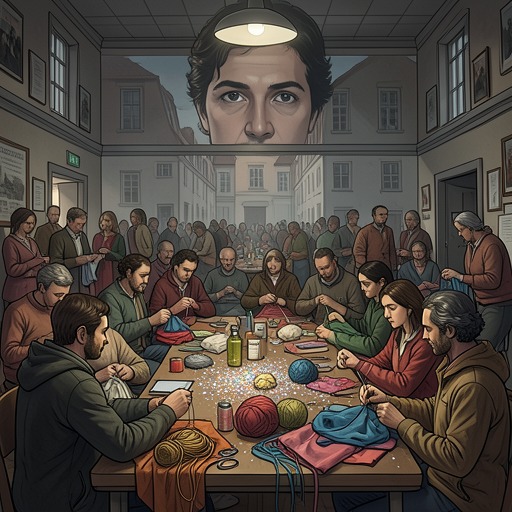
The program’s growth produces a physical transformation of the center. After the online registration reaches its limit, Eric moves the class into a larger room. The new space has long tables, better lighting, and more comfortable chairs, while a fifty-gallon plastic bin of yarn supplied by Eric keeps Trixie from exhausting her business resources on materials. These concrete adjustments show how institutional support follows community demand. The center adapts to the people using it, and the enlarged room makes visible the scale of a project that began as a modest class.
The classes also allow the center to absorb playful and practical forms of creativity. Participants ask whether they can crochet a bikini, while Trixie prepares projects suited to different abilities and ages. The humor does not cancel the labor involved; it gives the work a relaxed social atmosphere in which experimentation is possible. By teaching in a room used by little girls, adult friends, and older residents alike, Trixie makes domestic crafts public and collective, turning skills often associated with private household labor into a recognized community activity.
The Halloween Costume Drive
The center becomes the headquarters for Eric’s Halloween Costume Drive. Trixie looks forward to receiving the sewing machines Eric has promised, because the class can then help create costumes rather than merely practice small projects. The drive’s method is deliberately inclusive. Instead of spending a fixed budget on a limited number of finished costumes and leaving some children without one, Eric proposes buying fabric and accessories in bulk so volunteers can make wings, wands, capes, tiaras, and other pieces capable of completing a costume for children of different ages.
By the day of the drive, Trixie has arranged two large rooms. Eight sewing tables are prepared for shared use with the high school drama department once school resumes; a semicircle of chairs near the window serves knitting and hand sewing; and long tables at the back form a Glitter Station beside the snacks. The layout divides labor without separating the participants from one another. Sewing, handwork, decoration, food, and conversation occupy the same civic environment, allowing the center to function simultaneously as workshop, gathering place, and distribution network.
The event attracts assistance in several forms. Some residents offer costume-making skills, while others bring supplies, food, and drinks. Abby Thorpe and Andie Thorpe arrive with Jack Thorpe to help at the Glitter Station, decorating crowns and taking on projects assigned throughout the day. Trixie greets participants, tracks materials and finished costumes, and keeps the various stations moving. The center thus converts the town’s social capital into an organized process: relationships supply labor, recommendations and official support supply resources, and the resulting work is directed toward children who might otherwise be excluded.
Belonging, Boundaries, and Public Intimacy
The center is also where Trixie Beaumont’s professional and emotional boundaries repeatedly intersect. While she is managing the Costume Drive, she tries to avoid Jack Thorpe, but the public setting keeps bringing them into one another’s sightline. Their confrontation in the supply closet turns a practical space into a private threshold: Jack presses her about distance, while Trixie insists that they need to keep apart because he does not want love and remains bound to the memory of Marissa Thorpe. The center therefore contains both communal visibility and concealed intimacy. Its shelves and supplies belong to public work, yet the narrow room briefly shelters a conflict about desire, grief, and commitment.
That tension does not erase Trixie’s larger achievement. While she is trying not to look at Jack, she continues coordinating the event and greeting residents. The work forces her to inhabit Mustang Prairie as a participant rather than as someone merely passing through its remembered streets. Surrounded by people contributing according to their abilities, she realizes that she finally feels at home again. The community center is decisive in that change because it gives belonging a material form: a room to prepare, tables to organize, people to teach, and a shared obligation that depends on her presence.
Narrative Significance
Mustang Prairie Community Center links private development to public action. Abby Thorpe’s confidence there reassures Jack Thorpe while also unsettling his control; Trixie Beaumont’s classes establish her as a teacher and organizer; and the Costume Drive expands her work into civic leadership. Even the center’s association with Eric matters, because municipal promises—larger rooms, sewing machines, and supplies—become effective only when matched by residents’ time and skill.
The building’s recurring function is therefore connective. It brings children and adults, officials and volunteers, family members and friends into one working arrangement. Later communal occasions, including Thanksgiving at Jack Thorpe’s full house and Trixie’s successful lingerie launch elsewhere, gain meaning against this earlier practice of shared participation: the center is where the town learns to make room for one another. As a setting, it embodies the book’s movement from individual isolation toward found family and community, showing that home can be built through repeated acts of teaching, making, feeding, and helping.