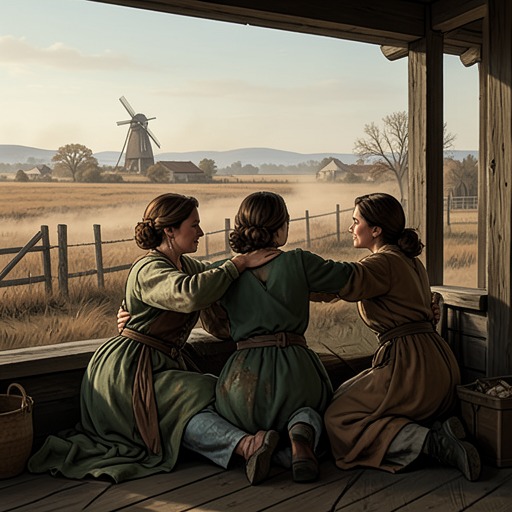
Sadie
It Must Be Love: A Mustang Prairie RomanceSadie is one of the central social and emotional presences in Mustang Prairie: witty, sexually confident, industrious, and fiercely protective of the people she loves. She works across several worlds at once—three days a week at Under the Skirt, five nights tending bar for Dylan, occasional singing, and late-night work on her own music—while carrying a difficult history that makes ordinary kindness feel both precious and unfamiliar. Her importance lies in the contrast between her comic energy and the hard-won stability beneath it: Sadie can fill a room with teasing and music, yet she is also carefully rebuilding a life in which care does not come with violence, abandonment, or manipulation.
Identity and Daily Life
Sadie is closely connected to Trixie Beaumont, whose lingerie business gives their friendship a practical setting as well as an emotional one. When Trixie is preparing new inventory, Sadie comes to help despite knowing that she is not required to do so, explaining that the two women have not seen enough of each other and that she misses her friend. Her presence is therefore not ornamental friendship but active labor: she folds, listens, observes, and makes herself available when Trixie is struggling.
Her own work is divided among Under the Skirt, Dylan’s bar, and music. At Under the Skirt, she sells lingerie to women of all body types and ages; at night, she serves drinks at The Lounge, sometimes sings, and then returns home to work on songs despite looming deadlines and not one completed piece. The arrangement is not the life she once imagined, but the preceding three months in Mustang Prairie have been the most relaxing period she has known. That calm matters because Sadie is accustomed to chaos, drama, and trouble; the town offers her a life that is modest and overworked but no longer defined by crisis.
Sadie also helps create the social rituals that make the town feel like a community. At Tequila Tuesday, she joins Trixie and other women in gatherings that have evolved from wine-based evenings into cocktail get-togethers. The events give the women space to drink, talk, and enjoy themselves, and Sadie’s participation places her at the center of that informal network. Later, when the group gathers with hooch and conversation turns to Trixie and Jack Thorpe, Sadie responds to the romantic speculation with the insistence that they are only friends, even as the room’s interest shows how visible the tension has become.
Friendship with Trixie Beaumont
Sadie’s bond with Trixie combines intimacy, humor, and blunt emotional accountability. She notices when Trixie is performing composure rather than feeling it and asks directly whether Trixie is truly all right about Jack Thorpe. Sadie remembers that Trixie has loved him for years and that Jack treated her cruelly, so her concern is not idle curiosity. She watches Trixie’s face for details, pressing past the answer Trixie has already given because friendship, for Sadie, includes the right to question a convenient lie.
Her support is expressed through both affection and criticism. At one point, after seeing Trixie dressed in an outfit that seems unlike her, Sadie tells her that she looks good but not like herself, then asks whether she is really okay and points out that everyone noticed her absence from Jack’s art show. Sadie also reports that Jack seemed upset when he realized why Trixie had not attended. In this role she becomes an interpreter of the social field around Trixie, conveying what Jack cannot or will not say directly while refusing to let Trixie’s withdrawal pass as simple indifference.
Sadie’s defense of Trixie becomes openly confrontational when Jack seeks sympathy. She tells him that he behaved callously, disregarded Trixie’s feelings, and used her because he knew Trixie’s longstanding crush made refusal difficult. She questions whether his renewed interest comes from love or merely from the fact that Trixie no longer wants him. This is not detached judgment: Sadie is speaking as the friend who has witnessed Trixie’s vulnerability and recognizes the danger of allowing romantic desire to erase the harm already done.
At the same time, Sadie does not reduce Trixie’s life to the Jack problem. She helps her friend with inventory, celebrates the development of Sexy Separates by Trixie, and participates in the lingerie line’s public launch. During the runway presentation at The Lounge, Sadie models a lacy teal boy-short set with a matching Basque and a fiercely seductive smile, while songs by Sadie and Kiki Ramirez provide the soundtrack. The event makes Sadie both collaborator and performer: she helps transform Trixie’s private designs into a communal spectacle that is sexy, playful, and deliberately welcoming.
Romantic Entanglement with Dylan
Dylan is Sadie’s closest friend and her most persistent source of unfulfilled desire. Their relationship is repeatedly described and defended as friendship, yet their physical ease makes the boundary unstable. She leans across the dark wooden bar, asks him for margaritas, and pulls him into a long, hot kiss; her teasing request that he tell Malcolm to prepare a pitcher turns ordinary bar service into flirtation and domestic familiarity at once. Her boldness is part of her language with Dylan, but it also exposes the feeling she keeps trying to classify as something safer.
Sadie is tired of explaining the friendship to other people because the relationship is more emotionally serious than the label suggests. She says that she loves Dylan because he is the first man who has been kind to her without demanding something in return, and because he takes care of her without treating care as a transaction. That distinction is crucial. Her previous relationships trained her to expect unemployment, criminal entanglements, physical violence, infidelity, or some combination of those failures. Dylan’s decency is so unfamiliar that Sadie jokes it must be a sign that he has major issues if she wants anything more from him.
Her denial is knowingly incomplete. Sadie admits internally that she does want more with Dylan, but she wants something normal, and the friendship feels better than normal—almost perfect. Dylan’s perspective confirms the depth of the attachment: he regards Sadie as his best friend and the closest female friend he has ever had, an unprecedented category for a man who has usually divided women into relatives and sexual prospects. He avoids workplace relationships because he does not want professional drama, yet Sadie occupies a place outside his usual system. Their intimacy therefore rests on a genuine transformation in how both understand closeness, even while desire threatens to disrupt the arrangement.
Recovery, Judgment, and Emotional Labor
Sadie’s history explains why she values non-possessive care so intensely. Her father abandoned her with a mentally unstable drug addict for years, and only after Sadie overdosed did he have no choice but to add her to his new family. The past gives weight to her insistence that Dylan’s kindness is different from what she has known. It also clarifies why she resists repeating the patterns of men who use fists instead of words or treat sexual access as an entitlement.
Her recovery is not presented as a clean escape from desire. Sadie still wants Dylan, still flirts with him, and still moves easily through sexualized spaces, but she is trying to keep desire from dictating her definition of safety. Her skepticism toward romance is therefore both defensive and perceptive. She can recognize that a man’s gentleness matters, yet she also fears that wanting more may turn a stable friendship into another damaged relationship. The tension between those impulses makes her emotional life more complex than her jokes suggest.
Sadie also performs substantial emotional labor for the people around her. She helps Trixie name grief and humiliation, protects her from Jack’s revision of events, organizes and inhabits social gatherings, and keeps Dylan’s bar lively through work, singing, flirtation, and practical requests. Her energy often makes these efforts look effortless, but the pattern is consistent: she notices what others need, supplies atmosphere, and intervenes when a friend is in danger of accepting less than she deserves. Even her humor is functional, lowering defenses while allowing her to say difficult things.
Narrative Role and Significance
Sadie links the novel’s principal strands: women’s friendship, creative enterprise, sexual autonomy, community life, and recovery from trauma. Through her involvement with Sexy Separates by Trixie, she turns lingerie from a private object into a collaborative performance and a source of confidence. Through her work at Under the Skirt and The Lounge, she helps connect women of different bodies, histories, and occupations. Through her music, she remains committed to an artistic self that has not yet fully taken shape, even when deadlines and incomplete songs threaten to make that ambition feel impossible.
Her role in Trixie’s romantic conflict also gives the story a moral counterweight. Jack Thorpe’s attraction may be intense, but Sadie insists that intensity does not cancel consequences. She names his callousness, challenges his motives, and refuses to let Trixie’s old devotion become permission for renewed harm. When Jack approaches Trixie, pulls her close, and says that he has realized something important, Sadie’s earlier confrontation remains the standard against which his claim must be measured: love must become accountable, not merely passionate.
Sadie’s deepest significance is that she represents a form of belonging built through repeated ordinary acts. She works, sings, pours drinks, assists with inventory, models for a friend, hosts or joins gatherings, and keeps asking whether the people she loves are genuinely well. Mustang Prairie does not erase her past, and Dylan does not automatically resolve her fear of intimacy. Instead, the town gives her enough safety to recognize the difference between chaos and desire, between possession and care, and between a life she merely survives and one she is gradually making her own.