The Lounge
It Must Be Love: A Mustang Prairie RomanceThe Lounge is Dylan’s bar and one of the most important communal spaces in Mustang Prairie. More than a drinking establishment, it functions as a meeting place, stage, refuge, and pressure chamber: characters arrive to celebrate, flirt, negotiate, confess, or escape, only to find that private feeling can become visible there. Its polished bar, crowded booths, music, and adaptable floor allow the location to shift from an ordinary business into a setting for romance, friendship, performance, and personal crisis.
Definition and Setting
The Lounge had been open for little more than a year when Trixie Beaumont and Jonquil Spring visited it, yet it had already established a steady trade. Dylan had transformed it into a gastropub, and the change made the place especially busy after seven in the evening. Its long wooden bar was kept gleaming, while an empty booth across from it offered a recognizable point of arrival for visitors and regulars alike. The large round booth was positioned unusually close to the bar because Dylan believed large parties valued easy access to drinks, a practical decision that also made the space suited to group gatherings.
The bar’s design gives it a dual character. It is organized as a working business, with inventory, staffing, cleanup, and revenue constantly demanding attention, but it is also intimate enough for private conversations. People can sit together in a booth, watch the room, or retreat outside while remaining only a short distance from the community gathered inside. That balance between openness and concealment makes The Lounge especially effective as a recurring setting: the same room can hold ordinary sociability one night and emotional upheaval the next.
Community and Everyday Life
The Lounge is closely identified with Dylan, who owns and operates it. His management is demanding; even an apparently simple request for use of the bar requires him to consider time, labor, champagne, cleanup, and lost business. When Sadie proposes an event, Dylan initially refuses, but ultimately agrees to five hours, free champagne, and cleanup. The negotiated arrangement reveals the practical foundation beneath the bar’s convivial atmosphere, while Sadie’s affectionate embrace and thanks show how business dealings there are continually softened or complicated by friendship.
Dylan’s relationship with Sadie gives the location an additional emotional center. He regards her as his closest friend and a source of unfulfilled desire, an unprecedented position for him because he has not previously treated women as friends. The Lounge therefore becomes the workplace in which his assumptions about intimacy are exposed. He separates women into relatives and potential sexual partners, avoids sexual involvement with coworkers, and rejects workplace drama, yet his bond with Sadie unsettles that rigid system without immediately resolving it.
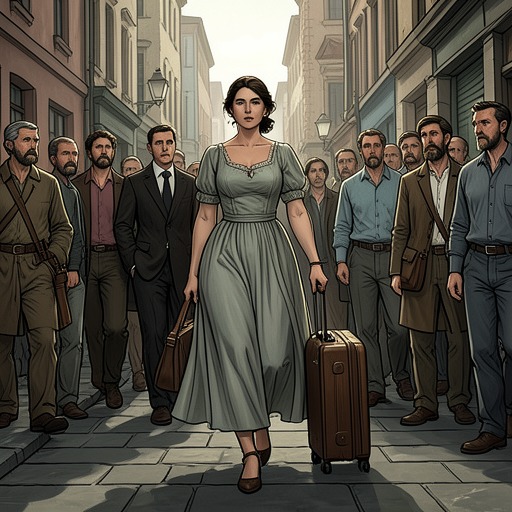
The bar also gathers a wide circle of recurring figures. When Jonquil arrives from Oregon with her suitcase, Trixie introduces her to Dylan at The Lounge, where the crowded gastropub becomes an initial point of entry into local life. Sadie’s singing helps draw people later in the evening, and Dylan takes pride in the bar’s success. The place is thus not merely where characters happen to meet; it is part of the town’s infrastructure of belonging, a business whose regular traffic produces a social network.
Performance and Public Display
The Lounge can be converted into a performance venue. For Trixie’s lingerie venture, a makeshift runway divides the bar in half, while gauzy fabric, lighting, music, and the crowd transform the room into something resembling a giant bedroom. Sadie and the other models wear Trixie’s designs as songs by Sadie and Kiki Ramirez supply the soundtrack. The ordinary commercial space becomes a controlled environment in which clothing, bodies, music, and spectatorship are deliberately arranged.
The fashion show gives Trixie’s private ambition a public form. She has spent months considering a clothing line, experimenting with names, sketching logos, and contacting a graphic designer, but the sketches have begun to taunt her because she has not acted. At The Lounge, the idea stops being hypothetical. Sadie appears in lacy teal boy shorts and a matching Basque, then returns in a white set with a silky duster, silver buttons, and cherry-red stilettos. The applause and camera flashes turn the display into the defining image Trixie believes can launch the line. The event joins business development to performance: the clothes are not simply shown but embodied, photographed, and given a memorable setting.
The location also supports less formal performances of identity. Ty Scanlon appears in a costume that replaces his usual handcuffs and utility belt with a fuzzy leopard pair and a shot-glass belt, while Jack Thorpe watches the costumed crowd and jokes about him as “Stripper Sheriff.” Trixie’s own costume is treated as a surprise, and her later appearance in a sexy white tank, visible red bra, black leather pants, knee-high boots, and leather jacket leaves her nervous before her date with Jack. In The Lounge, clothing becomes a social language: characters are seen, interpreted, teased, desired, and sometimes empowered by what they choose to display.
Romance, Jealousy, and Confrontation
The Lounge repeatedly turns romantic tension into a public problem. Jack sits in a booth drinking whiskey and keeping a dark ale beside him while asking Dylan and Ty Scanlon to discuss his “female problems.” His unusual willingness to summon friends and tell them everything shows how the bar can function as a confessional, even for someone who normally contains his feelings. Yet the openness of the setting cannot prevent misunderstanding. When Trixie later arrives with Sadie, Alex, and Shellie, she senses Jack nearby and refuses to look toward him until the men join the booth.
The physical arrangement intensifies the encounter. Jack slides so close to Trixie that she can breathe in his cologne, and the crowded booth makes avoidance increasingly difficult. When someone asks about her romantic situation, Trixie says that she already has Jack, while blaming herself for allowing a childhood crush to become something deeper. She leaves the booth, spends a long time in the bathroom, and then exits The Lounge into the crisp night air to sober herself emotionally as well as physically.
The conflict continues just outside the bar. Jack searches the empty street for Trixie, then hears her arguing on the phone near the permanently closed-off door of The Lounge. She is discussing an eleven-year-old girl, her college situation, and the possibility of moving with her father so the child will not be left alone. When Trixie sees Jack, her body freezes. Their confrontation escalates as Jack insists that he is not trying to protect her, grabs her shoulders, and kisses her. The threshold of The Lounge becomes a boundary between public restraint and private admission: the bar has exposed the emotional rupture, while the darkness outside permits the physical reaction that neither character has managed to articulate openly.
Narrative Significance
The Lounge’s importance lies in its repeated conversion of ordinary space into relational space. Its gleaming bar and booths support business, but they also hold friendship, rivalry, desire, and disclosures. Its adaptability allows a costume gathering, a date, a conversation among friends, and a lingerie launch to exist within the same setting without making the location feel static. The bar’s everyday commercial identity supplies the material conditions for the community’s emotional life.
It is also a place where looking carries consequences. Trixie’s clothing designs are judged by Eric, displayed through Sadie and the other models, and received by an audience whose applause validates a business she has previously kept at the level of sketches and logos. Jack’s gaze at Trixie and at the costumed crowd is playful in some moments and jealous in others, while Trixie’s own control over surprise, styling, and presentation turns visibility into an active choice rather than mere exposure. The Lounge therefore presents performance as both social risk and creative agency.
Finally, the bar’s recurring threshold scenes give it a structural role in the story. Inside, characters assemble themselves through jokes, drinks, music, work, and public roles. At the booths or along the bar, relationships are named, tested, or evaded. Outside, the feelings suppressed by the communal setting break through. The Lounge is consequently both Mustang Prairie’s social room and its emotional borderland: a place where people come together, where private identities are staged for others, and where the consequences of being seen cannot easily be taken back.