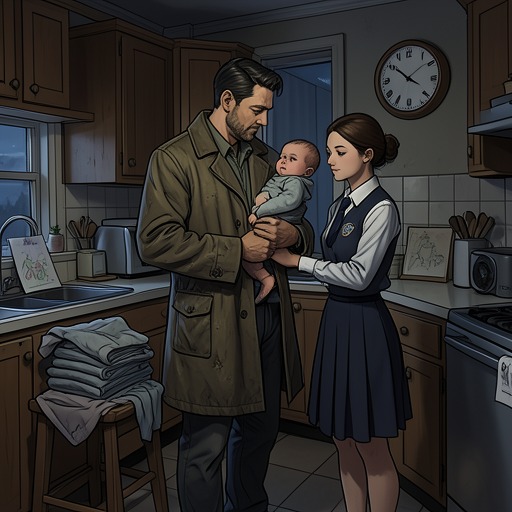
To the stars—and beyond!
It Must Be Love: A Mustang Prairie Romance“To the stars—and beyond!” is a recurring expression of affection between Jack Thorpe and his daughter Andie Thorpe. Its decisive significance lies in its simplicity: against the strained silences, apologies, refusals, and painful definitions that govern Jack’s adult relationships, the phrase provides a stable language of love within his family. It is both a private ritual and a compact symbol of the emotional bond Jack is trying to preserve while grief, parenthood, and romantic uncertainty reshape his life.
Origin and Family Ritual
Jack uses the expression while preparing food with Andie Thorpe at home. When he reassures her that he will always make salsa for her, she answers, “Yes Daddy. Love you.” He responds with a kiss on her head and the familiar words, “Love you too pumpkin. To the stars,” adding them as he always does. Andie supplies the completing phrase, “And beyond!” and shouts it with particular enthusiasm because it is her favorite part.
The exchange is more than a decorative family saying. Its repeated structure gives Andie a dependable answer to affection: Jack declares love, names the stars as the limit to which that love might reach, and Andie immediately expands the limit beyond them. The phrase therefore belongs to a relationship built on repetition, recognition, and mutual participation. Jack begins it, but Andie completes it, turning a paternal reassurance into a shared ritual that belongs to both of them.
Contrast with Silence and Conflict
The expression gains force from the family tensions surrounding it. Jack’s daughters are not uniformly open with him: Abby Thorpe has spent much of a month pretending he does not exist, answering him through withdrawal and terse practical communication. Jack recognizes that his daughter is miserable and believes he has the power to repair the situation, yet the household’s emotional life is often marked by frustration rather than easy speech. Against that background, “To the stars—and beyond!” preserves a direct and uncomplicated channel between father and child.
Its emotional clarity also contrasts with Jack’s language with Trixie Beaumont. When he apologizes for speaking harshly to her, Trixie accepts the apology with a guarded “Okay,” while Jack is dissatisfied that the exchange does not restore intimacy. Later, after their sexual relationship has become unstable, Trixie insists that they are merely friends who used to sleep together and then only neighbors. She rejects his attempts to redefine the relationship, declaring that he has no right to tell her what to do because they are “nothing but neighbors who used to screw!” The blunt classifications of that conflict show how adult intimacy in the novel is repeatedly negotiated through labels, refusals, and corrections; the family expression, by contrast, does not need to be argued into existence.
Affection, Grief, and Emotional Continuity
The phrase also belongs to Jack’s attempt to remain a reliable father while carrying the unresolved damage of his marriage to Marissa Thorpe. He tells Trixie that he and Marissa had been close to divorce when Marissa died after suffering an aneurysm behind the wheel. Because she died before the car struck a tree, other people preserve a more flattering version of the marriage, while Jack remains burdened by the resentment, arguments, and misunderstanding that preceded her death. His reluctance to enter another serious relationship is inseparable from that history.
In this context, the expression’s repeated use with Andie represents emotional continuity rather than romantic escape. Jack can remain a grieving widower and a guarded man while still giving his daughter an undamaged, recognizable declaration of love. The ritual does not erase Marissa’s presence or solve Jack’s fear of commitment, but it shows that grief has not exhausted his capacity for tenderness. The same father who struggles to explain his past to Trixie can still answer Andie immediately and lovingly.
Recurrence and Narrative Significance
The wording returns during Christmas, when Nina Thorpe observes that the celebration feels like the Christmases the family used to have. Jack is distracted by thoughts of Trixie and by the painful possibility that she now hates him. Andie responds by advising him to apologize, arguing that girls appreciate an apology when boys hurt their feelings, and then tells him that she and Abby know he likes Trixie. Her intervention connects the family ritual to the romantic conflict: the child who completes “To the stars—and beyond!” also recognizes the adult attachment Jack is trying to deny.
This recurrence gives the expression a structural role in Jack’s arc. The phrase begins as a secure declaration within the father-daughter relationship, while Jack’s connection with Trixie moves through attraction, withdrawal, sexual intimacy, avoidance, anger, and demands for honesty. Eventually Jack tells Trixie, “Yes Trixie, I love you.” That declaration is not identical to the family ritual, but it answers the same underlying problem: whether Jack can speak love directly instead of hiding behind grief, uncertainty, or the assumption that his first marriage defines all future intimacy.
“To the stars—and beyond!” therefore functions as a verbal emblem of the novel’s movement from emotional restriction toward renewed connection. In Andie’s excited completion, love is not treated as a fragile promise that must stop at the edge of what is already known. It is a phrase that Jack and his daughter repeat until it becomes dependable, expansive, and shared—a small domestic counterpart to the larger possibility that Jack may eventually build a future beyond the limits imposed by his past.