Trixie Beaumont–Abby Thorpe relationship
It Must Be Love: A Mustang Prairie RomanceThe Trixie Beaumont–Abby Thorpe relationship is an informal apprenticeship that becomes one of the clearest bridges between Trixie’s independent life and the Thorpe family. What begins with fabric, yarn, and questions in Under the Skirt grows into a reciprocal bond: Trixie teaches Abby to make clothing and trust her creative instincts, while Abby recognizes Trixie’s importance to her family before the adults can openly acknowledge it. Their connection also gives Abby a way to remember Marissa Thorpe without being reduced to her mother’s image, and gives Trixie a meaningful place within a household she once approached only through longing for Jack Thorpe.
Identity and Introduction
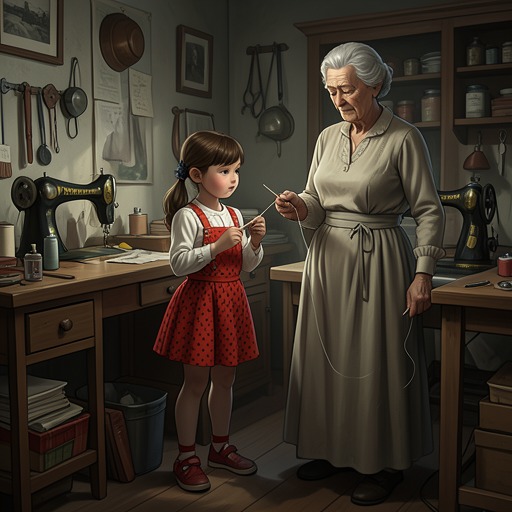
Abby first enters Trixie’s orbit as a nine-year-old visitor to Under the Skirt. She comes into the lingerie shop almost every afternoon around three, initially asking about fabric and stitching, but her repeated visits soon reveal that she is a fellow fashion enthusiast and an aspiring designer. Trixie notices the seriousness beneath the child’s enthusiasm and treats it as genuine talent rather than a temporary hobby. When Trixie finds silver-threaded fabric for Abby’s nearly finished shrug, Abby responds with delighted pride, and Trixie helps her understand how to leave enough yarn for the garment to curve correctly.
The relationship is therefore founded on recognition. Abby has sketchpads full of clothing designs but says that no one has been willing to teach her. Her father, Jack, has dismissed clothing construction as a waste of her abilities, while Trixie understands that creative work was once treated similarly in Jack’s family. By offering instruction instead of judgment, Trixie becomes the adult who validates the part of Abby that her father does not yet know how to encourage.
Teaching and Creative Practice
Trixie’s mentorship is practical and sustained rather than symbolic. She teaches Abby how to tie off a knitted piece, how to make the finish curve properly, and how to repair dropped stitches. Abby works on her shrug for three weeks, later returns with a pink-and-silver hat, and asks Trixie to demonstrate the repair again when the work becomes difficult. Trixie responds by positioning Abby’s hands and guiding the movements until Abby can correct the stitches herself. The method preserves Abby’s agency: Trixie does not simply complete the project for her, but turns instruction into competence.
The hat becomes a shared project involving Abby’s younger sister, Andie Thorpe. Trixie helps Abby plan matching winter hats inspired by a photograph of Marissa and her best friend wearing colorful hats with pom-poms. Abby gathers the materials, while Andie collects leftover yarn for the finishing touches. When Abby proudly puts on her completed hat, Trixie takes photographs of the sisters on the porch, placing the new image beside the older family photograph in the emotional record of the Thorpe household.
Trixie also encourages Abby to seek permission from Jack before continuing to visit the shop. When Abby discovers a photograph of her mother in the basement and asks for a hat like Marissa’s, Trixie promises that they will work it out but insists that Abby first clear the arrangement with her father. The boundary does not weaken their closeness; it shows that Trixie’s care includes respect for Abby’s position within her family and for Jack’s parental authority.
Memory, Grief, and Selfhood
Abby’s creative work is inseparable from the problem of memory. People in town repeatedly tell her that she resembles Marissa, and Abby fears that they see a ghost rather than a child with a distinct personality. Trixie does not deny the resemblance, but she redirects its meaning. She tells Abby that people are drawn to her not only because of her features but because she possesses the same ability to attract and connect with others. In this account, Marissa’s legacy is not a visual burden imposed from outside; it becomes a strength Abby may inherit without disappearing into it.
Trixie’s reassurance is especially important because she understands the danger of allowing fear to govern creative ambition. She tells Abby that, when she was young, she loved clothing but kept pursuing it secretly because her parents did not understand her. Abby, by contrast, has already shown the courage to approach a stranger and compliment her fashion sense. Trixie names her a junior designer and urges her to embrace what is exceptional in her, encouraging her to let her mother’s memory strengthen rather than weaken her.
The material objects exchanged between them preserve this revised memory. Abby’s hat, the photographs Trixie takes, and the remembered image of Marissa allow Abby to participate in family remembrance instead of merely being inspected as its substitute. Abby later tells Jack that Trixie has given her good memories of her mother. Trixie’s role is thus not to replace Marissa, but to help Abby hold on to her mother while developing a self that is recognizably her own.
Family Boundaries and Emotional Trust
Jack initially views Under the Skirt as an unsuitable place for his daughter and objects to Abby spending so much time there. After Abby begins avoiding him, he recognizes that the conflict has made her unhappy and that it is within his power to repair the situation. Trixie’s bond with Abby consequently becomes entangled with the unresolved attraction and resentment between the two adults. Trixie hopes Jack might come to the shop to collect Abby, while also fearing the renewed hurt that his attention can cause.
That tension is visible when Jack listens outside the shop as Abby asks whether she resembles Marissa. He hears Trixie answer with unusual sensitivity, telling Abby that she is one of a kind and that her ability to draw people toward her matters as much as her appearance. Trixie’s words give Jack a new view of the relationship: she is not merely the woman connected to his own romantic confusion, but an adult who makes his daughter feel capable, special, and understood.
Abby becomes perceptive about the adults’ concealed attachment. She notices that Jack holds Trixie’s hand when he thinks no one can see them and tells him that he should apologize for hurting Trixie’s feelings. Her intervention places the child at the center of a family system that the adults have tried to manage through avoidance. Abby does not understand every part of the conflict, but she understands its emotional direction: Trixie matters to her, and Jack’s refusal to address the relationship is causing pain.
Development and Narrative Significance
The relationship survives Jack’s restrictions and Trixie’s attempts to keep her distance. Even when Trixie avoids Jack, Abby continues to seek her out, missing her and returning for help with her projects. At Thanksgiving, Abby arrives early with Andie and Jonquil Spring, while Trixie appears only shortly before the meal, having avoided spending more time with Jack. Yet Trixie’s absence from the adult encounter does not erase her connection with the girls; her influence has already entered the household through the skills, photographs, clothing, and memories she has shared.
For Abby, Trixie represents a form of adult attention that is neither patronizing nor possessive. Trixie speaks to her as a capable young person, teaches her processes instead of merely praising results, and recognizes both her vulnerability and her boldness. For Trixie, Abby offers an emotional relationship not built on romantic uncertainty. Loving the girls and receiving their affection allows Trixie to experience belonging in the Thorpe home even while her connection with Jack remains unstable.
The bond therefore carries significance beyond its domestic scenes. It joins creativity to care, turns inherited grief into collaborative making, and allows a child to claim a future without surrendering the past. Abby’s confidence in Trixie helps push Jack toward apology and emotional honesty, while Trixie’s patient instruction helps Abby become more than the image of Marissa that the town keeps projecting onto her. Their mentorship is modest in its materials but large in its consequences: a shrug, a hat, a repaired stitch, and a photograph become the practical language through which trust and family belonging are built.