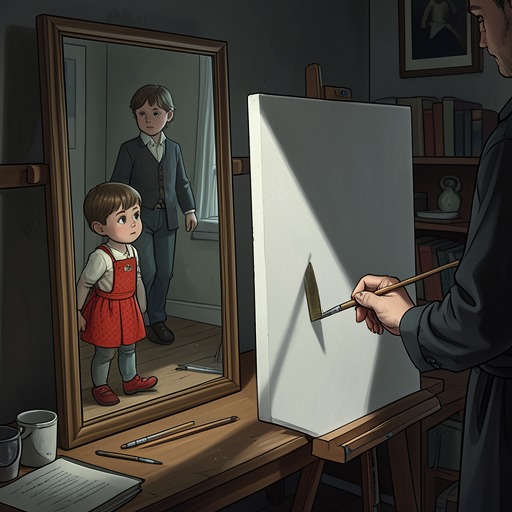
Trixie anonymously buys Jack’s portrait
It Must Be Love: A Mustang Prairie RomanceTrixie anonymously buys Jack Thorpe’s portrait at a gallery preview, an action that makes her love tangible while allowing her to deny it publicly. The purchase is not merely a transaction for an attractive painting: it is an attempt to possess a beautiful record of herself as Jack saw her, even as she tries to keep that emotional claim hidden from him and from herself.
The Portrait and Its Subject
Trixie discovers the work while visiting the exhibition with Blythe Danforth. The painting is a very large oil portrait, though its effect is closer to an arrested moment than a formal likeness. Jack has painted Trixie in the middle of a full-bodied laugh, with her head thrown back, her bare shoulders exposed, her long neck visible, and her multicolored hair arranged in a striking symmetry. The image makes her look beautiful, but its deeper force comes from recognition: it preserves the particular instant when laughter made her feel warm and convinced her that everything in the world was briefly right.
The portrait therefore gives visual form to a version of Trixie that she experiences as emotionally true. She does not respond only to Jack’s technical ability or to the value of a famous artist’s work. She responds to being seen through his eyes and to seeing herself returned as joyful, open, and alive. Her tears while looking at the canvas show that the image touches both desire and memory; it is a representation of a relationship she cannot safely claim, and of a self she does not want to lose.
The Decision to Buy Anonymously
Trixie immediately asks whether she can buy the painting. Blythe warns that it is expensive because Jack is a famous artist, and suggests that Trixie might persuade him to give it to her. Trixie rejects that possibility. She wants to purchase the work, but she insists that the sale be anonymous, because she does not want Jack ever to know that she owns it.
The concealment gives the action its central tension. Trixie is willing to spend money and assume possession of the portrait, but not to expose the feeling that motivates her. The anonymous purchase allows her to preserve the evidence of Jack’s regard without demanding recognition from him. It is at once an act of agency and a form of self-protection: she chooses the object decisively, then draws a boundary around the knowledge of why it matters.
Blythe agrees to handle the transaction on one condition: Trixie must tell the story behind her interest. The condition turns the private purchase into a confession, though only to a sympathetic intermediary. Blythe takes Trixie to her office, pours tequila, and asks her to explain. The scene establishes that anonymity does not eliminate emotional disclosure; it merely redirects it. Trixie can hide from Jack while still being forced to articulate, at least indirectly, the attachment embodied in the painting.
Jack’s Reaction to the Sale
Jack learns that the portrait has already been sold when a woman dressed in black and gold admires it and wishes she could buy it for twice the asking price. He is surprised by the sale, but his response is more complicated than professional satisfaction. A sharp, inexplicable feeling passes through him at the thought that the woman standing before the painting will never see it. He asks Blythe whether he can thank the buyer, describing the work as one of his favorites.
Blythe refuses to identify the purchaser, explaining that the buyer requested anonymity and paid the asking price. Jack presses her privately, but she maintains that disclosure could void the sale. His persistence reveals that the painting carries personal significance beyond its place in the exhibition. He wants to know who recognized its value, and he feels disappointed that the person who bought it will remain outside his reach. The anonymous buyer has therefore created a new distance around an image that already connects him to Trixie.
The exchange also exposes an asymmetry in their knowledge. Trixie knows exactly why she has bought the portrait and wants Jack kept unaware; Jack knows that someone has claimed one of his favorite works but cannot identify the person or understand the emotional meaning of the sale. His uncertainty does not resolve the relationship, but it makes the painting an active object of curiosity rather than a finished artistic product.
Emotional and Narrative Significance
The purchase transforms a public exhibition into a private emotional transaction. Jack’s painting was created from an intimate perception of Trixie, while Trixie’s purchase converts that perception into something she can keep. Yet the secrecy prevents the object from functioning as an open declaration. The portrait becomes a concealed repository of feeling, carrying the truth of Trixie’s attachment precisely because she refuses to speak that truth to Jack.
The action also extends the book’s recurring association between clothing, images, and self-definition. Trixie is building a lingerie line and shaping a public identity through design, color, presentation, and controlled visibility. Jack’s portrait offers a different kind of image-making: he fixes her in a moment of unguarded pleasure, while she controls the image’s afterlife by buying it without attaching her name to the purchase. In both cases, appearance is not superficial. It is a means of deciding who may see Trixie, in what form, and under whose authority.
The portrait’s significance deepens through its contrast with Blue Skies, the original painting Jack later gives Trixie as a gift. That work openly confirms his knowledge of her taste and his desire to offer her something precious, whereas the portrait is acquired by Trixie in secrecy. Together, the paintings trace a movement between concealed and acknowledged feeling. The anonymous purchase begins as Trixie’s attempt to retain love without confessing it, but Jack’s disappointment at losing the work shows that the image has already become emotionally charged for him too.