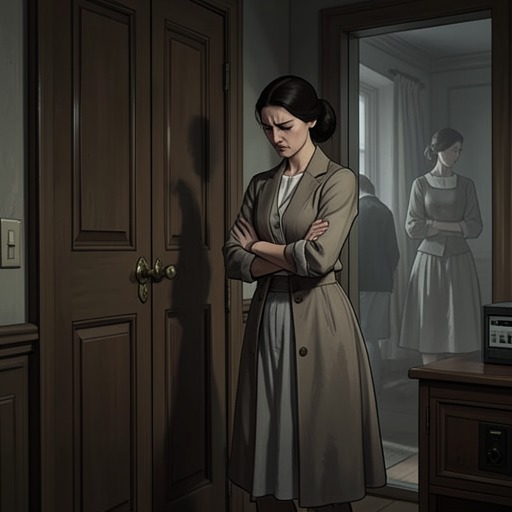
Trixie ends her relationship with Jack
It Must Be Love: A Mustang Prairie RomanceTrixie Beaumont’s decision to end her relationship with Jack Thorpe is the turning point that converts their sexually charged friendship into an explicit crisis over dignity, honesty, and choice. Her withdrawal is not a casual rejection: it follows the collapse of a childhood crush, the humiliation of being excluded from Jack’s art opening, and her realization that she can no longer accept intimacy without recognition. By asking him to stay away, Trixie attempts to reclaim control of both her emotional life and the future she is building through Sexy Separates by Trixie.
Causes and Background
Trixie’s decision grows out of an already complicated history with Jack. They are neighbors who have had sex, fought over its meaning, and tried to define the arrangement as finished, while Jack’s daughters have welcomed her with a warmth they have shown no other woman since Marissa Thorpe’s death. The attraction between the adults remains obvious: Jack is jealous when Trixie steadies herself against Ty at the Halloween gathering, and despite warnings from his friends against pursuing anything casual with her, he stops at her house and asks her out. Their dinner is therefore emotionally unstable from the beginning. Trixie knows they have already crossed the line into sex and conflict, yet she agrees to the date because she wants pleasure and believes she deserves a treat after working hard.
The relationship is also set against Trixie’s increasingly purposeful professional life. For months she has considered creating a clothing line, testing names, sketching logos, and even hiring a graphic designer, but the unrealized plans have begun to mock her inaction. She responds by moving from fantasy to enterprise. Her first line, Sexy Separates by Trixie, is designed around mix-and-match lingerie: six to ten panty styles, including g-strings, bikini, French cut, and possibly boy shorts, alongside four bra styles, including a convertible design. A rainbow palette in silk, lace, and cotton rejects the assumption that every woman must wear a matching set. With several consecutive profitable months behind her and Under the Skirt Online officially open, Trixie sees the possibility of a warehouse, a workspace, and eventually a part-time employee. Stability, not dependence, becomes the standard by which she measures her choices.
The Break and Its Immediate Consequences
The decisive emotional break occurs after Trixie tells Blythe Danforth the entire story of her relationship with Jack while drinking tequila. On the walk back to her store, she allows herself to cry—not in a dramatic sob, but in a quiet release. She mourns a crush that has lasted longer than any relationship she has had, along with the hope that life might offer something better than what she experienced with Preston or Jack. Most importantly, she abandons the patience of waiting for that hope to arrive. The tears mark a deliberate act of letting go, followed by a commitment to move forward.
That choice becomes visible when Jack sees her at The Lounge. He presses close to her in an overstuffed booth and asks her to forgive him. Trixie answers that she already has, but forgiveness does not restore the relationship. She leaves the booth, spends a long time in the bathroom, and then exits through the front doors so the crisp night air can dispel the remainder of her intoxication. Her movement away from the crowded bar gives physical form to the boundary she is trying to establish: she will no longer remain available simply because Jack has finally decided to seek her attention.
Outside, Trixie states the relationship in the harshest terms available to her. She tells Jack that they are nothing but neighbors who used to have sex, and she accuses him of treating the end of their sexual arrangement as though it also ended every obligation of care. Her anger centers on his failure to invite her to his art opening. She is not merely hurt at missing an event; she is wounded that Jack knows she is a fan of his work and still did not think her presence mattered. She insists that the situation is simple, that she understands they are finished, and that he need not fear her pining after him or making their proximity awkward.
Trixie then makes the boundary explicit. She tells Jack that she has listened long enough and that the only thing she ever asked of him was honesty. She will not stop his daughters from visiting her at home or at her shop, but she asks that the two adults avoid each other. When Jack tries to resist, she pulls free of his grasp and repeats that he has ignored her successfully before and should continue doing so. Even while he attempts to hold her arm and prevent her departure, her position remains that the decision is hers to make and that he has no authority over her actions.
Conflict Over Autonomy and Honesty
The confrontation is driven by a clash between Trixie’s need for a clean boundary and Jack’s sudden refusal to accept one. Jack says that he made a mistake and will make it right, but Trixie rejects the premise that he is entitled to repair what she has already learned to live without. She tells him that she is fine, while the narrative makes clear that her anger protects a deeper hurt. Her refusal to be managed by Jack is inseparable from her declaration that she is no longer the fragile little girl who carried a wicked crush on him. The language of protection itself becomes suspect: Trixie does not need Jack to decide what she can endure.
Jack’s resistance exposes the difference between sexual desire and emotional recognition. He tells her that he wants her, but Trixie hears this as too little and too late. Wanting her does not answer why he excluded her from the exhibition, why he remained silent, or why he allowed their connection to be reduced to sex. Her accusation is not that Jack feels nothing; it is that he has failed to tell her what he feels and has made her bear the consequences of that silence.
The break therefore functions as a struggle over who has the right to define the relationship. Trixie names it finished and tries to impose distance. Jack insists that it is not that simple and says he will make it impossible for her to ignore him. His determination is romantically charged, but it also collides with the autonomy she is defending. The scene’s emotional value shifts from hope to injury, then from injury toward self-command: Trixie cannot control Jack’s belated realization, but she can control her access to him.
Jack’s Late Realization
Jack’s response begins to change the meaning of the rupture. When Trixie leaves, he explains that he cannot let her go because he has realized something important. During his art opening, he spent the night looking for her and wondered whether she was like Marissa Thorpe, unwilling to support him. A conversation with Dylan revealed that Jack himself had made the mistake: he had forgotten to invite Trixie. The discovery shamed him, but the stronger revelation was emotional. He had expected the success of the exhibition to satisfy him, yet he could not enjoy the night because Trixie was absent.
Jack’s attention had been fixed on one painting in particular while he tried to persuade himself that he did not love her. His reasoning depends on the belief that previous love had taught him what love felt like, but the absence of Trixie unsettles that certainty. He wanted her to see the new series, to recognize the difference in his strokes and the maturity of his subjects, because her judgment mattered to him as both a fan and an intimate presence. The exhibition’s success is thus diminished by her absence, revealing that his silence was not evidence of indifference but a failure to understand and communicate his attachment.
This realization arrives only after Trixie has begun mourning the relationship and choosing independence. Jack’s confession cannot erase the circumstances that produced her decision. Instead, it creates the central irony of the moment: Trixie ends the relationship precisely when Jack starts to recognize that he wants her as a permanent part of his life. Her boundary forces the honesty he withheld, but it does not obligate her to resume the relationship on his timetable.
Significance in Trixie’s Arc
Trixie’s ending of the relationship is part of the same movement that makes her an entrepreneur. She does not abandon one unstable arrangement merely to become dependent on another. She has already chosen a business model that gives women freedom to mix colors and styles according to their own preferences; she now applies a similar principle to intimacy by refusing a relationship whose terms deny her emotional needs. Her control over the new line, including her insistence on personally supervising quality rather than immediately using a manufacturer, parallels her insistence on controlling the terms of contact with Jack.
The timing sharpens the contrast. While Trixie’s models parade her work through The Lounge’s makeshift runway, the line is officially launched as a success, and she experiences the satisfaction of having done it herself. Yet she also feels that she has no one with whom to share the achievement. Jack’s appearance brings that absence into focus, but it does not undo her accomplishment. The launch demonstrates that she can create a public future even while a private hope is dying.
As a narrative action, Trixie’s decision supplies the romance with its dark moment while preserving her agency within it. She forgives Jack without returning to him, admits hurt without presenting herself as helpless, and chooses distance rather than another round of undefined sex. The action’s decisive consequence is not simply separation from Jack; it is the replacement of waiting with movement. Jack may now pursue emotional honesty, but Trixie has already begun building a life in which love must meet her as an equal rather than ask her to remain suspended in uncertainty.