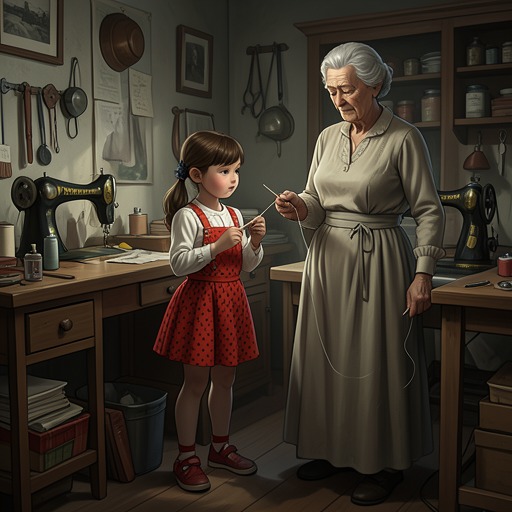
Trixie launches the Mustang Prairie sewing and knitting classes
It Must Be Love: A Mustang Prairie RomanceTrixie launches the Mustang Prairie sewing and knitting classes as the practical beginning of a broader community enterprise. The classes transform her private interest in clothing and needlework into a public resource, giving her a way to test her skills, build relationships, support local projects, and establish herself as both an entrepreneur and a community organizer. Their importance lies not only in what participants make, but in the confidence, labor, and social connection the classes generate around her.
Origins and Municipal Approval
Trixie’s decision grows out of a long-developing ambition. For several months she had seriously considered creating her own clothing line, experimenting with possible names, sketching logo ideas, and even contacting a graphic designer. Those preparations made the dream tangible, but they also began to mock her because she had not acted. The classes become the first decisive movement from private planning to visible enterprise.
She approaches Mustang Prairie City Hall in a favorite red dress with black polka dots, strappy red heels, a sweater, and a black beaded handbag. Her immediate request is practical: she wants to start a sewing or knitting class but does not know the first administrative step. She explains that she is developing a lingerie line and lacks confidence in her technical skills, even imagining garments carrying the tag “Made in Mustang Prairie.” The proposal therefore serves two purposes at once: it helps her improve, and it gives the town a direct connection to the production of her future brand.
Eric, serving as Interim Mayor, explains that the process is straightforward. An assistant will place an announcement on the town website once Trixie chooses a class name; Trixie must pay a small room-rental fee and leave the space as she found it. That modest arrangement matters because it makes the project achievable without disguising its obligations. Trixie leaves feeling that she has taken a substantial step toward making her dreams real, while Eric’s offer of support confirms that the municipality sees her work as a legitimate local contribution rather than a private hobby.
Building the Classes Through Shared Resources
The first classes develop alongside Trixie’s growing business. She prepares simple patterns for hats, gloves, scarves, blankets, and baby items because those are the projects most participants want. Eric supplies a huge fifty-gallon plastic bin filled with yarn, allowing the class to operate without forcing Trixie to absorb all the material costs. The arrangement reveals the classes’ cooperative structure: municipal assistance provides resources, while Trixie supplies initiative, instruction, and practical knowledge.
Participation quickly broadens beyond a single demographic. The second sewing class includes little girls such as Abby and her friend Sam, older women such as Luna and Edie, and Jade, Baxter’s mother. Trixie is still improving her own knitting and crocheting abilities, yet she is already helping others discover an interest in those crafts. The exchange is reciprocal rather than purely instructional. Students bring questions and expectations that test her patience and imagination, including the playful possibility of crocheting a bikini, while their presence confirms that the class has become a shared social space.
Demand soon exceeds the original room. By the time of a later Saturday session, online registration has reached its limit, and Eric moves the group into a larger room with better lighting and more comfortable chairs. Trixie dismisses another packed class and cleans up scraps of yarn in every imaginable bulk, weight, and color. The physical work of gathering materials after everyone leaves makes the enterprise’s labor visible: the classes require preparation, procurement, teaching, supervision, and cleanup, not merely the appealing image of people crafting together.
From Craft Instruction to Civic Work
The classes expand when Eric connects them to Mustang Prairie’s Halloween costume drive. He and Trixie plan to use sewing machines and craft materials to make costumes rather than spend the entire budget purchasing a limited number of finished outfits. The project is designed to provide wings, wands, capes, tiaras, and other accessories so that children who might otherwise be left without a costume can receive a complete one.
Eric explicitly asks Trixie to find ways for local residents to do what she does. His aim is not simply to recruit free labor; he wants classes that bring the community together across generations and give people something constructive to do. Trixie initially wonders whether the request for help reflects distrust, especially because she has not lived in Mustang Prairie for long and is still sensitive to the possibility of being judged. Eric reassures her that he trusts her implicitly and praises the weekend classes because mothers have told him how much they enjoy participating alongside their children. The reassurance restores Trixie’s confidence and clarifies that the classes are already producing civic value.
The costume drive eventually takes over two large rooms reserved by Eric. The setup includes eight sewing tables to be shared later with the high school’s drama department, a semicircle of chairs for knitting and hand sewing, and long tables known as the Glitter Station near the snacks. Half the town is expected to pass through during the day to help provide a good Halloween for children with fewer resources. In this setting, Trixie’s classes become an infrastructure of mutual aid: craft knowledge is converted into garments and accessories, and local participation is converted into care.
Business Development and Labor Control
The classes also strengthen Trixie’s entrepreneurial trajectory. While teaching, she continues imagining a lingerie line built around mix-and-match garments. She develops six to ten kinds of panties, from g-strings to bikini and French-cut styles in silk, lace, and cotton, with a possible boy-cut option, alongside four bra styles and a convertible bra. A rainbow theme is intended to accommodate vibrant colors and different preferences. The educational work and the commercial work therefore remain connected: teaching improves the skills she needs for production, while the class provides a public setting in which her identity as a designer becomes credible.
Her business is already becoming more stable. She has experienced several consecutive months of profit, and Under the Skirt Online is officially open. She considers renting the adjoining space as a warehouse that could also serve as a workspace, and she begins thinking about hiring a part-time worker. Yet she treats growth cautiously. Stability matters intensely to her because her parents, although loving and consistently supportive, moved from hobby to hobby, interest to interest, and religion to religion rather than providing a settled model of obligation and responsibility. Trixie wants her enterprise to be creative without becoming financially reckless.
That caution later shapes her decision to retain direct control over production. After Jonquil Spring helps rank interviewed seamstresses, Jonquil suggests that Trixie reconsider using a manufacturer because some candidates are unsuitable. Trixie refuses to surrender control while the line is new: she wants total authority over quality until the brand is solid. She may contract with a manufacturer after the holiday, but only as a later stage of development. The classes thus belong to a broader labor process in which Trixie moves from solitary design and retail work toward organized production without abandoning standards or decision-making power.
Community Enterprise and Lasting Consequences
The classes’ effects extend beyond instruction. Trixie gains confidence in her technical abilities and in her capacity to organize other people. Eric’s belief in her, the municipal rooms, the donated yarn, the participants’ labor, and the costume drive’s shared purpose create a network that allows her to act before she feels completely prepared. Her initial uncertainty is not erased by a single success; it is answered repeatedly by evidence that people attend, register, contribute, and return.
The same network supports the later launch of Sexy Separates by Trixie. At Dylan’s bar, Sadie and the other models walk a makeshift runway in Trixie’s lingerie while several of Sadie’s and Kiki Ramirez’s songs provide the soundtrack. The class-based community work and the commercial spectacle are distinct activities, but they share the same logic of collective participation. Trixie designs and directs; friends model, perform, photograph, and celebrate; the town supplies an audience. Her line is officially launched as the show receives applause, and the achievement is presented as the culmination of sustained labor rather than a sudden miracle.
The classes also foreshadow the changing scale of Trixie’s work. Later, three seamstresses stand by the shop door as orders through the following week hang on a rack, while Trixie returns to her sketchpad to design Valentine’s Day pieces. The enterprise has moved beyond a woman alone behind a counter, though the sketchpad remains central to her creative control. In that progression, the sewing and knitting classes function as a hinge between self-doubt and professional authority, between individual craft and community production, and between a dream that exists on paper and a business that occupies rooms, employs labor, and gathers people together.