Abby Thorpe
It Must Be Love: A Mustang Prairie RomanceAbby Thorpe is Jack Thorpe’s nine-year-old daughter and Andie Thorpe’s older sister, but she is more than a child moving through the margins of adult romance. A budding designer with a sharp memory, theatrical confidence, and an instinct for emotional truth, Abby turns clothing and handmade objects into ways of understanding family history. Her relationship with Trixie Beaumont gives her a creative mentor and a trusted adult, while her conversations with Jack force him to confront both his daughters’ grief for Marissa Thorpe and his unresolved feelings for Trixie.
Identity and Introduction
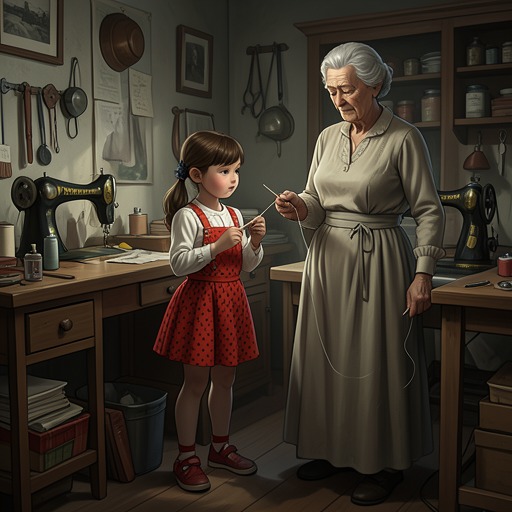
Abby first appears in Trixie’s lingerie shop, Under the Skirt, where she has been visiting almost every afternoon at around three o’clock. What begins as a child’s questions about fabric and stitching develops into a shared interest in design. Abby has worked for three weeks on an almost-complete silver-threaded shrug, and her delight when Trixie helps her finish it establishes her as an eager, capable maker rather than a passive observer. Trixie recognizes her as a fellow fashionista and budding designer, praises her appearance, and treats her curiosity seriously.
Abby’s confidence is balanced by an unusually adult awareness of language and memory. When she repeats that a long memory is all a woman needs, attributing the saying to her grandmother, the remark is comic because it comes from such a young voice, but it also signals how closely she listens to the adults around her. She can be playful, knowing, and self-possessed without losing the openness of childhood. Her emotional intelligence becomes most visible when she speaks about her mother.
Family Memory and Marissa’s Shadow
Abby is troubled by the way Mustang Prairie remembers Marissa. People constantly tell her that she resembles her mother, yet Abby feels that they do not see her as an individual; they see a ghost. Her complaint gives precise form to the burden of inherited resemblance. Marissa’s beauty and popularity dominate the town’s memory, leaving Abby to negotiate an identity defined by comparison with someone she has lost.
Trixie’s response matters because she refuses to reduce Abby to Marissa’s image. She acknowledges that Abby shares features with her mother but insists that Abby is distinctive in the way she draws people toward her. This distinction becomes part of their bond. Later, Abby finds a photograph of Marissa in the basement and asks Trixie to make her a hat like her mother’s. The request is not merely imitation: Abby wants to recreate an object connected to Marissa and to complete the work herself, even though Jack has forbidden her from coming to the shop. Trixie agrees to help while telling her to clear the plan with Jack, preserving Abby’s agency without encouraging her to disregard a parental boundary.
The resulting hat becomes a material bridge between past and present. Trixie helps Abby and Andie make matching colorful winter hats with pom-poms, planning a photograph modeled on an older picture of Marissa and her best friend. When Trixie studies the reference photograph and leads the girls to the porch for a new picture, the act does not erase Marissa; it places the sisters inside a continuing family story. Abby can remember her mother through a new experience rather than through the town’s impersonal repetition of her beauty.
Creativity, Clothing, and Agency
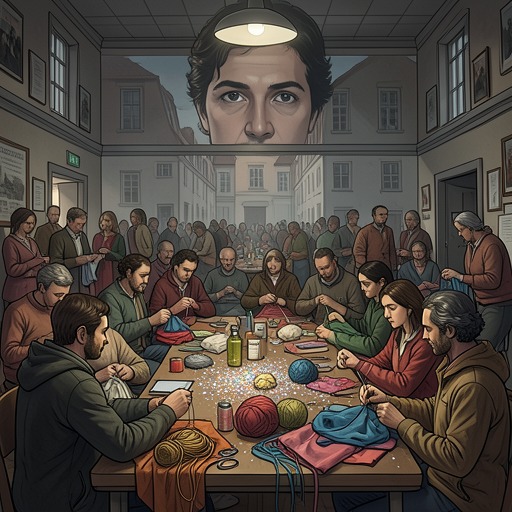
Abby’s creative life is expressed through practical work. She learns to tie off the shrug so that it curves, gathers leftover yarn for the hats’ pom-poms, and proudly evaluates her progress. When Trixie gives her a complete knitting kit, Abby reacts with unrestrained joy, jumping up and down and immediately explaining what she intends to make with the yarn and needles. The gift recognizes a skill that already exists; it does not simply entertain her. Trixie’s message that Abby’s skills should not lapse confirms that their relationship is organized around encouragement and practice.
Clothing also lets Abby experiment with social roles. At the town’s costume gathering, she and Andie volunteer to help Trixie run the glitter station. Abby confidently explains the process as glue, glitter, and shaking, adopting the brisk authority of someone who knows what she is doing. She also greets Kiki Ramirez with delighted theatricality, comparing her costume to a hot Madonna and asking whether she is a party girl. Her comments show how readily she reads appearance as performance and how comfortably she participates in that performance herself.
Her influence extends beyond her own wardrobe. Abby helps shape the atmosphere around Jonquil Spring by proposing a Twilight movie marathon and sleepover. She presents the plan with elaborate persuasion, promising that the girls will be quiet and that Jack can either watch television or visit Trixie. Her apparent innocence conceals a clear understanding of household dynamics: she knows Jack is a pushover where his daughters are concerned, and she uses affection, persistence, and carefully staged pleading to achieve what she wants.
Relationship with Jack Thorpe
Abby’s relationship with Jack is loving but strained during the period when she spends time at Trixie’s shop and refuses to speak to him normally. Jack repeatedly tells his oldest daughter that she cannot ignore him forever and objects to a lingerie shop as a place for a girl her age to spend time. Abby responds by pushing away from the table, gathering her books, and stomping upstairs. Her silence is not simple disobedience; it is her chosen way of registering anger when Jack tries to control a relationship that has become important to her.
Jack recognizes that Abby’s withdrawal resembles Marissa’s emotional distance, which makes the conflict more painful. He sees that his daughter is miserable and understands that he has the power to alter the situation, even if he does not yet know how. Abby therefore becomes a point at which Jack’s habits as a grieving widower and single father collide with the changing needs of an older child. His protective impulse keeps him from seeing immediately that Trixie’s shop offers Abby mentorship, confidence, and a way to work through memories of her mother.
Abby eventually becomes one of the clearest advocates for Jack’s emotional honesty. At Christmas, she tells him that he should apologize to Trixie for hurting her feelings. She then reveals that she and Andie know he likes Trixie because he holds Trixie’s hand when he thinks no one is watching. Abby’s observation punctures Jack’s attempt to keep his intimacy hidden, but she delivers it without cruelty. Her intervention is practical and affectionate: she believes an apology can repair what adult fear has damaged.
She also explains why Trixie matters to the children. Abby says that Trixie makes them pretty things, talks to them as though they are big kids rather than babies, and has given her good memories of Marissa. This last point changes the meaning of Trixie’s presence in the household. Trixie is not replacing Marissa in Abby’s imagination; she is helping Abby preserve a happier, more active memory of her mother. Abby’s final instruction to Jack to go to Trixie makes her an emotional catalyst within the family.
Relationship with Trixie Beaumont
Trixie treats Abby as a person with taste, skill, and judgment. She teaches rather than patronizes, offering technical guidance about knitting and allowing Abby to take ownership of her projects. She compliments Abby’s individuality, helps her make the hat connected to Marissa, takes photographs of the sisters, and gives her a knitting kit. These actions create continuity between Trixie’s professional world and Abby’s emerging creative identity.
Abby reciprocates with unusual trust. She brings Trixie the photograph, confides her wish for a hat like Marissa’s, asks whether Jack hurt Trixie’s feelings, and notices the tension between the adults. Her questions are not decorative child dialogue; they place her at the center of the novel’s emotional negotiations. She understands that Trixie has been hurt, that Jack is withholding something, and that the family’s future depends partly on whether those injuries are acknowledged.
Trixie’s care for Abby also changes the texture of the Thorpe household. During Thanksgiving, Abby is among the children and family members eager to share traditions with Jonquil, while Trixie delays her arrival until shortly before the meal. Abby’s connection to Trixie remains active even when the adults are avoiding one another. The child’s loyalty thus outlasts the temporary rhythm of adult withdrawal and helps keep Trixie connected to the family.
Narrative Role and Significance
Abby functions as a truth-teller inside a family organized around grief, avoidance, and incomplete explanations. She does not possess adult power, but she notices what adults conceal: Jack’s hand-holding, Trixie’s hurt, the town’s habit of treating her as Marissa’s ghost, and the emotional value of shared photographs and handmade clothes. Her directness repeatedly brings hidden relationships into the open.
Her creativity provides the novel with a language of repair. A shrug, a knitting kit, a pair of matching hats, and a photograph all convert memory into something that can be handled, altered, and shared. Through these objects, Abby moves from being compared with Marissa to actively interpreting Marissa’s legacy. Trixie’s presence becomes part of that interpretation because she helps Abby remember without surrendering her own identity.
Abby’s importance finally lies in the way she joins generations and emotional timelines. She carries Marissa’s memory, lives under Jack’s protection, learns from Trixie, and welcomes Jonquil into a more ordinary family life. Her interventions do not resolve every adult conflict by themselves, but they make denial harder to sustain. Abby sees that affection is already present, recognizes that apology is necessary, and uses the creative practices available to her to turn family pain into connection. In that sense, she is both a child shaped by the Thorpe family’s history and one of the forces capable of giving that history a less haunted future.