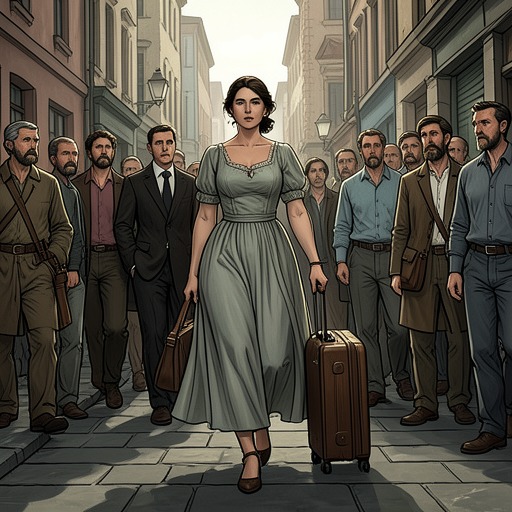
Divorce and post-divorce independence
It Must Be Love: A Mustang Prairie RomanceDivorce and post-divorce independence is the central condition of Trixie Beaumont’s reconstruction. The end of her marriage does not merely remove a husband; it clears the social and emotional space in which she can decide what her work, home, body, and future will mean. With the marriage’s financial settlement and married name as the only benefits she intends to retain, Trixie returns to Mustang Prairie determined to make her own choices, even when independence leaves her without the support she once expected from either family or romance.
Marriage, Separation, and the Refusal to Repeat
Trixie describes the marriage as bad and short-lived, ending with a new start in Mustang Prairie. She cannot explain the circumstances freely because she signed an agreement and cashed the check, but the arrangement has left her with a financial settlement rather than an ongoing emotional or social obligation. She rejects the idea that the marriage should continue to define her identity: there is no domineering husband to direct her, no prominent family to pressure her into performing a particular role, and no parental authority nearby demanding explanations. Her married name and the large check are all she takes from the relationship, and she regards that limited inheritance as sufficient.
Her account of the marriage reveals how thoroughly she once subordinated her own ambitions. Preston, her ex-husband, was sophisticated, charming, handsome, and wealthy; she was already dating him when she learned that he was the governor’s son. He persuaded her to pause design school so that she could help establish his career. Trixie then became the carefully presented “little lady,” hosting parties and dinners for his employers, business associates, and other influential guests, although she hated the work. The divorce forces her to confront the fact that she had placed her life on hold for a role designed around his advancement, without finding a satisfying explanation for why she had accepted it.
The conclusion she draws is practical rather than romantic. Even if she were to fall in love again, she would not allow a partner’s life to become more important than her own. This is not a rejection of love itself; it is a boundary against the self-erasure that had accompanied her first marriage. Her post-divorce independence therefore rests on a promise not to abandon her ambitions a second time.
From Deferred Dream to Business Plan
For months, Trixie has considered creating a clothing line, testing possible names, sketching logo ideas, and hiring a graphic designer to develop them. The completed logos become reminders of her inaction, but the hesitation ends when she decides to act. She begins with the established lingerie shop Under the Skirt, whose steady profits and official online opening provide a financial base from which the larger venture can grow. Her independence is consequently built through accumulated commercial work rather than through a single dramatic gesture.
Her first line takes shape as Sexy Separates by Trixie. She envisions six to ten kinds of panties, ranging from g-strings and bikinis to French cuts in silk, lace, and cotton, with a possible boy-cut option. A rainbow theme will accommodate vibrant colors, while four bra styles, including a convertible bra, will allow customers to mix and match. The concept responds to different preferences rather than imposing the matching sets Trixie herself enjoys: Sadie’s habit of combining different colors becomes an everyday example of the market she wants to serve. Lingerie is thus both a product and a language of choice, allowing women to construct combinations according to their own tastes.
Trixie also treats the venture as a responsibility requiring stability. Her parents, dyed-in-the-wool hippies who farmed, traveled, and moved from one interest or belief to another, provided materially but were not emotionally present for her. They are away in a new RV somewhere in South America, nine months into an open-ended tour that might last until they tire of seeing the world. Their absence leaves Trixie without the parental reassurance she sometimes wishes for, but it also means that no one is present to redirect her. She wants a dependable livelihood precisely because her childhood offered provision without much consistency.
Control, Labor, and Scaling the Enterprise
Trixie’s independence becomes visible in the amount of work she personally absorbs. She designs, folds panties, arranges displays, steams merchandise, sketches new pieces, handles customers, rings up sales, and monitors the store’s finances. When an injured foot leaves her exhausted and in pain, she still makes her way to the shop and manages the register, hoping that a part-time worker will soon make the workload sustainable. The digital register, with a battery for power outages, suits her practical concern with continuity and her admission that mathematics is not her strength.
As the line develops, she begins to create a separate working area by opening a space next door. A new contractor, Derek Hayes, cannot start until Black Friday, so Trixie hangs a curtain over the opening while she prepares the business. The proposed expansion could become both a warehouse and a workspace, and the prospect of hiring a part-time employee appears in her business plan sooner than expected. The physical growth of the premises mirrors the psychological shift from solitary survival to deliberate enterprise.
Her management style is defined by quality control. When Jonquil Spring suggests reconsidering the use of seamstresses and moving toward a manufacturer, Trixie refuses to surrender total oversight while the line is still new. She will consider outside manufacturing only after the brand is solid. The decision places control of materials and production above immediate scale, showing that post-divorce independence includes the right to determine how the work is made, not merely the right to own its profits. By the time the seamstresses leave orders hanging on the rack for the following week, the business has moved beyond a private fantasy into an organized operation.
Public Launch and Emotional Consequences
The formal launch of the line takes place in Dylan’s bar, transformed into a makeshift runway divided by gauzy fabric, music, lighting, and the models’ movement. Sadie and other models present Trixie’s designs, including a teal boy-short and Basque combination, a white cheeky set with a matching bra and silky duster, and cherry-red stilettos that catch the light. Several of Sadie and Kiki Ramirez’s songs provide the soundtrack. The setting turns the bar into a playful bedroom-like space, giving Trixie’s work a public identity that is sensual, colorful, and deliberately fun.
The show confirms the commercial and creative possibility she has been building toward. Cameras flash, the audience applauds, and Trixie joins the models on the runway while congratulations pass from hand to hand. She experiences the line’s official launch as a success: the dream has become a visible brand, supported by models, music, staging, and a community willing to celebrate it. Yet the triumph contains an absence. She has achieved the milestone without anyone who can fully share its meaning with her, so independence feels both satisfying and lonely.
That loneliness remains connected to her unresolved relationship with Jack Thorpe. After their sexual encounter, Jack tells her that he cannot make promises because his life is full and chaotic. Trixie receives the warning without an argument, then turns toward the house and greets his daughters. Her response illustrates the discipline of her new life: desire cannot be allowed to dictate her expectations, and emotional uncertainty cannot be permitted to dissolve the boundaries she has rebuilt. Later, when she avoids Jack at Thanksgiving and he recognizes that she has waited until the last possible moment to arrive, her withdrawal functions as an attempt to protect the independence she has worked to secure.
Community, Recognition, and Continuing Autonomy
Although Trixie is on her own, her independence does not mean isolation from all human connection. Mustang Prairie supplies a working community in which Sadie models her designs, Kiki Ramirez contributes music, Jonquil assists with interviews and ranking seamstresses, and local friends gather around the launch. The enterprise depends on cooperation, but Trixie remains the person who sets its standards and decides its direction. Community becomes a resource without becoming another structure that claims ownership of her choices.
Her ties to Jack’s daughters complicate that balance. Abby Thorpe has spent much of a month refusing to speak to Jack because she considers the lingerie shop an inappropriate place for a girl her age, while Jack recognizes that his daughter is miserable and that he could repair the situation. Later, Andie Thorpe tells Jack that he should apologize to Trixie and says that both girls know he likes her. These interventions show that Trixie’s independence is being observed and negotiated within a wider family network, even when she does not directly seek that role. Jack’s mother also tells him that Trixie deserves the truth about the tension, anger, and resentment in his marriage to Marissa Thorpe, warning that competing with a ghost is unfair. Trixie’s post-divorce life therefore develops beside another household’s unresolved grief, without requiring her to become its cure.
The business continues after the launch. A burst of creativity leads Trixie to sketch a black-and-pink bustier for Valentine’s Day, making the imaginative part of ownership energizing enough to offset its mundane routines. Her growth is not presented as a completed escape but as an ongoing practice: she plans, produces, tests, hires, markets, and protects her standards while refusing to put her own life on hold again. Divorce becomes the boundary between the woman who performed someone else’s future and the woman who designs her own.