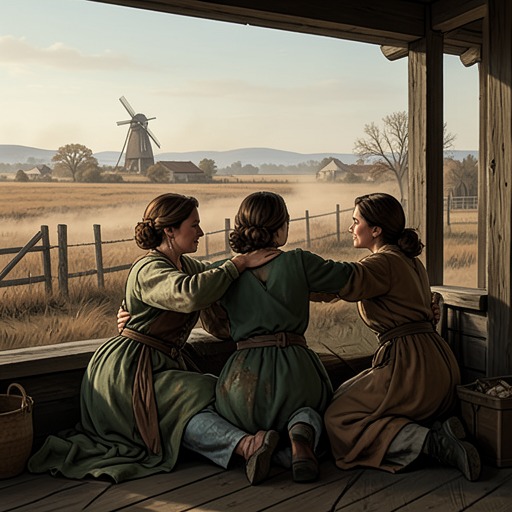
Found family
It Must Be Love: A Mustang Prairie RomanceFound family is one of the central forms of belonging in the novel: it describes the relationships Trixie Beaumont builds beyond her failed marriage and unstable childhood home, and it becomes visible through practical care, shared work, recovered memories, and mutual recognition. Rather than replacing biological family, this network enlarges it, allowing Trixie to become a trusted presence in the Thorpe household while giving her own life a durable sense of home.
Definition and Emotional Background
Trixie’s need for a found family grows out of an upbringing in which her parents provided for her but offered little stability. They moved from hobby to hobby, interest to interest, and even from one religion to another, leaving Trixie with affection but without the dependable structure she wanted. Her marriage to Preston intensified that contrast: she had performed a polished, “perfect” couplehood through shopping, beauty routines, and constant self-presentation, then abandoned that false ideal to make a life that was not perfect but was right for her.
Her return to Mustang Prairie initially leaves her feeling like a visitor rather than a resident. That changes through repeated acts of participation. At the Mustang Prairie Community Center, she organizes people who bring costume-making skills, supplies, food, and drinks, while she manages stations, materials, and completed costumes. The work makes the town’s affection tangible, but its deeper consequence is personal: amid the shared labor, Trixie realizes that she is home again rather than merely passing through.
Trixie’s Expanding Community
The found family around Trixie is not formed by a single declaration. It accumulates through friendships and ordinary obligations. Jonquil Spring, Sadie, Dylan, Ty, Shirl, and Luna become part of a circle that gives Trixie companionship while she rebuilds her independence. During the winter holiday season, she recognizes these people as more than friends: they have become a kind of family, one stronger and more sustaining than the family she had known before. Gifts purchased for Jonquil and the others express that change through concrete acts of attention, including a holiday dress for Jonquil and a crystal-encrusted microphone for Sadie.
Trixie’s professional life reinforces the same communal structure. Her lingerie business begins as a private ambition, with tentative names, logo sketches, and contact with a graphic designer, but develops into a project requiring collaboration and trust. She conceives Sexy Separates by Trixie as a rainbow-themed line of mix-and-match garments, imagines multiple styles of panties and bras, and insists on controlling quality while the brand is new. When Jonquil helps rank prospective seamstresses in the workshop, Trixie treats her contribution as part of the work rather than as a child’s imitation of adulthood. The business therefore becomes both livelihood and shared household activity.
At the line’s launch in Dylan’s bar, community support turns Trixie’s private dream into a public achievement. Sadie and the other models wear Trixie’s designs on a makeshift runway, with Sadie’s music and Kiki Ramirez’s songs creating the atmosphere. Trixie watches the teal boy shorts, matching Basque, white bra, cheeky bottoms, silky duster, and cherry-red stilettos move beneath the lights, then joins the models in congratulations after the applause. The show succeeds, but the triumph contains a loneliness: Trixie has launched her line without having one particular person with whom to share the achievement. Her wider found family makes the success possible, even as Jack Thorpe’s absence reveals the limits of communal belonging when romantic desire remains unresolved.
Kinship with the Thorpe Household
The Thorpe household gives found family its most intimate and complicated form. Trixie’s connection with Abby Thorpe and Andie Thorpe develops through care that respects their intelligence rather than treating them as helpless children. When Abby discovers a photograph of her mother in the basement and wants a hat like Marissa Thorpe’s, she turns to Trixie because Jack Thorpe has forbidden her from spending time at the lingerie shop. Trixie agrees to help her make the hat, but first tells her to clear the project with her father. The task becomes more than craft instruction: by helping Abby reproduce an object associated with Marissa, Trixie participates in preserving a family memory without trying to displace the woman whose image remains central to it.
That memory work becomes visible when Trixie photographs Abby and Andie wearing the finished hat. As she searches for a suitable setting, she notices Marissa’s face in the photograph and then collides with Jack Thorpe on the porch. The scene joins domestic continuity to romantic tension: Trixie is helping the girls create a new memory while standing inside the visual and emotional space of their mother’s absence. Abby later tells Jack that Trixie makes the girls pretty things, speaks to them as though they are older children rather than babies, and has given her good memories of Marissa. Trixie’s place in the household is therefore defined not by replacing Marissa but by helping the girls remember her with less pain and more tenderness.
Jack’s resistance shows that found family also depends on negotiated boundaries. After Abby spends nearly a month pretending that he does not exist, Jack tells her that she cannot ignore him forever and insists that a shop filled with sexy lingerie is no place for a girl her age. Abby responds by pushing away from the table, gathering her books, and stomping upstairs. Jack recognizes that his daughter is miserable and that he has the power to change the situation, yet his protective impulse risks cutting her off from one of the relationships that comforts her. Trixie’s involvement consequently brings the Thorpe family’s unresolved grief and parental anxiety into the open rather than offering an uncomplicated domestic refuge.
The relationship also exposes the romantic history beneath the household’s affection. Jack’s mother observes that Trixie once stayed near him while he was with Marissa, then withdrew like a ghost when the couple’s tension became impossible to miss. She urges Jack to tell Trixie the truth, warning that competing with a dead woman is an especially difficult position. Jack’s marriage to Marissa remains a ghostly presence in his decisions, but the Thorpe children respond to Trixie in the present tense. At Thanksgiving, the full house includes Jack’s parents, Sadie, Dylan, Luna, Mr. Scanlan, Jonquil Spring, Abby, and Andie; Trixie arrives only ten minutes before the meal because she is avoiding Jack, yet her connection to the household is already strong enough that Jonquil is welcomed into its traditions and the girls continue moving between the two homes.
The clearest recognition comes through Andie’s advice to her father. She tells Jack that he should apologize to Trixie for hurting her feelings, then explains that she and Abby know he likes her because he holds her hand when he thinks no one is watching. The children’s awareness turns private adult tension into family knowledge, while their affection gives Trixie a legitimate place in their emotional world. Found family here is not a sentimental substitute for blood ties; it is a structure built through permission, memory, craft, meals, apology, and the children’s insistence that the adults acknowledge what their actions already reveal.
Jonquil Spring and Chosen Sisterhood
Found family also gives Trixie Beaumont the sisterhood she had wanted but never possessed. Jonquil Spring arrives from the commune with a letter left for her mother, practical skills in cleaning, cooking, and computers, and an uncertainty about whether she can remain with Trixie without becoming a burden. Trixie rejects that transactional framework. She tells Jonquil that she does not need to earn her keep, though she will have to help, because they are sisters. The claim is both generous and demanding: belonging includes care without a price, but it also includes participation in the shared life being built.
Jonquil does not accept the declaration without testing its meaning. She asks whether Trixie wanted a sister even while living on the commune, and Trixie explains that she had imagined someone who would share secrets and clothes, discuss anything without embarrassment, mock her love of lace while still supporting it, and understand the loneliness of wanting a different life. The confession gives their new bond a history: Trixie is not merely offering shelter to a gifted eleven-year-old, but recognizing in Jonquil the companion she had long wished for. Jonquil’s practical competence soon becomes part of that relationship’s everyday reality. She helps evaluate seamstresses for the new lingerie line and questions whether Trixie should use a manufacturer; Trixie listens seriously but keeps control of production because the young brand’s quality still depends on her direct supervision. Their sisterhood therefore joins emotional intimacy to shared responsibility, allowing Jonquil to belong without erasing her usefulness or independence.
Found Family as Memory and Repair
The network Trixie enters also repairs, rather than conceals, the damage carried by older relationships. The Thorpe children’s affection is inseparable from Marissa Thorpe’s absence, and objects become bridges between generations. Abby’s photograph and handmade hat connect Trixie’s craft to her mother’s image, while the girls’ later testimony confirms that Trixie has helped them retain positive memories of Marissa. Jack Thorpe’s gift of the original Blue Skies painting similarly demonstrates how objects can carry love across a strained relationship: Trixie receives the work with tears because it is her favorite painting, even as she understands that the gift may make it harder to overcome her feelings for him. Found family thus grows through material tokens that preserve memory while creating new emotional associations.
This process is not limited to the Thorpe household. Trixie’s work transforms community participation into a form of mutual recognition. The costume project at the Mustang Prairie Community Center gives residents distinct roles as designers, makers, donors, cooks, and organizers; the lingerie launch gives Sadie, Dylan, Ty, and Kiki Ramirez ways to contribute their labor and artistic presence to Trixie’s achievement. Such scenes make belonging visible as coordinated action rather than abstract affection. Trixie is accepted because she contributes, but the contribution is reciprocal: the community supplies time, performance, music, encouragement, and a place in which her private ambitions can become shared occasions.
Boundaries, Conflict, and Durable Belonging
Found family does not eliminate conflict. Jack’s attempt to restrict Abby’s access to Trixie reveals how biological parents may defend boundaries even when those boundaries intensify a child’s isolation. Trixie responds cautiously, asking Abby to obtain her father’s permission before finishing Marissa’s hat, and this restraint allows her to support the girl without encouraging open defiance. Jack’s later recognition that the girls trust Trixie, combined with Andie’s demand that he apologize, shows the household gradually adjusting to a relationship it can no longer treat as peripheral.
Trixie’s own avoidance of Jack creates another boundary. During Thanksgiving she arrives only shortly before the meal and keeps away from him afterward, even though Jonquil remains connected to his daughters and is welcomed into the family gathering. This separation distinguishes romantic reconciliation from communal belonging: Trixie can be part of a network that includes Jack while refusing to surrender her emotional judgment to him. By the holiday season, she can acknowledge that Jonquil, Sadie, Dylan, Ty, Shirl, and Luna form a family around her even while Jack remains a source of pain and uncertainty.
The concept’s lasting importance lies in that distinction. Found family gives Trixie a home that is chosen through repeated acts of attention, but it does not require her to declare every relationship safe, permanent, or romantically fulfilled. It accommodates the Thorpe children’s grief, Jonquil’s need for a sister, the community’s shared labor, and Trixie’s independent business at the same time. Her new lingerie line and her relationship with Jonquil become the two bright spots she can name after her marriage and relationship with Jack break down. The resulting family is therefore not a replacement for everything lost; it is a living structure of care that lets Trixie remain connected while becoming more fully self-directed.