Jack Thorpe–Andie Thorpe relationship
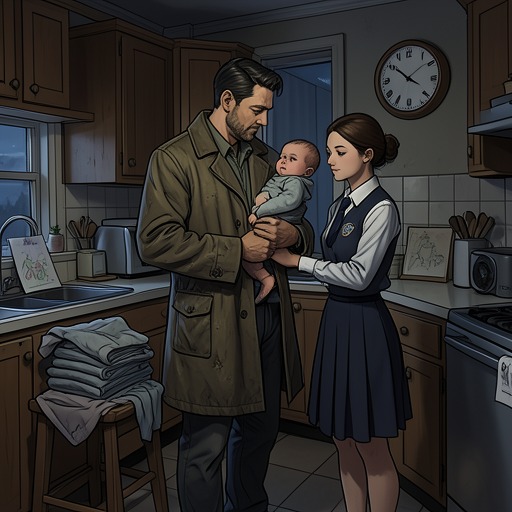
It Must Be Love: A Mustang Prairie RomanceThe Jack Thorpe–Andie Thorpe relationship is one of the most secure and restorative bonds in the story. Jack’s love for his youngest daughter is expressed through ordinary acts—finding her, feeding her, carrying her through a grocery store, cooking with her, and answering her repeated declarations of love—but those routines carry the weight of a widowed father trying to preserve family life after Marissa Thorpe’s death. Andie, in turn, offers Jack uncomplicated affection, comic energy, and a surprisingly clear understanding of the emotional changes taking place around her.
Identity and Family Context
Andie Thorpe is Jack Thorpe’s younger daughter and grows up within a household marked by the death of Marissa Thorpe. Jack sees Marissa in Andie’s golden curls, hazel eyes, and familiar expressions, so the child is both herself and a living reminder of the woman he lost. That resemblance intensifies his protectiveness: after bringing Andie and Abby Thorpe home from the hospital, he has carried a persistent fear of losing either girl, a fear made worse by Marissa’s death.
The relationship nevertheless does not reduce Andie to a memorial for her mother. Jack notices her as a distinct person: quiet and observant, yet full of zest for life. Her presence makes him feel young and vibrant when he otherwise feels worn out, old, and tired. The contrast is central to their bond. Andie carries traces of family memory, but her babbling, giggles, stubborn wishes, and energetic curiosity continually pull Jack back into the present and remind him that his daughters—not grief alone—are his family and his responsibility.
Everyday Care and Emotional Security
When Abby goes missing, Andie enters the search with Dylan, carrying her Little Buzzers uniform because she is not yet old enough for the Bees. She asks Jack whether Abby has been found, and he reassures her that Ty and Dylan will locate her. His confidence is partly protective performance—he is deeply afraid that Abby may be hurt—but Andie receives it as the assurance of a father who can still make the world feel manageable. When she accidentally reveals that Abby often sneaks away to Trixie Beaumont’s shop, Jack takes her hand and lets her lead him there, even as a bad feeling settles in his stomach.
At home, Jack and Andie share rituals that make affection tangible. While preparing tacos, she promises to arrange the ingredients as Abby taught her, and when she worries about whether he will make real salsa, Jack assures her that he will always make it for her. Their exchange ends with the familiar family refrain, “To the stars,” answered by Andie’s delighted “And beyond!” The words function as a private affirmation of permanence: Jack promises love through repetition, and Andie answers with enthusiasm that turns the promise into a shared game.
Their grocery trip extends the same pattern. Andie protests that she wants to remain small forever, and Jack jokes that he wishes for that too so he could carry her in his pocket. Her giggles wake him emotionally, interrupting his anxious thoughts about adolescence, dating, sex, and the future. He is not ready for the stages of life that will make his daughters less dependent on him, but with Andie he can still inhabit the uncomplicated intimacy of carrying, feeding, teasing, and being needed.
Andie Within the Wider Family Circle
Andie’s relationship with Jack is also a channel through which the family absorbs Trixie. At Trixie’s shop, Andie arrives with cookies that she and Jack made. Jack watches Trixie lift the child onto her lap, taste the cookie, and playfully assess its orange flavor and sprinkles before joking that the recipe should be kept from Shirl. Andie then hugs Trixie and returns to the other children, while Jack recognizes that Trixie has won both girls over. The scene makes visible a developing domestic alliance: Andie’s trust in Trixie is not abstract approval but a bodily, cheerful ease around her.
Andie also participates in the handmade memories Trixie creates for the sisters. While Abby finishes a colorful winter hat modeled on a photograph of Marissa and her best friend, Trixie gives Andie the task of gathering leftover yarn for the pom-poms. The younger girl runs in with the materials, contributing to a recreation of family history rather than merely watching it. Trixie then photographs the sisters together, placing Andie inside a new image that echoes the older picture of Marissa. For Jack, these objects and photographs allow the family to remember Marissa without leaving the children trapped in the past.
At Thanksgiving, Andie comes early with Abby and Jonquil Spring, eager to learn the traditions surrounding the meal. Jack’s parents, Sadie, Dylan, Luna, and Mr. Scanlan join the household, creating the full house Jack has not experienced since the girls were babies. Andie’s presence belongs to this larger reconstruction of family: she is not only Jack’s child but one of the people whose excitement helps turn a crowded holiday into a functioning home. The gathering’s emotional significance lies in its ordinary abundance—food, stories, grandparents, children, and shared work—after years in which Jack’s household has been defined by absence.
Recognition and Influence
Andie is more perceptive than Jack initially assumes. During Christmas, she tells him that apologizing is what he must do when he has hurt Trixie’s feelings. She explains that she and Abby know he likes Trixie because he holds Trixie’s hand when he thinks no one can see them. Jack’s attempt to keep the relationship separate from the girls’ awareness has failed, not because the children have been given an explicit explanation, but because affection is legible in gesture.
Her judgment is grounded in direct experience. Andie says that she and Abby like Trixie because Trixie makes them pretty things, speaks to them as though they are big children rather than babies, and gives them good memories of Marissa. This last point is especially important to Jack. Trixie has not displaced Marissa; through the hats and photographs, she has helped the girls preserve a joyful connection to their mother. Andie therefore becomes an emotional mediator between Jack’s guarded grief and Trixie’s place in the family. Her instruction—“Go get her Daddy”—converts a child’s observation into a decisive moral push toward apology and emotional honesty.
Narrative Significance
The relationship gives Jack’s character a measure beyond romance and artistic identity. He is an artist and a widower, but with Andie he is also the father who makes salsa, shops for vegetables, cooks dinner, carries a small child’s worries, and answers a ritual phrase every night. His care is not grand or heroic; it is repetitive, practical, and emotionally attentive. That repetition supplies the family’s stability while Jack struggles with the damage left by his marriage to Marissa and with his fear of loving again.
Andie’s role is equally active. Her exuberance relieves Jack’s exhaustion, her trust helps normalize Trixie’s presence, her participation in the hat-making project links the living family to Marissa’s image, and her Christmas advice exposes the affection Jack tries to conceal. The bond therefore develops in two directions: Jack gives Andie safety and continuity, while Andie gives Jack evidence that the family can grow without betraying its dead. Through their relationship, grief becomes compatible with play, memory with renewal, and fatherhood with the possibility of a new emotional home.