Marissa's Halloween hat
It Must Be Love: A Mustang Prairie RomanceMarissa's Halloween hat is a recovered keepsake that turns an ordinary article of clothing into a family archive. Jack Thorpe won the hat for Marissa at the Halloween Festival shortly after they met, and she wore the supposedly ugly item throughout the winter. Years later, its familiar fabric carries the history of their courtship, marriage, and loss into Abby Thorpe's relationship with Trixie Beaumont. Through the hat, memory passes from Marissa to Abby, and from Abby to the woman increasingly becoming part of the family's emotional life.
Origin and Material Memory
The hat first belongs to Jack Thorpe and Marissa Thorpe's early romance. Jack remembers winning it for Marissa at the Halloween Festival soon after they met, and he recalls that she wore the “ugly thing” for the entire winter. The dismissive description is affectionate rather than contemptuous: its awkwardness is precisely what makes the object intimate, because Marissa chose to keep wearing a small, impractical token of the moment when their relationship began.
The hat later reappears as recognizable fabric in Abby's hands. When Jack sees it, he freezes because the object is no longer merely a remnant in the basement; it is a direct material link to Marissa. Abby has found a photograph there and wants to make a hat just like her mother's, but she is unsure she can finish it alone. The photograph supplies the image, while the old hat supplies the tactile pattern and emotional authority. Together, they let Abby approach her mother's memory through making rather than through passive mourning.
Abby's Reconstruction of Her Mother
Abby brings the hat to Trixie Beaumont's attention while working on her own version. She explains that Jack will not let her come to the store, so she needs help completing the project. Trixie does not patronize her. She promises that they will figure it out, while first insisting that Abby clear the plan with her father. That practical boundary matters: the hat is not used to bypass Jack's parental authority, but it becomes a reason for Abby and Trixie to build trust within it.
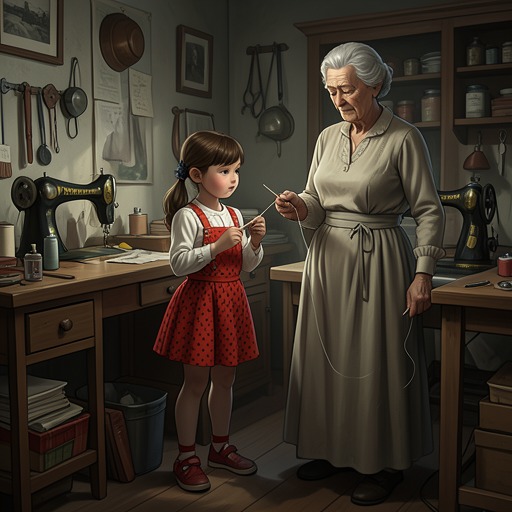
Trixie adjusts Abby's wrist, discusses the design, and later teaches her how circular needles produce the hat's shape. When Abby asks for reassurance, Trixie offers a promise and seals it with a pinky swear, pledging to help finish this hat before beginning another. Abby completes the line, packs the needles and yarn into a canvas sack, and plans to ask Jack whether Trixie may return the following week. The hat therefore changes from a relic associated with Marissa into an active lesson in skill, patience, and continuity.
When the hat is finished, Abby pulls it down over her head and asks what Trixie thinks. Trixie praises her work, adds pom-poms, and prepares to photograph Abby and Andie Thorpe on the porch. In searching for the right background, she notices Marissa's face in the photograph and the striped setting behind the girls. The composition places mother, daughters, and the new image-maker within one visual field. The hat does not replace Marissa's picture; it stands beside it, allowing Abby to resemble her mother without pretending that the loss has disappeared.
Trixie and the Thorpe Family
The hat gives Trixie a form of access that romance alone cannot provide. Jack finds her with Abby and notices how carefully she is helping the child, even as their own attraction and unresolved hurt make the room uncomfortable. Trixie has been avoiding Jack, yet she remains present for Abby's work. The object thus holds two relationships in tension: Jack and Trixie's difficult intimacy, and Trixie and Abby's increasingly secure bond.
Trixie's gifts and instruction make the hat part of a wider exchange of handmade objects. She gives Abby a complete knitting kit through Sadie, including yarn and needles, after Jack has worried that his daughter should not spend time in a lingerie shop. Abby responds with extraordinary enthusiasm, shouting her thanks and immediately imagining what she will make. Trixie also gives Andie lace for a princess veil. In this household, craft is not ornamental. It is a language through which Trixie demonstrates care, while the children answer with trust and participation.
Abby later tells Jack that she and Andie like Trixie because Trixie makes them pretty things and speaks to them as capable people rather than babies. Most importantly, Abby says Trixie has given her “really good memories of Mom.” The hat is central to that claim: the finished object preserves the resemblance to Marissa while placing the memory inside a new shared experience. Jack remembers Abby's happiness when Trixie took the photograph and recalls that she often sees it beside a similar photograph of Marissa wearing the hat. The object consequently helps Trixie enter, without erasing, the family's existing memory of Marissa.
Emotional and Narrative Significance
Marissa's Halloween hat demonstrates how an apparently trivial object can outlast the circumstances that produced it. It begins as a flirtatious prize, becomes a piece of clothing worn through a season of early love, then survives as a basement-found artifact and a model for Abby's handmade project. Each stage adds rather than cancels meaning. The hat's material continuity lets Abby inherit a memory that is both visual and practical: she can see her mother in it, and she can learn to reproduce its form with her own hands.
The object also mediates the difference between remembering Marissa and remaining trapped in the past. Jack's recollection is marked by grief and by the complicated history of his marriage, while Abby's response is creative and forward-looking. Trixie helps transform the recovered hat from evidence of absence into an occasion for competence, affection, and family connection. The result is not a replacement for Marissa but a layered memory in which Marissa's presence remains visible while Abby's own identity takes shape.
That pattern echoes the book's broader use of gifts, photographs, clothing, and art to communicate what characters struggle to say directly. Trixie's original Blue Skies painting from Jack becomes a powerful declaration of feeling, while the antique painting kit Jack receives from his parents marks their recognition of his artistic self. Against those more conspicuous gifts, Marissa's Halloween hat is humble and handmade, but its emotional reach is unusually intimate. It links a first meeting, a lost mother, a daughter's imitation, a teacher's promise, and a family's gradual acceptance of Trixie. Its decisive power comes from making memory touchable—and from allowing that memory to generate a future rather than merely preserve a past.