Mustang Prairie
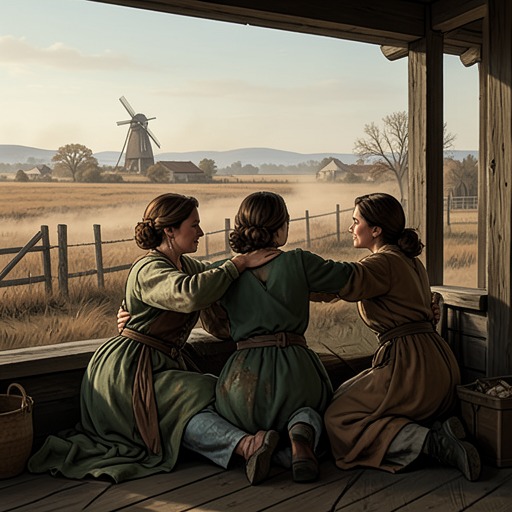
It Must Be Love: A Mustang Prairie RomanceMustang Prairie is the small town at the center of the book’s emotional and creative geography: a place remembered as idyllic, revisited as a business opportunity, and finally reclaimed as home. Its decisive significance lies in the way it turns return into transformation. For Jack Thorpe, the town offers his daughters the safe childhood he once knew, even while initially failing to restore his artistic purpose. For Trixie Beaumont, it provides the distance, community, and practical setting in which post-divorce independence becomes a viable life. Through shops, streets, family homes, celebrations, classes, and informal gatherings, Mustang Prairie repeatedly makes belonging visible as something built through participation rather than inherited through memory.
Identity and Setting
Mustang Prairie is presented as a peaceful, bucolic town whose tree-lined streets and carefully maintained lawns express a particular kind of small-town order. Homeowners tend their own yards or hire teenagers rather than professional landscapers, and new neighbors may be welcomed with homemade casseroles whose ingredients are sometimes mysterious. The town’s scale encourages recognition: residents notice arrivals, remember loyalties, and treat local accomplishments as shared events rather than private achievements.
The town also carries the force of childhood memory. Trixie had idealized Mustang Prairie before returning, and at first she experienced it as a visitor, a permanent tourist in a place that should have been hers. That estrangement matters because the town does not simply restore her automatically; she must work, socialize, teach, create, and accept care before its remembered safety becomes present-tense belonging.
Mustang Prairie’s public life is organized around recognizable local spaces. Fourth Street functions as the town’s equivalent of Main Street, lined with stores whose Christmas decorations remain in place a few days after the holiday. The Stick Shift and Ground Up are among Trixie’s few regular destinations during her first period back. The Community Center becomes a larger, better-equipped venue for communal work, while Dylan’s bar provides a flexible gathering place that can hold both ordinary sociability and a major fashion event.
Return, Work, and Creative Renewal
Jack Thorpe’s return begins as a decision made for his daughters. He moved back so they could have the same safe, idyllic childhood he had experienced, and Mustang Prairie fulfills that family purpose even though it initially does nothing to inspire him. After establishing his studio, he repeatedly sits down to paint and produces only fruit, grass, flowers, and pictures of his girls. The work is competent but, in his judgment, lacks significance and emotional force.
The town nevertheless contains the visual trigger that breaks his creative paralysis. While walking down Fourth Street, Jack notices a strange metal table displayed in the new lingerie shop. That object produces a sudden insight, linking the ordinary commercial landscape of Mustang Prairie to the return of his artistic imagination. Later, after completing another large canvas, he goes to Trixie’s shop, Under the Skirt, while his daughters are at school and considers asking her to lunch. The town therefore functions as both domestic refuge and artistic stimulus: its routines do not erase difficulty, but they place the characters close enough to unexpected forms, people, and possibilities for change to occur.
Trixie’s entrepreneurial life is similarly rooted in Mustang Prairie. After leaving the discouraging influence of her ex-husband and his family, she imagines the empty shelves of her shop filled with lingerie for women in sexy cuts, vibrant colors, and new designs. She has already considered creating a clothing line, experimented with names, sketched logo ideas, and contacted a graphic designer, but those preparatory steps have begun to taunt her because she has not acted. The town gives the dream a concrete address, a storefront, and a market in which it can be tested.
That process becomes more focused when Trixie develops the name Sexy Separates by Trixie. She imagines six to ten styles of panties, ranging from g-strings to bikini and French-cut designs in silk, lace, and cotton, with a possible boy-cut option. A rainbow theme accommodates the vibrant colors she wants, while four bra styles, including a convertible bra, allow women to mix and match. Her design philosophy rejects the assumption that every woman wants matching sets with garter belts and thigh-high stockings; Sadie’s habit of combining colors that look good together becomes a practical reminder that lingerie should accommodate different tastes rather than impose one ideal.
Community as Infrastructure
Mustang Prairie’s community life supplies more than atmosphere. It provides labor, friendship, resources, and occasions through which private projects become collective enterprises. Trixie’s knitting class grows quickly enough to require a move into a larger room after online registration reaches its limit. The new space has better lighting, better chairs, and long tables covered with scraps of yarn in many weights, colors, and textures. The class is not merely an activity; it is an early model of Trixie’s ability to organize people around making things.
The classes also connect creative work to civic responsibility. Trixie thanks participants for knitting with her and looks ahead to the sewing machines Mayor Eric has promised, hoping the group can help with the costume drive. The community center thus links skill-sharing, municipal support, and charitable production. Mustang Prairie’s economic and social life is shown as something residents can enlarge through cooperation: a room becomes a workshop, a workshop becomes a class, and a class becomes a resource for the wider town.
Trixie’s rediscovered attachment to the town crystallizes during the costume effort at the Community Center. She greets people who offer costume-making skills and others who bring supplies, food, and drinks. Her pride comes not from an abstract belief in the town but from watching its residents enact the generosity she had remembered. In that moment, the imagined Mustang Prairie and the lived Mustang Prairie finally coincide, and she realizes that she feels at home rather than like a temporary observer.
The town’s gatherings also create recurring social continuity. Trixie rushes from closing her shop to Tequila Tuesday, stopping for limes, more ice, and whole-wheat tortilla chips at Alex’s request. She notices that the former wine-based gatherings have quickly become cocktail get-togethers, a small evolution that shows the community adapting around changing lives. Her friendship with Sadie remains important even as Sadie’s new love and new album give her separate concerns. Mustang Prairie makes room for intimacy without requiring constant availability.
Family, Conflict, and Shared Holidays
Mustang Prairie brings family tensions into public and semi-public spaces, where private conflicts become part of a larger network of care. Jack’s daughters are central to his reason for returning, but his parenting also generates friction. When Abby spends much of a month pretending he does not exist, he confronts her and objects to her spending time in a shop filled with sexy lingerie. Under the Skirt consequently becomes more than Trixie’s workplace: it is a site where adult independence, adolescent curiosity, and parental protection meet uneasily.
The town’s social world also exposes romantic tensions that its residents cannot entirely conceal. At a costume gathering, Jack notices Trixie towering over the crowd and using Ty’s shoulder to steady herself. Jealousy flares at the contact, even as the ridiculousness of Ty’s costume prompts Jack to laugh. The moment compresses Mustang Prairie’s characteristic mixture of public festivity and private conflict: costumes make people playful and temporarily transform their roles, but physical gestures still reveal attachments that conversation has not resolved.
Thanksgiving expands that network into a full household. Jack experiences a full house for the first time since his daughters were babies, with his parents still in town, Sadie and Dylan bringing side dishes, Luna arriving with a ham while quietly holding Mr. Scanlan’s hand, and Jonquil coming early with Abby and Andie to learn the traditions of preparing the meal. Trixie arrives only ten minutes before dinner, saying she lost track of time, and her late entrance preserves the tension between her growing place in the family network and her continued independence from it.
Mustang Prairie’s celebrations therefore do not produce effortless harmony. They gather people who carry different histories, loyalties, and grievances into the same rooms. The town’s achievement is not that conflict disappears, but that conflict becomes survivable within repeated communal rituals. A holiday meal, a costume event, or a class gives relationships another occasion to continue after disappointment.
Art, Commerce, and Belonging
The town’s commercial spaces repeatedly become laboratories for self-definition. Under the Skirt begins as an empty shop whose slinky merchandise gives Trixie a private setting in which to imagine future designs. It later becomes a workplace with orders hanging on the rack through the following week, evidence that her dream has moved beyond fantasy into sustained demand and organized labor.
Mustang Prairie also supports a dialogue between different creative practices. During a post-Christmas walk, Trixie explores a small street she vaguely remembers as Artist’s Row, where her mother once sold paintings, jewelry, and large sculptures. She enters galleries, introduces herself to their owners, and takes pleasure in watercolors, clay, gourds, oils, and sketches. One gallery’s sculptures made from alternative materials particularly intrigues her. Surrounded by art, her heart calms, suggesting that the town reconnects her not only with commerce but with a family inheritance of making and looking.
That artistic atmosphere reaches a public climax at the fashion show and brand launch for Sexy Separates by Trixie in Dylan’s bar. A makeshift runway divides the room, Sadie and the other models wear Trixie’s designs, and songs by Sadie and Kiki provide the soundtrack. Teal lace boy shorts and a matching Basque, pulsing music, theatrical lighting, and gauzy fabric turn the bar into a giant bedroom. The setting joins town sociability to entrepreneurial visibility: Trixie’s work is no longer confined to folding garments or imagining shelves but is performed before the community that helped make it possible.
The fashion show’s tagline, “Sexy and fun,” captures the project’s relation to Mustang Prairie. Trixie’s lingerie is commercially ambitious, but it is also a claim to pleasure, variety, and bodily self-determination. The town gives that claim an audience and a network of practical supporters. Its significance lies in making creative self-expression communal without making it anonymous; residents witness whose labor produced the spectacle.
Narrative Significance
Mustang Prairie is the book’s principal structure of second chances. Jack returns from artistic frustration and finds an unexpected route back to painting through a local shop and Trixie’s presence. Trixie returns from marital discouragement and turns a remembered hometown into the base for a clothing line, classes, friendships, and a renewed sense of self. Dylan, too, returns after years away and re-enters the town’s economic and social life by becoming a full-time bar owner, sometimes bartender, and resident.
Dylan’s attachment clarifies why Mustang Prairie can function as home even for someone who once left. He departed at fifteen after his father’s failed attempt at an academic life, and the town became a distant memory for the rest of his family. Dylan never forgot it. On returning, he remembers the tree-lined streets, the neighbors who welcomed newcomers with casseroles, and the people who supported him on the football field without demanding that he follow his father’s career. The town’s acceptance of his independence becomes part of the reason he embraces it again.
The residents also attach civic pride to individual acts. After Dylan returns, much of the town visits his bar or house to welcome him and congratulate him on his distinguished career; some thank him for putting Jebediah Wainwright behind bars. He accepts the praise warmly but uneasily, a response that preserves the town’s generosity while acknowledging the discomfort of becoming a local symbol. Mustang Prairie celebrates people through personal familiarity, yet it also turns their actions into communal memory.
Across the narrative, the town’s streets and interiors repeatedly convert isolation into relation. Its storefronts invite invention, its community center organizes shared labor, its bar hosts both friendship and public performance, and its galleries reconnect the present to artistic family history. Mustang Prairie is therefore not simply the place where the characters happen to live. It is the social mechanism through which return becomes inhabitation, ambition becomes work, and separate individuals become a community capable of holding contradiction, desire, grief, and change.