Mustang Prairie Halloween Costume Drive
It Must Be Love: A Mustang Prairie RomanceMustang Prairie Halloween Costume Drive is a community project in which Mustang Prairie residents make Halloween costumes for children who might otherwise go without them. Its decisive significance lies in the method: rather than treating charity as the purchase and distribution of finished goods, the drive turns available money into materials, turns materials into collaborative labor, and turns that labor into a recurring social bond. For Trixie Beaumont, it is also an important expansion of her role from lingerie-shop owner and aspiring designer into teacher, organizer, and visible contributor to the town’s public life.
Origins and Purpose
Mustang Prairie Halloween Costume Drive grows from Eric’s proposal to redirect the costume budget. Instead of buying a fixed number of ready-made costumes, a plan that would leave some children without one, he suggests purchasing large quantities of fabric and accessories so residents can make costumes themselves. The materials are intended to support many possibilities, including wings, wands, capes, and tiaras, allowing children of different ages and interests to receive a more complete Halloween outfit.
The project therefore joins material redistribution to community participation. The goal is not merely to place a costume in a child’s hands, but to widen the number of costumes that can be produced while giving local people a shared task. Eric explicitly wants the activity to reach beyond a narrow circle of specialists: he asks Trixie Beaumont to find ways for people of different backgrounds to do what she does, and to hold classes that bring young and old together while giving them something constructive to do.
Trixie Beaumont’s Role
Trixie Beaumont becomes the drive’s practical instructor and central coordinator. Her weekend knitting class quickly outgrows its original room after online registration reaches its limit, forcing the organizers to move into a larger space with better lighting, more comfortable chairs, and long tables suited to group work. At the end of one session, she dismisses the participants with thanks for knitting with her and points toward the next stage, when promised sewing machines will allow the class to help with the costume production itself.
Her work combines teaching with the unglamorous labor of preparation and cleanup. Once the class empties, she gathers scraps of yarn in every imaginable weight, bulk, and color from the tables. The detail matters because the drive is built from accumulated, handled materials rather than an abstract charitable gesture. Trixie Beaumont’s expertise is converted into a form that other residents can share, making craft a public resource rather than a private skill confined to her shop.
Eric’s confidence reinforces this transition. When Trixie Beaumont wonders whether he has asked someone else to help because he does not trust her, Eric assures her that the classes have already earned praise from local mothers and that participants are eager to make the costumes. He tells her that she has brought the community together even though her original purpose was simply to improve her needle skills. His response changes the meaning of her work: what began as personal practice is recognized as civic leadership.
Organization and Production
The drive operates through a distributed production system. Trixie Beaumont teaches knitting and sewing, Eric secures the public resources and equipment, and residents contribute time, skill, and practical assistance. When Eric gives her a Mustang Prairie flag credit card for shopping, he places procurement within her responsibilities and treats her judgment as trustworthy. He also asks her to identify activities that will let people participate according to their abilities, extending the project beyond a single class or craft technique.
The shopping itself shows how broadly the costumes are imagined. Trixie Beaumont and Jack Thorpe work from a detailed list, with Trixie Beaumont taking responsibility for finding the items while Jack Thorpe manages the cart and tablet. Wands are selected for princesses, princes, magicians, and sorcerers, with a preference for several different kinds rather than a uniform supply. The exchange over wigs—Jack Thorpe worries that they might constitute cheating, while Trixie Beaumont treats them as legitimate costume materials—captures the drive’s practical inventiveness. Its purpose is to make imaginative costumes possible, not to enforce a narrow definition of handmade purity.
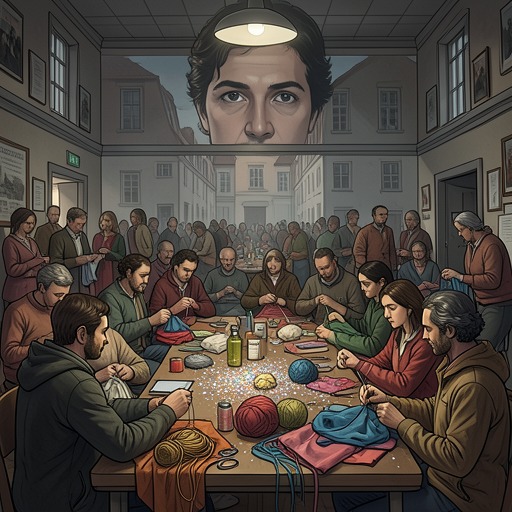
By the main production day, Eric has reserved two large rooms. The layout divides the work into distinct stations: eight sewing tables, a semicircle of chairs for knitting and hand sewing, and several long tables called the Glitter Station near the snacks. The sewing tables are also scheduled to be shared with the high school’s drama department once school resumes, showing that the drive creates infrastructure with uses beyond Halloween. The arrangement makes the project legible as a temporary workshop, but its tools and partnerships suggest a continuing community capacity.
The Public Workday
The workday begins before ten in the morning, when Trixie Beaumont has already arranged the rooms and prepared the stations. She expects much of Mustang Prairie to pass through during the day in support of children who are less fortunate. The event is deliberately accessible: food and socializing help draw people in, while the craft stations give the gathering a concrete purpose. The town’s willingness to attend free food or a party becomes an asset rather than a weakness, because the organizers combine hospitality with useful collective work and schedule the event early enough for seniors to participate.
The scale of the day contrasts with Trixie Beaumont’s exhaustion. She has been spending more time on her store and her newer business, and a previous gathering that involved too much wine has left her short of energy. Even so, she continues to manage the costume drive. The scene refuses to separate community service from labor: the cheerful public event depends on planning, physical arrangement, instruction, shopping, and sustained attention, much of which Trixie Beaumont carries while also maintaining her own business.
Relationships and Wider Significance
The drive brings Jack Thorpe and Trixie Beaumont into a cooperative setting that differs from their more intimate and conflicted encounters. While shopping, Jack Thorpe takes the supporting role of handling the cart and tablet as Trixie Beaumont directs the selection of materials. His desire to make their association visible during a later dance, when he pulls her toward the center of the floor because he wants everyone to know she is with him, contrasts with the practical partnership of the costume project, where their connection is expressed through coordinated work rather than possession.
The project also intersects with Jack Thorpe’s family life. At Thanksgiving, his parents remain in town for festivals and holiday parties, Sadie and Dylan bring side dishes, Luna arrives with a ham while holding Mr. Scanlan’s hand, and Jonquil Spring comes early with Abby Thorpe and Andie Thorpe to learn the household’s traditions. This larger gathering gives the costume drive’s community ideal a domestic counterpart: public collaboration and shared celebration gradually overlap with family routines, creating circumstances in which Trixie Beaumont is not simply an outsider passing through town.
The costume drive’s importance ultimately exceeds Halloween. Its classes establish Trixie Beaumont as someone Mustang Prairie can rely on, while its rooms, machines, materials, and intergenerational participation convert individual craft into collective infrastructure. In parallel with her development of Sexy Separates by Trixie, the drive shows her learning to design systems as well as garments. The project’s lasting achievement is therefore double: children receive costumes, and the town discovers a way to make care visible through shared skill, shared time, and the deliberate creation of something that did not exist before.