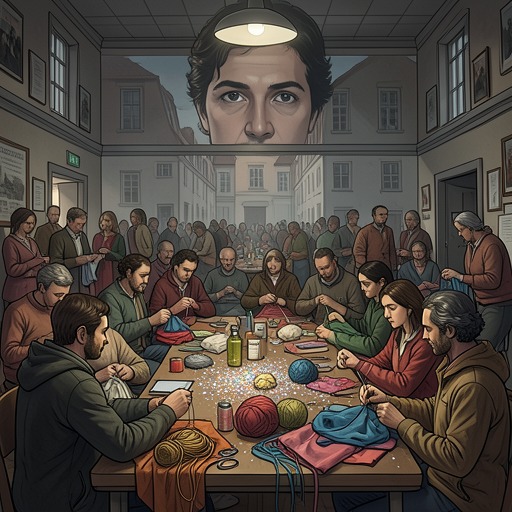
Mustang Prairie History Week costume drive
It Must Be Love: A Mustang Prairie RomanceMustang Prairie History Week costume drive is a volunteer costume-making and donation effort centered at Mustang Prairie Community Center. Its decisive significance lies in the way it joins Trixie Beaumont’s entrepreneurial abilities to the town’s communal life: the project gives her a concrete responsibility, places her among neighbors who contribute labor and materials, and becomes the occasion on which she finally recognizes that she belongs in Mustang Prairie again.
Causes and Background
The drive emerges while Trixie Beaumont is already trying to transform an unrealized creative ambition into a viable business. For months she has considered creating her own clothing line, experimenting with names, sketching logo ideas, and even hiring a graphic designer to develop them. The finished logos have begun to trouble her because they make the gap between her dream and her inaction impossible to ignore. The costume project therefore arrives against a background of preparation without movement: Trixie has imagination and plans, but needs an undertaking through which those abilities can become materially useful.
Her business thinking is already moving toward lingerie design. She later conceives Sexy Separates by Trixie as a line built around choice and combination, with multiple panty styles, several bra designs, convertible options, and a rainbow palette in silk, lace, and cotton. Her practical caution is as important as her creativity. Under the Skirt Online has only recently become officially operational after several consecutive profitable months, and she is considering additional space as both warehouse and workspace, along with the eventual hiring of a part-time employee. The costume drive places that same managerial and design intelligence in a communal setting before the commercial launch of her line.
Organization and Course
Trixie takes responsibility for the drive’s moving parts rather than treating it as a symbolic appearance. At Mustang Prairie Community Center, she greets arrivals, tracks materials and completed costumes, and assigns people to the stations she has established. Volunteers come with different forms of support: some offer costume-design and construction skills, while others bring supplies, food, and drinks. The event thus operates through distributed labor, with Trixie coordinating rather than performing every task herself.
One of her specific systems is the costume-label station. She asks Jack Thorpe to label each completed costume, adding a child’s name when the costume is intended for a particular child and otherwise recording the costume type. The instruction is simple, but it shows Trixie imposing order on a large, potentially chaotic undertaking. The drive depends not only on goodwill but also on identification, sorting, and follow-through—small administrative acts that make community generosity usable.
The project also creates a direct connection between Trixie and Jack Thorpe’s daughters. Abby Thorpe brings Trixie a basement photograph and asks for a hat like her mother’s, admitting that she is unsure she can complete it alone and that her father will not let her come to the store. Trixie promises that they will work it out, while first telling Abby to clear the plan with her father. Together they decorate the hat, add pom-poms, and take photographs of Abby and Andie Thorpe on the porch. In this small act of making, the costume drive becomes a means of preserving Marissa Thorpe’s image and giving Abby a new memory connected to her mother.
Participants and Interpersonal Stakes
The drive gathers a broad local network, including Trixie Beaumont, Jack Thorpe, Luna, Anda, and the residents who arrive with skills or supplies. Luna enters with Anda, while Trixie continues greeting and directing people. Anda’s blunt suggestion that Trixie and Jack might suit each other makes Trixie confront the possessiveness she insists she has no right to feel. Her work is therefore accompanied by a second, more private form of management: she must keep the event functioning while trying to maintain distance from Jack.
Jack’s presence intensifies that conflict. Trixie has recently slept with him and knows how powerful their physical connection is, but she believes that he wants only an enjoyable arrangement while she wants love and lasting commitment. She adopts distance as a rule for preserving her sanity and gives Jack the practical task of making costume labels. Yet he keeps drawing her attention, and she finds it difficult to avoid his gaze while monitoring the hall. The public project consequently becomes a setting in which professional cooperation and unresolved attraction repeatedly collide.
The event also changes the emotional boundaries of Jack’s household. His daughters, who had not warmed to any woman other than their mother since Marissa’s death, treat Trixie as though she has always belonged in their lives. Abby later explains that Trixie makes them pretty things, speaks to them as older children rather than babies, and has given her good memories of her mother. The hat photograph stands beside a similar photograph of Marissa, allowing Trixie’s creative labor to enter the family’s existing visual record without erasing the dead woman who remains central to it.
Consequences and Aftermath
The most important immediate consequence is Trixie’s altered sense of place. During the drive she takes pride in seeing the town she had loved and idealized respond with the same generosity she remembered. For the first time since returning to Mustang Prairie, she realizes that she no longer feels like a permanent tourist. The project gives that realization a social basis: belonging is not merely a memory of the town, but participation in its labor, its children’s lives, and its shared responsibilities.
The drive also strengthens Trixie’s standing as someone capable of turning creative work into organized production. Her later insistence that she retain total control over the quality of her new lingerie line echoes the discipline displayed at the Community Center. When Jonquil Spring suggests reconsidering a manufacturer because some seamstresses are poor candidates, Trixie answers that the line is new and that she will not feel comfortable surrendering quality control until the brand is solid. The costume project helps establish the practical identity behind that decision: Trixie is not simply dreaming of design; she is learning to coordinate people, materials, standards, and outcomes.
Its emotional effects continue beyond the drive itself. Jack’s daughters’ attachment to Trixie contributes to his recognition that she is valuable to the family, while Trixie’s connection with them complicates her attempt to keep Jack at a safe distance. The event does not resolve their relationship, but it makes their separation harder to maintain as an abstract choice. Community work has placed Trixie inside the family’s everyday world, and the children’s affection gives that inclusion a force neither adult can easily dismiss.
Narrative Significance
As a narrative event, the costume drive is a threshold between Trixie Beaumont’s remembered home and her inhabited one. It begins as organized civic labor, but its deeper value shifts from usefulness to belonging. Trixie arrives with tasks to complete and a town to coordinate; she leaves with evidence that her skills, care, and presence have a place there.
The event also establishes a recurring pattern in Trixie’s story: creative production becomes a form of relationship-building. A hat preserves Abby Thorpe’s connection to Marissa Thorpe; labels make the collective work legible; volunteer contributions turn individual effort into community infrastructure. Later, Trixie’s lingerie line is publicly launched at Dylan’s bar in a runway show featuring Sadie and Kiki Ramirez, where the finished garments become “her stuff” and the applause confirms the commercial achievement. The costume drive is the earlier, less glamorous version of that same transformation—from private design ability to work witnessed, shared, and sustained by others.
Finally, the drive places Trixie’s personal conflict within a larger social rhythm. She may tell herself that distance from Jack is necessary, but the town’s gatherings continually return her to the people and responsibilities that make Mustang Prairie feel like home. The project’s achievement is therefore both practical and symbolic: it helps children receive costumes, gives volunteers a structure for generosity, and gives Trixie the first convincing proof that returning home can mean becoming part of the present rather than merely revisiting the past.