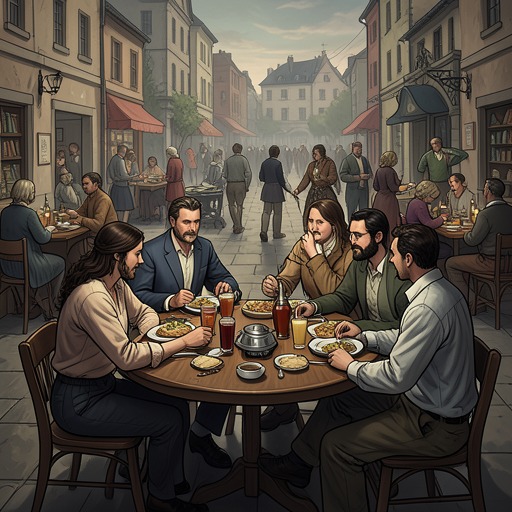
Mustang Prairie Thanksgiving Party
It Must Be Love: A Mustang Prairie RomanceThe Thanksgiving dinner at the Thorpes is a pivotal domestic gathering in which food, family ritual, and shared care briefly create the full household Jack Thorpe has missed since his daughters were small. The occasion brings together the Thorpe family, close friends, and Jonquil Spring, but its deeper significance lies in the way it turns Trixie Beaumont from an intermittent presence into someone emotionally adjacent to the family. Although Trixie arrives at the last possible moment to avoid Jack, the evening ends with them sharing a blanket and mulled wine beneath the stars, raising a toast to finding where they belong.
A Full House After Loss
For the first time since Abby Thorpe and Andie Thorpe were babies, Jack has a full house for Thanksgiving. His parents remain in Mustang Prairie to enjoy local festivals, holiday parties, and visits with old friends. Sadie and Dylan bring side dishes, Luna arrives with a ham while quietly holding Mr. Scanlan’s hand, and Jonquil comes early with Abby and Andie, eager to experience the family traditions associated with preparing the meal. The gathering is therefore larger than a conventional dinner: it joins the Thorpe household to the wider Mustang Prairie network and places the young Jonquil inside a family ritual that is new to her.
Jonquil’s presence also changes the emotional texture of the meal. When Jack’s parents propose moving down to live with the family, explaining that they have already placed a deposit on a new condominium near the old courthouse, the suggestion briefly exposes the future his mother appears to imagine for him: a crowded home with more grandchildren and an even denser family life. Jonquil’s excited questions about whether visits with grandparents will involve baking and wise old stories release the tension. Her curiosity allows everyone to laugh, share memories, and explain family traditions to a young genius who is being welcomed rather than merely accommodated.
Trixie’s Delayed Arrival
Trixie does not arrive with the rest of the group. She appears only ten minutes before the meal, claiming that she lost track of time, but Jack does not believe her explanation. After their dinner at his house, he had assumed that they understood one another: they could enjoy their attraction for as long as it lasted without turning it into a serious conversation. Trixie’s subsequent disappearance unsettles that arrangement. She continues to be present indirectly through Jonquil and the girls, who spend time at her home, yet she makes herself absent whenever Jack comes to collect them.
The dinner consequently contains a quiet separation inside its apparent togetherness. Trixie is physically present but treats Jack like an intimate stranger, smiling and speaking politely while refusing the closeness he wants. Jack reads her behavior as deliberate avoidance, yet he also refuses to relinquish what they have shared. To him, the relationship is good, easy, and sexually charged; he tells himself that nothing serious needs to be discussed. The dinner exposes the instability of that logic. A family holiday creates precisely the kind of public intimacy that his noncommittal arrangement cannot comfortably contain.
Jack’s mother’s matchmaking places him beside Trixie, giving the evening a small but consequential arrangement of bodies. He whispers that he cannot decide whether to cringe at her sweater or tear it off, preserving the erotic play between them even while the family surrounds them. His remark does not resolve their conflict, but it keeps the attraction alive beneath the formal politeness and makes the later outdoor scene possible.
From Household Ritual to Private Threshold
After the meal, Trixie and Sadie help Jack’s mother put away leftovers and clean the kitchen while the others remain in the living room, entertained by Abby and Andie. The practical labor matters because it gives Trixie a place within the household’s ordinary work. She is not simply a guest receiving hospitality; she participates in the care that sustains the gathering. Jack watches this domestic scene and realizes that he feels happy, light, and free, a state he has not experienced since before his art career took off.
When Trixie goes outside for air, Sadie knowingly suggests that she may want a blanket. Jack immediately retrieves a large flannel blanket and watches Trixie from the doorway. Her rainbow-colored waves move in the breeze as she looks toward the stars and distant galaxies. The scene shifts the event from communal ritual to a private threshold. Inside, the family is gathered around food, stories, and children; outside, Jack and Trixie face the uncertainty of belonging and the possibility that their relationship may become more than an arrangement neither of them names.
Jack fills a thermos with mulled wine and follows her. Trixie accepts the blanket, and when he asks whether there is room for him beneath it, she invites him to use his body heat to warm her. He settles behind her, wraps his arms around her waist, and wishes her a happy Thanksgiving. She relaxes against his chest and returns the greeting. Their physical closeness is not an isolated sexual encounter; it is a public holiday’s intimate afterimage, carrying the warmth of the household into the cold night.
Belonging, Memory, and Recognition
Under the blanket, Trixie explains that she never fit into the life she had before and eventually understood that she needed to leave and make a life of her own choosing. Jack recognizes the feeling through his own history. After Marissa Thorpe died, he tried for about a year to maintain the life he and Marissa had built with the girls in the city, even though parts of that life made him miserable. His admission frames the holiday as an exchange of difficult histories: both characters have been living inside structures that no longer fit, and both are searching for a home that can be chosen rather than merely inherited.
Their toast, “Here’s to finding where we belong,” gives the gathering its clearest thematic expression. Trixie drinks from the thermos and passes it to Jack, establishing a small act of reciprocity. Jack then tells her that she is beautiful. He has not intended to say it aloud, but the statement is sincere, especially because he sees her moving among several styles: a sexy pinup, a hippie-chic figure, and an ultra-feminine woman. Trixie answers by calling him beautiful too and says she would sketch him. The exchange joins desire with artistic recognition. Jack is not only attracted to Trixie’s appearance; he is being seen by someone whose creative eye can translate him into an image.
The family’s memories also make Trixie part of a continuing account of Marissa. Abby has found a photograph in the basement and asks Trixie to help her make a hat like her mother’s, because Jack will not let her come to the lingerie shop. Trixie agrees to help but first tells Abby to clear it with her father. Later, Trixie photographs Abby and Andie in the finished hat beside the memory of Marissa, noticing the resemblance between the new image and the family’s existing picture of their mother. Abby values Trixie not merely because she makes pretty things or speaks to the girls as capable people rather than babies, but because she gives her good memories of Marissa. In this way, Trixie’s place in the family is connected to remembrance rather than framed as a replacement for the dead.
Consequences for the Relationship
The Thanksgiving gathering does not eliminate Jack’s fear of commitment or Trixie’s fear of being hurt. Jack’s mother tells him that he could tell Trixie the truth about his marriage, arguing that the tension, anger, and resentment between Jack and Marissa had been visible and that competing with a ghost is difficult. Jack insists that his marriage has made him unable to repeat the experience, while his mother challenges his assumption that all marriages are alike. The holiday therefore brings the unresolved marriage trauma into the orbit of the new relationship, even when Jack tries to keep the evening easy and physical.
Trixie’s later professional triumph sharpens the contrast. At Dylan’s bar, she launches her lingerie line in a makeshift runway show, with Sadie and the other models wearing her designs and Sadie and Kiki’s songs supplying the soundtrack. The bar becomes a transformed bedroom-like space of gauze, music, lighting, and applause. Trixie experiences the satisfaction of seeing her work officially launched and recognizes the event as a success, yet she also feels that she has no one to share it with—not really. The Thanksgiving intimacy explains why professional independence does not settle her emotional life: belonging requires more than achievement.
The same pattern continues through gifts and apologies. Jack gives Trixie the original of Blue Skies, her favorite painting, and the gift intensifies her love even as she is trying to suppress it. Andie then tells Jack that he should apologize for hurting Trixie’s feelings, while Abby explains that the girls like Trixie because she makes beautiful things, smells good, treats them as older children, and has helped preserve memories of Marissa. The children thus become witnesses and moral participants in the relationship. Their approval does not decide the adults’ future, but it makes clear that Trixie has already affected the household’s emotional memory.
The event’s movement toward reconciliation is completed later when Jack and Trixie kiss in the snow near the turn of the year. Jack declares that he had to have her, and he proposes beginning the new year with a kiss. Trixie answers with a more playful suggestion, and Jack responds that he loves the way she thinks. The later union does not erase the tensions visible at Thanksgiving; rather, the dinner functions as an earlier ritual of re-entry. Shared food, family labor, inherited memories, private warmth, and the toast to belonging allow Trixie and Jack to imagine intimacy as part of a community instead of as a secret arrangement detached from consequence.
Narrative Significance
The Thanksgiving dinner is structured as a passage from separation to provisional incorporation. Trixie begins outside the household’s rhythm, arriving late and avoiding Jack; she moves through the kitchen as a helper, joins the family’s emotional space through the girls and Marissa’s memory, and finally enters a private shelter with Jack beneath the flannel blanket. The movement resembles a social rite of transition: distance is maintained, a threshold is crossed, and a new form of belonging becomes imaginable without being falsely declared complete.
Its importance also lies in its ordinary materials. Side dishes, ham, leftovers, cocoa, cookies, a blanket, and a thermos of mulled wine carry the scene more decisively than grand declarations. The holiday makes care visible as repeated labor, while the outdoor conversation gives that labor an emotional vocabulary. By the end, Jack’s household is not healed of grief, and Trixie is not free of fear, but both have occupied a shared space in which memory, desire, family approval, and personal choice can coexist. The dinner therefore becomes one of the book’s clearest demonstrations that love is not only a private feeling: it is also a practice of being admitted into, contributing to, and helping reshape a home.