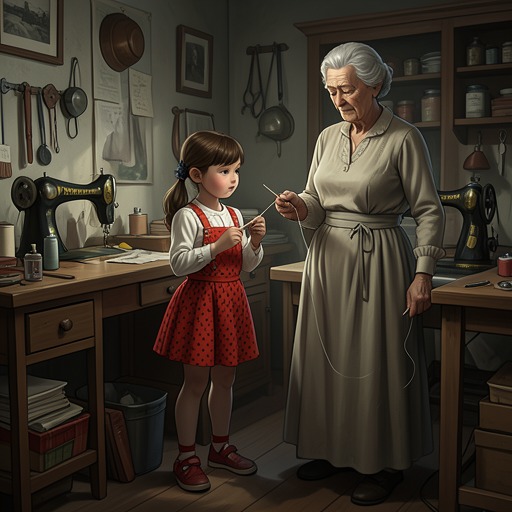
Trixie's knitting and sewing classes
It Must Be Love: A Mustang Prairie RomanceTrixie's knitting and sewing classes are the practical foundation of Trixie Beaumont's transformation from a lingerie-shop owner with an unrealized clothing-line dream into a designer, teacher, organizer, and community builder. The classes do more than teach crafts: they convert uncertainty into routine, bring women and girls into shared work, supply labor and materials for the town's Halloween costume drive, and give Trixie a public role that grows alongside her business.
Origins and Municipal Approval
Trixie's classes emerge from a period in which her clothing line exists more vividly on paper than in production. For months she has considered creating the line, experimented with possible names, sketched logo ideas, and even hired a graphic designer to develop them. The completed logos have begun to taunt her because they make her inaction visible. Her decision to approach Eric at City Hall therefore represents more than administrative preparation: it is the first concrete move against the hesitation that has kept the business imaginary.
Trixie arrives at City Hall in a red dress with black polka dots, red strappy heels, a sweater, and a black beaded handbag, crossing the street from the apartment above her lingerie shop. She explains to Eric, the interim mayor, that she wants to start a sewing or knitting class but does not know where to begin. She also describes her lingerie line and admits that her technical confidence is shaky. Her pitch combines personal ambition with local identity: she imagines lingerie carrying the label “Made in Mustang Prairie,” making the class part of a broader attempt to root her future brand in the town.
Eric gives her a straightforward path forward. His assistant will place an announcement on the town website once Trixie supplies the class name; Trixie must pay a small room-rental fee and leave the space as she found it. The modest conditions matter because they make the dream operational rather than ceremonial. When Trixie admits that she is really doing this, she experiences the decision as a major step toward making her ambitions real. Municipal support thus supplies access to space and publicity without taking control of the project away from her.
Teaching, Learning, and Expanding Demand
The first class is followed by a second that goes better, showing that Trixie's role develops through practice rather than arriving fully formed. She prints simple patterns for hats, gloves, scarves, blankets, and baby items because those are what most participants want. The class includes a striking range of students: Abby Thorpe and her friend Sam represent the younger participants; Luna and her friend Edie are older women; and Jade, Baxter's mother, also attends. Trixie is improving her own knitting and crocheting skills while helping others discover an interest in making things, so the teaching relationship runs in both directions.
The class also becomes a setting in which practical instruction and comic social energy coexist. A participant asks whether she could crochet a bikini, an especially fitting question given Trixie's lingerie work. The possibility links the apparently domestic craft lesson to the more ambitious design business developing elsewhere in Trixie's life. Sewing and knitting are not treated as separate from fashion; they become accessible forms of experimentation through which Trixie can test skills, respond to local interests, and imagine future products.
Demand quickly exceeds the original arrangement. By the sixth chapter, Trixie dismisses another packed class after the online registration reaches its limit. The group has moved into a larger room, where the lighting is better and the chairs are more comfortable. The expansion is evidence of a genuine community response, but it also increases the invisible labor of the project: Trixie must gather scraps of yarn of every size, weight, and color from long tables, close the room, and prepare for the next session. The classes become a recurring cycle of advertising, enrollment, instruction, cleanup, and resource management rather than a single inspirational gesture.
Materials, Labor, and the Costume Drive
The classes become closely connected to Eric's Halloween costume drive. Trixie tells the participants that sewing machines promised by Eric may be available by the following Saturday, allowing them to help with the project. The machines would make the classes more productive and widen the range of work possible, while also connecting instruction directly to a public need.
Eric's plan is to use the costume-drive budget to buy fabric and accessories rather than purchasing a fixed number of finished costumes. That choice allows the community to make wings, wands, capes, tiaras, and other components for children who might otherwise be left without a costume. Trixie's classes therefore become part of a distributed production effort: materials are procured, skills are taught, and finished imaginative objects are assembled collectively. The work gives participants a concrete purpose while preserving the creative pleasure associated with craft.
The scale of the volunteer operation becomes clearer when Trixie prepares two large rooms for the drive. Eight sewing tables are arranged for use with the high school's drama department once school resumes; a semicircle of chairs near the window accommodates knitting and hand sewing; and long tables at the back become a “Glitter Station” beside the snacks. The arrangement separates different forms of labor without isolating them. Sewing, handwork, decoration, food, and conversation occupy one coordinated environment, making the town's generosity dependent on organization as much as goodwill.
Business Development and Professional Control
For Trixie, the classes run alongside the development of Sexy Separates by Trixie. She conceives the lingerie line as a rainbow-themed system of mix-and-match pieces: six to ten styles of panties, from g-strings and bikinis to French cuts and perhaps a boy-cut option, accompanied by four bra styles, including a convertible bra. The business idea grows from her awareness that customers do not all want matching sets. The classes help establish the practical world in which such design ambitions can be tested, taught, and eventually produced.
Trixie's commercial position strengthens as Under the Skirt Online officially opens and the shop records several consecutive profitable months. She considers renting the space next door as a warehouse that could also serve as a workspace, and she begins to imagine hiring a part-time worker. These possibilities show the classes and the lingerie line moving from solitary aspiration toward an expanding operation with inventory, workspace, and additional labor.
That expansion does not mean Trixie surrenders control. When Jonquil Spring helps rank seamstresses interviewed for the growing business, Jonquil suggests reconsidering a manufacturer because some candidates are unsuitable. Trixie replies that the line is new and that she will not feel comfortable without total control over quality; only after the brand becomes solid will she consider outsourcing. The same principle governs the classes: growth is welcome, but the work must remain connected to standards Trixie can oversee. After the holiday, she plans to photograph Sadie as a model and promote the line more aggressively, while keeping manufacturing expansion as a later option.
Community, Intimacy, and Narrative Significance
The classes enlarge Trixie's place in Mustang Prairie by making her useful to people outside her shop and immediate circle. Abby's attendance brings her into Jack Thorpe's family life, and Jack's daughters greet Sadie warmly at gatherings where the wider network of friends and relatives exchanges food, labor, and affection. The classes are consequently not only vocational spaces; they help create the social conditions in which Trixie becomes legible as someone who belongs in the town's everyday life.
Their importance is also measured against Trixie's private uncertainty. She remains focused on the shop and on starting her line, resisting Sadie's suggestion that she use sexual attraction as a way to reopen her connection with Jack. Craft work offers a disciplined alternative to heartbreak: it gives her schedules, students, designs, and responsibilities that do not depend on whether Jack approaches her. Even when a foot injury leaves her exhausted and unable to refold or steam merchandise, she uses the quiet hours behind the counter to work in her sketchpad, treating enforced physical limitation as an opportunity to advance the line.
The classes finally lead toward public visibility. Trixie's lingerie collection is launched at a fashion show in Dylan's bar, where Sadie and the other models walk a makeshift runway through a room transformed by music, lighting, gauzy fabric, and applause. That show is not itself a class, but its communal structure echoes the classes' method: people contribute skills, bodies, materials, space, and encouragement until Trixie's private designs become a shared public event. The classes thus function as the earliest durable expression of her central achievement—building a livelihood without separating it from teaching, mutual aid, and the collective life of Mustang Prairie.