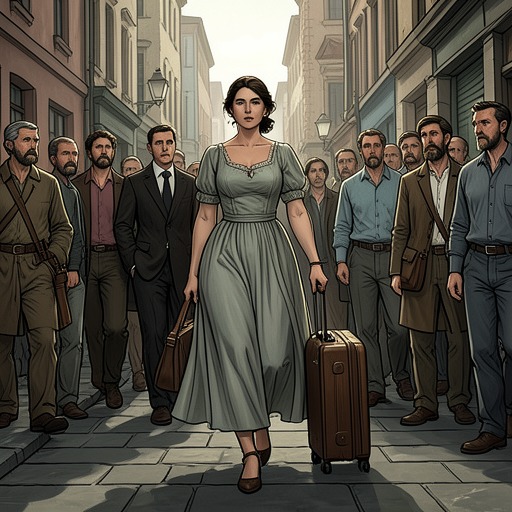
Under the Skirt’s growing business operation
It Must Be Love: A Mustang Prairie RomanceUnder the Skirt’s growing business operation is the material foundation of Trixie Beaumont’s independence and creative identity. The shop is not merely a setting for her romance with Jack Thorpe or a place where lingerie is sold; it is the enterprise through which she converts a long-considered dream into income, employment, design, production, and public recognition. Its growth carries her from solitary retail work toward a deliberately structured brand while forcing her to balance ambition with control, risk, and the ordinary labor of keeping a business alive.
From Shop to Enterprise
For months, Trixie had been considering a clothing line seriously rather than treating it as a passing fantasy. She had experimented with names, sketched logo ideas, and even contacted a graphic designer to turn those ideas into finished marks. The completed logos became a source of pressure because they made her inaction visible. The turning point came when she went to Mustang Prairie City Hall to seek the approval required for her next step, presenting herself with unusual deliberateness in a red polka-dot dress, red strappy heels, a sweater, and a black beaded handbag. The visit shows the business moving from private imagining into civic and practical negotiation.
By the time the online arm, Under the Skirt Online, was officially open, the shop had achieved several consecutive months of profit. Trixie could therefore imagine renting the space next door as a warehouse and converting it into a workspace, with the possibility of hiring a part-time employee earlier than her business plan had projected. Expansion is presented not as effortless success but as a calculation: the same profits that make growth possible also increase the consequences of a careless decision. Trixie understands that the store is her livelihood, career, and stability, so she treats every new commitment as something that must be made safe enough to sustain.
Designing Sexy Separates by Trixie
The first line takes shape during a long weekend when Trixie remains at her rental house and performs the mindless retail task of folding panties for a new display table. She settles on the name Sexy Separates by Trixie, and the name becomes more convincing the longer she lives with it. Her design plan is specific: six to ten types of panties, ranging from g-strings to bikini and French-cut styles, made in silk, lace, and cotton, with a possible boy-cut option. A rainbow theme allows the collection to accommodate vibrant colors rather than imposing one narrow version of femininity.
The corresponding bra line is equally deliberate. Trixie imagines four styles, or five if a convertible bra is included, so customers can mix and match instead of being required to purchase fixed matching sets. Her own fondness for garter belts and thigh-high stockings does not become a rule for every woman; Sadie’s habit of combining different colors in her lingerie drawer helps confirm that the collection should support personal choice. The concept therefore joins commercial flexibility to a broader idea of self-styling: lingerie can be coordinated, contrasted, playful, or practical according to the wearer’s preference.
The shop’s existing operation gives this design work a market and a testing ground. Under the Skirt serves women of varied body types and ages, and Trixie’s plans grow from that inclusive customer base rather than from an abstract fashion ideal. The line is still financially vulnerable, however. Orders have begun to arrive at a rate higher than expected, but they remain too few to justify complacency. Trixie knows that a striking idea must become reliable merchandise before it can become a stable brand.
Labor, Control, and Expansion
The growth of Under the Skirt exposes how much work is hidden inside Trixie’s entrepreneurial image. When an injury leaves her exhausted and in pain, she cannot refold or steam the merchandise, so she sits behind the counter, rings up customers, shouts instructions, and prepares the digital register. The register’s battery makes it useful during power outages, a small practical detail that reflects her preference for dependable systems. Even while physically limited, she turns the forced pause into design time, keeping her sketchpad open between customers and using the quiet first half of the day to develop her line.
As production becomes more demanding, Trixie moves toward a workshop with seamstresses and assigns Jonquil Spring a concrete role in evaluating applicants. Jonquil ranks the women interviewed and questions whether Trixie should reconsider using a manufacturer. Trixie rejects that course for the present because the line is new and she wants total control over quality. Her decision is both entrepreneurial and emotional: outsourcing could make growth easier, but it would also place the brand’s standards in someone else’s hands. She plans to reconsider manufacturing only after the brand is solid.
A temporary opening between the shop and the neighboring space marks the physical transition toward expansion. Jack notices the hole when Trixie leads him through the store, break room, and adjoining area; she explains that contractor Derek Hayes cannot begin work until Black Friday, so a curtain conceals the unfinished alteration. The improvised partition captures the business at an intermediate stage: already too large for a purely private dream, but not yet fully equipped as a finished production space.
Trixie’s staffing decisions likewise develop in stages. By the later period of growth, three seamstresses have completed the week’s work, and their orders through the following week hang ready on the rack. Her part-time worker Marnie has proved herself an excellent saleswoman, leading Trixie to imagine making her manager when the time is right. Yet Trixie still personally checks the garments before they are steamed and shipped. Delegation has begun, but responsibility has not disappeared; the shop’s reputation remains attached to her judgment.
Launch and Continuing Operation
The public launch of Sexy Separates by Trixie takes place in Dylan’s bar, transformed for the occasion into a makeshift runway. Sadie and the other models present the garments while songs by Sadie and Kiki Ramirez provide the soundtrack. Gauzy fabric, lighting, and music turn the bar into a theatrical bedroom, giving the collection a new tagline, “Sexy and fun.” The setting links Trixie’s commercial project to Mustang Prairie’s social network: a local bar, local performers, familiar models, and community attention become the resources of a fashion presentation.
Sadie’s appearances demonstrate the line’s range and its promotional logic. She walks in lacy teal boy shorts with a matching Basque, later returns in white cheeky lingerie with a matching bra and a silky duster fastened by silver buttons, and completes the look with cherry-red stilettos. Trixie recognizes the latter appearance as the image that could launch the line. The cameras flash, the crowd applauds, and the show establishes that the garments can be marketed through movement, personality, music, and spectacle rather than through static shop displays alone.
The launch is emotionally triumphant but personally incomplete. Trixie feels satisfied because the line is officially launched and the show is a success, yet she also feels that she has no one with whom to share the achievement fully. That contrast prevents the business victory from becoming a simple reward scene. Public recognition confirms her competence, while private loneliness shows that professional independence has not automatically resolved her desire for intimacy or belonging.
After the launch, growth becomes routine as well as celebration. Trixie begins sketching additions for Valentine’s Day, including a black-and-pink bustier designed to be sexy and fun for women of different ages. The new creative work makes the mundane parts of owning a shop more bearable, but she disciplines her enthusiasm by refusing to expand too quickly. She checks the orders, supervises steaming and shipping, and reminds herself that moving too fast could overextend the company and damage what she has built. Under the Skirt’s growth therefore continues through measured repetition: designing, hiring, inspecting, selling, fulfilling orders, and planning the next seasonal opportunity.
Community Function and Significance
Under the Skirt also operates as a social crossroads. Trixie identifies it when speaking with Blythe Danforth, explaining that her shop is on Fourth Street. Blythe’s purchase of a sexy one-piece has pleased Wade, turning an ordinary sale into a small piece of local testimony about the store’s effect on customers’ intimate lives. The exchange presents the business as familiar enough to be discussed within the town’s everyday relationships, not as an isolated boutique detached from its community.
Sadie’s employment makes the enterprise a source of stability for another woman as well. She works three days a week selling lingerie at Under the Skirt and five nights serving drinks at The Lounge, sometimes singing, while continuing to work on her music at home. The schedule is demanding, but Mustang Prairie’s relative lack of chaos allows Sadie to concentrate on the future, and the shop becomes part of that quieter reconstruction. Trixie’s business thus creates paid work while also participating in the town’s informal network of recovery and mutual support.
The operation’s significance lies in the way it joins creative self-expression to material discipline. Trixie does not simply announce herself as a designer; she builds a supply chain, develops recognizable products, protects quality, hires labor, promotes through a fashion show, and plans for seasonal demand. Her growing business makes independence visible in concrete forms: a profitable online store, an adjoining workspace, seamstresses, a promising saleswoman, racks of outgoing orders, and a brand carrying her name. Under the Skirt is consequently both a shop and a structure of becoming—the place where Trixie’s imagined future acquires inventory, employees, customers, and a public life.