Care, Assistance, and Autonomy
Jacob's LadderCare, Assistance, and Autonomy names a tension running through Yasha’s encounters with help: rescue may interrupt danger, but recovery cannot be imposed without regard for the survivor’s own judgment. JT’s efforts to direct Yasha toward support are compassionate and informed by his work, yet Yasha repeatedly insists that having been hurt does not erase his capacity to decide. Their exchanges make the difference between offering assistance and taking control part of the story’s emotional and ethical substance.
Care After Rescue
Yasha’s resistance to being treated as helpless has a concrete history. He is trained in Krav Maga and has believed he could always take care of himself; attraction to large, physically imposing men has not, in his view, made him incapable of defending himself. That confidence is shaken when a man’s grip tightens and his face darkens with fury. The scene exposes a painful gap between being capable and being safe: Yasha’s skills and self-belief have not prevented intimate violence. His insistence on autonomy therefore does not mean that he has not been harmed, or that he needs no help.
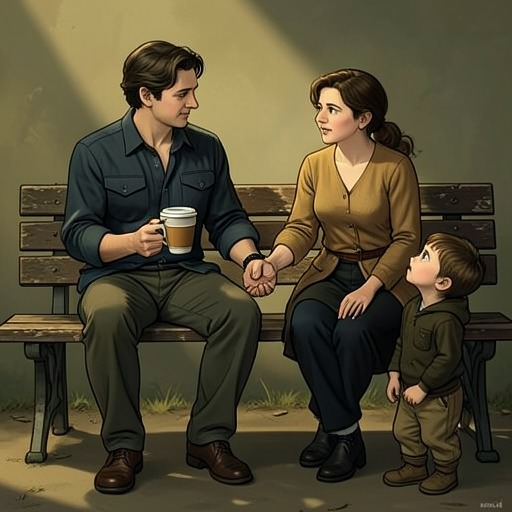
After the rescue, JT proposes coffee and frames it as a chance to tell Yasha that he should not accept being someone’s punching bag. The offer is simultaneously personal and practical: JT wants another meeting, but he also names the violence Yasha has endured and refuses to treat it as acceptable. Yasha reacts as though JT has told him something he already knows. His sharp response shows that recognition of abuse is not the same as readiness to discuss it, and that stating a principle on a survivor’s behalf can feel less like support than a judgment of what he has failed to do.
JT explains that, through his work, he sees many things and has researched ways to help victims of domestic violence. He points to a support group in St. Nacho’s, presenting it as an available resource rather than a condition of the rescue. Yasha immediately questions whether this is standard follow-up care and indicates that he already knows what a group might say. JT distinguishes the suggestion from professional routine: his concern is directed specifically at Yasha, not merely at completing a responder’s checklist. Still, the gap between JT’s intention and Yasha’s experience remains. Good motives make help possible; they do not decide for the person receiving it.
The Support Group and the Right to Refuse
When Yasha reaches the group, he is holding coffee and looking at a small circle of women sitting silently, their bodies tense. The unfamiliarity of the setting is plain in his uncertainty about how he got there. The group offers a place to be among people affected by domestic violence, but its presence does not make participation effortless or guarantee that Yasha will feel at home in it.
When he is invited to speak, Yasha’s mouth goes dry. The facilitator tells him it is all right if he does not feel like sharing that day. That explicit permission matters: attendance does not have to become disclosure, and silence need not be treated as failure. Yasha rises so quickly that his chair tips over and clatters across the quiet room. The physical interruption gives the scene a force that a simple account of reluctance would miss. He has entered the group, but the invitation to speak still meets a bodily response he cannot readily smooth over.
The group scene also makes the limits of assuming that one form of support fits everyone visible. Yasha is a male survivor sitting among women; the evidence establishes the difference in the room without suggesting that their experiences are identical or that the group is useless to him. His discomfort does not settle whether he belongs there. JT’s earlier advice leaves room for precisely that uncertainty: Yasha can attend and discover that the group is not right for him. Assistance, in this instance, has value as an option he can test rather than a verdict about what he must need.
Concern, Pressure, and Boundaries
JT’s impulse to intervene is not limited to the referral. When he raises a concern about Cam, describing him as a player, Yasha cuts him off: the rescue is over, and he can take care of himself. The exchange reveals how easily protective attention can extend beyond its original purpose. JT is still looking out for Yasha, but Yasha hears the danger of being kept in the role of a person who must be watched over. His boundary is not a denial that JT has been kind; it is a claim that kindness does not grant permanent authority over his choices.
Yasha then softens the exchange without withdrawing that claim. He puts a hand on JT’s arm and says he is glad JT is looking out for him, while also reminding him that he has been taking care of himself for a long time. Gratitude and self-determination coexist. The moment resists a simple division between a caring helper and an ungrateful recipient: Yasha can value JT’s attention and still object when that attention becomes presumptive. JT’s face closes when Yasha describes how difficult his week has been, and he apologizes. The apology marks a small recalibration rather than a resolution of every difference between them.
Yasha’s broader habits reinforce that autonomy is practical as well as emotional. He is helping Mary Catherine with pie baking until Friday and hopes his brother will come to get him. The detail places him in ongoing work and in plans of his own, even as his next step depends in part on another person. Neither accepting a ride nor receiving support cancels his agency; the story allows dependence and self-direction to occupy the same life.
Triage and the Limits of Individual Attention
The crash-rescue scene gives JT’s care a different shape. When Yasha asks about someone who is injured, he learns that Cam is attending to the person, whose arm is pinned. JT takes Yasha’s arm and begins guiding him toward one of the tarps, explaining that he has to perform triage and care for people according to their needs; ambulances are on the way. Unlike the earlier advice about the support group, this is an immediate emergency decision. JT does not promise that everyone can receive equal attention at once. He makes the constraint and the order of care legible while continuing to act.
That explanation does not turn the scene into a claim that Yasha welcomes every touch or instruction. It does, however, distinguish urgent coordination from a general presumption that a survivor cannot manage his own life. JT’s obligation at the crash is to assess competing needs, and he tells Yasha why he is moving him and what is happening next. The ambulances provide a concrete next step; the triage explanation gives Yasha information rather than leaving the intervention unexplained.
Significance
Across these encounters, help is most meaningful when it preserves the distinction between a person’s vulnerability and a supposed inability to choose. JT’s research and referral make support available; Yasha’s discomfort, questions, and boundaries show why availability cannot substitute for consent. The group’s permission not to speak offers one model of assistance that leaves room for refusal, while the crash scene presents another: transparent action under conditions in which urgent needs must be prioritized.
The story does not resolve the tension by making Yasha either wholly self-sufficient or wholly dependent on others. He has training and a long-standing belief in his ability to protect himself, yet experiences violence that unsettles that belief; he resists being managed, but acknowledges JT’s kindness and accepts practical help in his life. Care and autonomy are not opposing outcomes. The harder task is to offer care without treating survival as evidence that the survivor has surrendered the right to decide what comes next.