Economic Independence Helps Domestic Violence Survivors Leave Abusive Relationships
Jacob's LadderEconomic independence is presented as a practical condition that can make leaving an abusive relationship more possible, not as a guarantee that a job alone will secure safety. Through Miss Independence Pies, the novel gives this principle an institutional form: a business created to provide employment for female survivors, while also showing that modest earnings may need to be combined with other forms of assistance. Yasha’s own position complicates the project’s gendered mission, and his questions about the money he earns prevent its social purpose from being mistaken for proof that every worker can become financially independent.
Economic independence as a condition for leaving
The rationale for the project is stated directly when Dan asks Yasha about the pie business. It began with a loan from the Santo Ignacio City Council and was intended to give female victims of domestic violence jobs, helping them break free from financial dependence on their abusers. This frames economic dependence as more than an inconvenience: when a survivor relies financially on an abusive partner, the practical possibility of leaving may be constrained. The business is designed to address that condition by connecting employment with a route toward greater independence.
The novel does not claim that earning a wage automatically ends abuse or makes departure safe. Yasha’s history with Sander supplies a personal context for the problem of recognizing and responding to harm. He had known for some time that Sander was unfaithful but postponed dealing with it because Sander was usually discreet. When Sander’s grip tightened and his face darkened with fury, Yasha’s confidence in his ability to protect himself was shaken: his Krav Maga training had led him to believe he could always take care of himself, until he could not. These details establish vulnerability without suggesting that financial dependence is the sole explanation for staying or leaving. The project addresses one material barrier, not every consequence or danger of an abusive relationship.
The design and limits of Miss Independence Pies
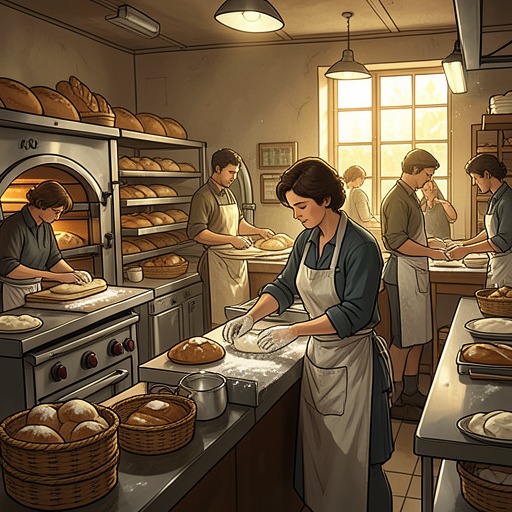
Miss Independence Pies joins commercial activity to a social purpose. Its original public funding and employment mission make the workplace part of a larger effort to help survivors build alternatives to dependence on an abuser. The idea is concrete rather than abstract: the project offers jobs, and Yasha participates by applying skills he already has to the pie business. The connection between earning and choice gives ordinary work a consequential role in the story.
At the same time, Yasha doubts that anyone can break free on what the workers make. His objection matters because it distinguishes the existence of employment from the adequacy of its pay. A job may offer income without, by itself, covering the costs of independent living. Dan answers not by claiming the wages are sufficient on their own, but by placing them alongside subsidized housing and programs including Medicaid and WIC. With those supports, he argues, independence becomes a more realistic goal. The exchange therefore presents the project as one component in a broader support structure, rather than as a self-sufficient solution.
That qualification also sets a limit on what the novel demonstrates. The conversation explains the intended mechanism and the proposed role of complementary assistance; it does not establish that every employee receives those benefits, that the wages are enough for a particular survivor, or that the business has already enabled someone to leave an abuser. The emphasis is on making an exit more feasible, not on promising a guaranteed outcome.
Yasha’s work and the project’s gendered mission
Yasha explains that he began helping because he was already in St. Nacho’s and had the relevant skills. Mary Catherine Jensen gives him a little cash at the end of the day so he can buy food. He says he would have done most of the work even without payment, because Mary Catherine inspires a protective instinct in him. His account places him in the business both as a worker with useful skills and as someone drawn to helping its founder. The small amount of cash is a concrete benefit, but the passage does not equate it with a living wage or financial independence.
His participation also complicates the project’s stated focus. Miss Independence Pies was intended to provide jobs for female survivors, while Yasha is a male survivor of abuse. The novel does not say that the business changes its formal mission or describe its eligibility rules. Instead, Yasha’s presence makes visible a distinction between the project’s defined target population and the wider reality of abuse. His experience should not be treated as identical to that of the women for whom the initiative was designed; it nevertheless places his work within the same conversation about support and material dependence.
Work alongside social support
Employment is only one part of the support surrounding Yasha. JT researches how to help victims of domestic violence and tells him about a support group in St. Nacho’s. Yasha initially refuses to attend, but Mary Catherine eventually draws him into the group indirectly: he later realizes that she had maneuvered him through the back door because the women there were the support group. The episode links the pie business to a community of survivors without making the two forms of help interchangeable. Work can provide skills and some cash; the group offers a setting for support. The novel presents them as neighboring parts of a response, not as substitutes for one another.
Taken together, the business, public assistance, and survivor support clarify the meaning of economic independence in the story. It is not portrayed as a simple instruction to leave, nor as a quality produced by individual determination alone. The possibility of leaving depends in part on whether income and other resources make an alternative life practical. Miss Independence Pies embodies an attempt to alter that material calculation, while Yasha’s doubts keep the ambition grounded in the difference between offering a job and providing enough support to make freedom attainable.