Mary Catherine Jensen
Jacob's LadderMary Catherine Jensen, known as Miss Independence, links survival to practical independence: she has left an abusive husband, and the pie business associated with her is designed to create jobs for women seeking freedom from financial dependence on abusers. Her story also turns on the way she recognizes and recruits ability. Through her work with Yasha, Miss Independence Pies develops from a place of baking into a plan for new products and retail expansion, while remaining both a livelihood and a community resource.
Identity and Background
Yasha first meets Mary Catherine in a domestic-violence support group. The room is small, its chairs arranged in a circle, and the women are silent and tense. In that guarded setting, she offers her hand and gives her name. Yasha gives the name he has been using, one Alice had introduced him by. Their brief exchange establishes a relationship that will move beyond the group: Mary Catherine meets him not as a business asset but as another person entering a difficult room without an easy script for being there.
The name Miss Independence is tied to both her personal history and her work. When Yasha wonders whether she is safe from her abuser, she explains that she left her husband when her son, Jordan, moved to St. Nacho’s. She says that she might not have left otherwise; Jordan had been carjacked at the SeaView Motel, and she went to make sure he was all right. The account makes her departure concrete: concern for her son brought her to St. Nacho’s, and the move became the point at which she left her marriage. Her description does not erase how difficult leaving had been; it identifies the circumstance that finally made it possible.
Work at Miss Independence Pies
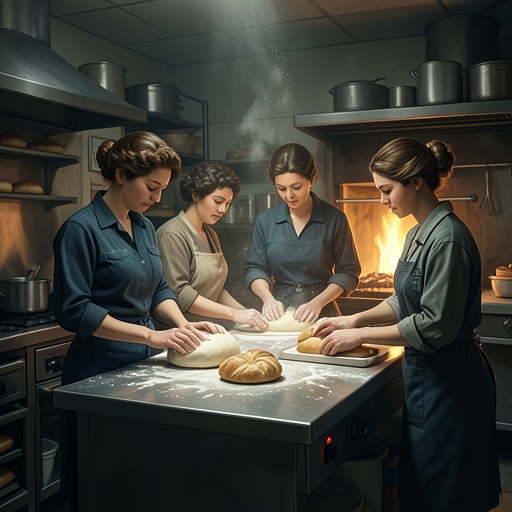
Yasha enters Miss Independence Pies at three in the morning and realizes that the circumstances bringing him into the work have not been as incidental as he thought. The hour gives the episode an offbeat, demanding quality, but what follows is sustained labor rather than a symbolic rescue. Mary Catherine has a business to run, and Yasha’s training and practical skills prove useful to its needs. Their association develops through concrete work: planning, discussing operations, and handling dough together.
Mary Catherine sees room to expand beyond the shop’s existing pies. She is considering savory pies as a new part of the business, and she and Yasha draw up a plan based on what that development would require. His training becomes useful in assessing the work, and he spends much of the day working with the women. The expansion begins as a practical question—what can the business make, and what will it take to do it—rather than as a vague aspiration. Yasha’s contribution is valuable because it answers that question with planning as well as effort.
Her confidence in him becomes explicit when she tells him that he is coming with them and calls him a godsend, recognizing that he seems to know what he is doing. The invitation changes the terms of his involvement: he is not merely someone who has helped for a shift but someone Mary Catherine expects to include in the next stage. Her directness is characteristic of the partnership as presented. She identifies useful ability and makes a place for it, while the work itself gives Yasha a role grounded in contribution rather than pity.
Expansion and Business Planning
The idea of savory pies leads into a broader discussion of a retail space. Mary Catherine asks Yasha what he imagines for the shop, and the two make drawings and write down ideas. They discuss the menu and agree on a measured approach: begin with a short list of items, do them well, and widen the range after seeing what customers respond to. The plan balances ambition with evidence from the business. Growth is not treated as expansion for its own sake; the proposed sequence lets the shop learn from what sells before taking on a larger range.
The numbers for Miss Independence Pies look strong compared with what most start-ups could expect. That assessment gives the retail conversation a concrete basis: Mary Catherine is not planning in a vacuum, but considering the next step while the existing business is performing well. The book does not present the retail space as already secured. Instead, it shows planning in progress, with the menu, scale, and shape of the future store still being worked out.
Ken Ashton also becomes involved in evaluating a possible building near the fire station. He has arranged another look at the property and has rough figures from contractors; he presses Mary Catherine to accompany him. The proposed location and preliminary numbers extend the planning beyond drawings and menu ideas into a physical site and construction costs. They also show that the expansion is being considered collaboratively, with decisions still dependent on what the building and its costs will support.
Mission, Livelihood, and Community
Yasha later explains the business’s original purpose to Dan: it was funded by a loan from the Santo Ignacio City Council and intended to provide jobs for female victims of domestic violence, giving them a way to escape financial dependence on their abusers. This account clarifies why Miss Independence Pies matters beyond its products. Employment is part of the means by which the women it serves can make a break from an abusive relationship materially possible; leaving is connected to access to income, not only to the decision to go.
The enterprise is not, however, described as charity alone. Mary Catherine needs to make a living, and the stronger the business becomes, the more it can help the community. The distinction matters to the expansion plan: a successful enterprise can support its owner and extend its capacity to help others. Yasha also explains that a retail space could be established as a separate enterprise from the original operation, preserving a distinction between the business’s strands even as they are connected by the larger project.
Narrative Significance
Mary Catherine’s role is defined by the way personal escape and economic structure meet. Her own departure from her husband is associated with Jordan’s move to St. Nacho’s, while the business offers other women a route toward independence through paid work. The story does not make those experiences identical: her account is specific to her son and the circumstances that brought her to leave, while the shop’s mission addresses a wider community need. What connects them is the practical question of what makes freedom sustainable.
Her partnership with Yasha gives that question a working form. She notices his capabilities, draws him into planning, and gives him a place in the shop’s future; he helps turn the proposal for savory pies and a retail space into concrete decisions about needs, menu, scale, and location. Mary Catherine therefore stands not only for recovery but for the labor of building something that can endure: a business that must be viable in order to offer the independence it was created to support.