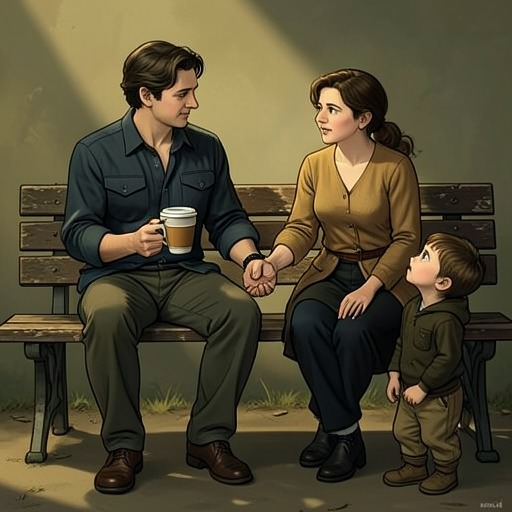
Phil
Jacob's LadderPhil’s role in Jacob’s life is defined less by explanation than by action: he notices when Jacob is unwell, urges him to stop working, and later checks whether Jacob is certain about what he wants. These brief encounters present him as a steady, practically minded presence whose concern does not erase Jacob’s autonomy.
Identity and Work
Phil has authority in the crowded kitchen where Jacob works. When Jacob begins to feel sick, his assistant Arthur notices that he looks unwell, and Phil makes the decision plain: Jacob has a fever and should go home, both for his own sake and to keep the others from getting sick. The scene places Phil in a position to intervene in the workday, not merely offer sympathy from the sidelines.
Phil’s concern is grounded in the circumstances around him. Jacob is reluctant to leave, but Phil’s say in the matter is acknowledged, and the immediate risk of illness spreading gives his instruction a practical purpose. The exchange presents care as a willingness to interrupt routine when someone’s condition calls for it.
Concern and Reciprocity
Phil’s attention to illness continues beyond that kitchen scene. In a later call, he tells Jacob that he is heading to the valley early because he is experiencing what he describes as probably psychosomatic flu symptoms, then asks whether Jacob needs anything before he leaves. The remark connects Phil’s departure with a check-in: even while managing his own uncertain symptoms, he makes room to offer help. The passage does not confirm that Phil has the flu; its emphasis is on his self-deprecating description and the offer to Jacob.
Another exchange shows Phil repeatedly asking whether Jacob can be talked out of something. Jacob has a bruised throat, split lips, and an aching body, and speaking is difficult. Phil has asked five times, making his concern persistent rather than ceremonial. The specific decision remains unnamed in this excerpt, so the scene’s force lies in the contrast between Jacob’s physical vulnerability and Phil’s effort to make sure he is not proceeding without reconsideration.
Respecting Jacob’s Decisions
Later, Jacob asks whether Phil can call Sander and tell him to pick up his belongings. Phil does not simply treat the request as settled: he asks whether Jacob is sure. Jacob’s answer is conflicted—yes and no—but he also says the relationship is over and that he wishes he could handle the matter himself. Phil’s question gives Jacob room to acknowledge that ambivalence while still stating his decision.
Across these encounters, Phil’s support takes several forms: directing Jacob away from work when he has a fever, offering practical help before leaving town, questioning a choice when Jacob is badly hurt, and checking his certainty before a consequential request involving Sander. The excerpts do not establish what Phil does after every offer or question. They do, however, establish a consistent pattern of attention: he responds to Jacob’s condition and choices with direct, concrete concern.