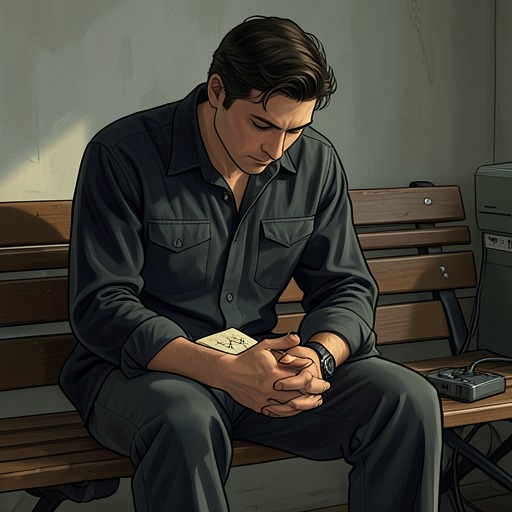
Sander
Jacob's LadderSander’s relationship with Jacob turns from a source of attraction into a pattern of betrayal and abuse. His defining significance in the story is the way intimacy and danger become entangled: Jacob’s delayed response to Sander’s infidelity gives way to a physical assault that shatters his confidence in his own ability to stay safe.
Relationship and Betrayal
Jacob had already realized that Sander was not faithful, but postponed confronting him because Sander had generally been discreet. That arrangement ends when Jacob finds Sander in bed with other men. Jacob’s horror at discovering his lover in an orgy is met with laughter from most of the men present; only one seems to recognize that the situation is not funny. The scene makes the betrayal public as well as intimate, leaving Jacob to confront both Sander’s conduct and the humiliation of being treated as a joke.
Assault and the Limits of Self-Protection
The confrontation turns physical when Jacob turns away from Sander and tells him to leave him alone. Sander, who resents being dismissed, grips Jacob’s shoulder and spins him around, then wraps a large hand around his neck and shakes him. The rage Jacob had understood as simmering beneath Sander’s surface breaks into open violence; as the grip tightens and Sander’s face darkens, Jacob feels genuine alarm. The reversal is especially stark because Jacob is combat-trained in Krav Maga and had believed he could always protect himself. His confidence in that ability does not prevent Sander from overpowering him.
The assault continues with a kick to Jacob’s ribs, delivered after Sander asks whether he is sorry. The blow sends pain through Jacob’s body; flashing lights cross his field of vision as he curls into a ball. The scene replaces Jacob’s former assurance with the bodily fact of injury and vulnerability. His attraction to large, brutal men and his training in self-defense coexist in the narrative, but neither makes him immune to violence from someone he loves.
The aftermath is visible in Jacob’s first appearance at the women’s support-group meeting. Facing five pairs of eyes filled with sadness on his behalf, he identifies himself as a veteran and insists that he can take care of himself. The insistence preserves his sense of competence, but the group’s concern—and the fact that he is there at all—shows that Sander’s violence has made accepting support part of Jacob’s circumstances, even when he resists being seen as helpless.
Departure and Lasting Consequences
After Jacob leaves, Sander returns to the apartment to collect what he considers his belongings. Phil later tells Jacob that Sander has packed and left, and that he changed the locks afterward because he does not expect Sander to return. The practical safeguards mark a shift from confronting the abuse to securing the space it has made unsafe.
The apartment bears the disorder of Sander’s departure: bedroom drawers have been emptied, papers and mail rifled through, and the media center scavenged. Some of Jacob’s least-favorite DVDs remain, while he suspects his Linkin Park CDs may be gone. The rummaging makes the breakup tangible in the wreckage of shared domestic life, and leaves Jacob uncertain even about what Sander took.
The danger is not treated as over simply because Sander has left. Someone points out that Sander could have killed Jacob in the apartment, including by taking one of Jacob’s expensive knives. Jacob acknowledges that he understands the risk. In retrospect, Sander’s violence has exposed the limits of Jacob’s confidence in self-protection: the person who had seemed manageable while discreetly unfaithful became a physical threat inside Jacob’s home, and leaving required both outside help and changed locks.
Appeal and the Slow Recognition of Harm
In the early days, Sander’s enthusiastic, almost childlike delight had charmed Jacob. That remembered appeal stands beside Jacob’s later knowledge that Sander was unfaithful: he had recognized the pattern before the confrontation but postponed acting because Sander was usually discreet. The contrast helps explain the delay without excusing it; the relationship’s earlier attraction and its concealed betrayals had become difficult for Jacob to separate.
When the betrayal is exposed, Jacob asks how many times Sander has gone to bed with someone else. Yet Jacob is sick and can barely lift his head from the pillow, leaving him too depleted to muster the righteous anger he expects of himself. The encounter therefore strips away not only the secrecy around Sander’s conduct but also Jacob’s imagined ability to confront it on his own terms.
Later, Jacob recalls that while he was living with Sander he had been putting one foot in front of the other. Set beside the earlier charm and the eventual assault, that recollection gives the relationship a longer arc than a single violent episode: a period of endurance in which Jacob’s capacity to keep going coexists with the danger he had not yet escaped.