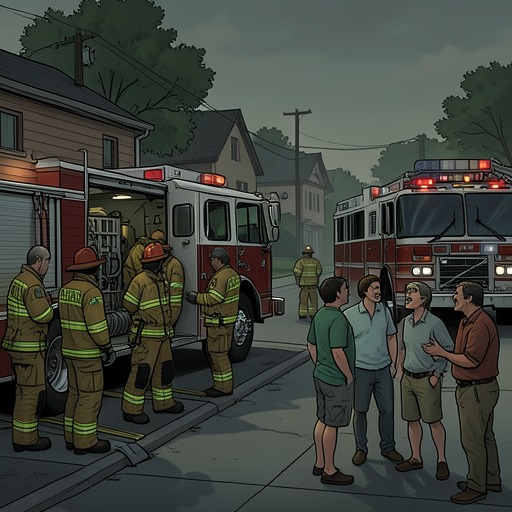
Santo Ignacio Firehouse
Jacob's LadderSanto Ignacio Firehouse is a working base for the town’s firefighters and a recurring meeting place in Yasha’s life. The novel shows it through concrete routines—a truck being washed, equipment stowed in an EMS rig, dishes being done—rather than through a formal description of the building. That everyday workplace is also where Yasha encounters JT in his professional world, and where the fire department’s public role becomes visible in the response to a major crash.
Setting and Working Life
Yasha comes upon the firehouse while walking toward the pier. The station stands along the street he has taken, and firefighters are scrubbing down a truck in the driveway of its large garage. The image makes the station legible as a place of labor and upkeep: its vehicles are not scenery but equipment that must be kept ready. The casual work happening outside also allows Yasha to approach the crew and speak with JT.
JT is shown handling the smaller EMS rig, pushing a toolbox into its cargo compartment and closing the door before leaning against the vehicle’s rear fender with a clipboard held to his chest. These specific tasks place him inside the practical routines of emergency work. His joking description of his life as a firefighter sits beside the evidence of preparation: tools secured, equipment checked, and a vehicle at hand. The station’s working character is conveyed through this contrast between teasing ease and the tangible readiness of the rig.
A Meeting Place Beyond the Garage
The firehouse also serves as a point of contact between JT and Yasha. At another visit, Cam calls into the station and JT comes out, waves, and walks over. The exchange makes the building a social threshold: JT can be summoned from within, then step out to join a conversation. The scene ties his public work to his growing familiarity with Yasha without suggesting that their relationship is separate from the rhythms of the town.
JT later invites Yasha to come by the firehouse while he is off shift. He has stopped in to mooch lunch and expects to be assigned dishwashing before the two of them take a walk. The invitation gives the station a domestic, communal aspect alongside its professional one. Yasha finds JT loading the dishwasher and notices a nearly empty pot on the stove, wondering whether the food is chili. The kitchen is not presented as a grand gathering hall; its significance lies in this ordinary meal, shared work, and unceremonious conversation.
That informality strikes Yasha as distinctive to St. Nacho’s. At the firehouse, joking and ease appear compatible with the firefighters’ work, and the station feels socially accessible rather than remote from everyday town life. It is a place where Yasha can arrive, find JT doing a mundane task, and continue their conversation before they go for a walk.
JT’s Work and the Town’s Social Life
The station helps define JT’s identity beyond his private connection with Yasha. He describes himself as an unmarried first responder, a combination that makes him unusually desirable within a Jewish singles group. His work is therefore not merely a setting detail: it shapes how he is regarded in another part of his social life and contributes to the way he understands his place in the community.
His professional experience also informs his attention to domestic violence. JT says that his line of work exposes him to many things and that he has researched ways to help victims; he uses that knowledge to tell Yasha about a support group in St. Nacho’s. The book does not place that offer inside the firehouse, so the station is not the group’s meeting place. Rather, JT’s work gives context to his awareness and to the practical assistance he tries to offer. The firehouse is associated with a person who moves between emergency service and care for someone facing a private crisis.
From Station to Emergency Response
The firehouse’s public function comes into sharper focus during the fog-triggered pileup involving Yasha and Danilo. As the wrecked car is left vulnerable among other vehicles, the sound of a fire engine gives Yasha hope that help has arrived. The narrative moves from the station’s familiar equipment and routines to the larger emergency scene, where firefighters and first responders must address multiple injured people.
JT takes Yasha by the arm and begins pulling him toward a tarp, explaining that he has to triage people according to their needs and that ambulances are on the way. His action puts professional responsibility ahead of Yasha’s immediate wish to remain focused on Danilo, even as JT is speaking directly to him. Cam is caring for Danilo, whose arm is pinned, and later Cam and two other firefighters bring him out on a backboard. Yasha ultimately travels with Dan to the hospital in an EMS rig that is not JT’s. The distinction matters: the rescue is a coordinated response, not a single-person intervention or a private vehicle carrying only the people closest to JT.
Narrative Significance
Across these scenes, Santo Ignacio Firehouse links routine work, local sociability, and crisis response. Its driveway and garage introduce the firefighters through maintenance; its kitchen makes room for food and conversation; its staff later appear in the more demanding work of triage and rescue. The building itself remains secondary to the people and practices associated with it, but that pattern gives it a clear role: it is a civic base from which care can move outward into the town.
For Yasha, the station is also a place where JT’s different roles become visible at once. He is the man who jokes, washes dishes, and asks Yasha to take a walk, but also a first responder who must distribute attention according to need when a crash overwhelms the scene. That movement between ordinary companionship and urgent duty gives the firehouse its narrative weight. It anchors JT in St. Nacho’s community and connects their developing relationship to a wider network of people working to help others.