SeaView Motel
Jacob's LadderSeaView Motel is a modest roadside lodging in St. Nacho’s whose significance accumulates through repeated returns. Its flickering sign, occupied rooms, and helpful manager give it a concrete place in the town’s landscape, while its role as a place of refuge is measured in practical acts: a severely dehydrated guest is found there, Carl checks whether he will remain in town, and later visits keep the motel connected to the people who offer care. The building is never made grand; its importance lies in the vulnerable lives that pass through and return to it.
Setting and Appearance
The motel announces itself with a pole-mounted sign whose letters do not all work. On the narrator’s first approach, the sign reads “SEAVIEW MOTEL,” but the V and I remain unlit; a red vacancy sign is still visible to travelers. The distinction between the motel’s name and its intermittently dark letters gives the place an immediately recognizable, worn presence. The sign does not disappear from the story after this first glimpse: later, the same missing letters remain a point of recognition on the highway.
The physical setting is equally unpolished. Rain falls intermittently as the narrator tries the small office door; the knob turns, but the door sticks, apparently because of the humidity. The details are functional rather than picturesque: damp weather, a stubborn entrance, and a sign that is only partly illuminated. They establish the motel as an ordinary place with ordinary inconveniences, not a polished refuge insulated from the world outside.
Shelter and Emergency
The motel is where the narrator had been staying before being found unconscious in a room. A later account explains that the motel manager discovered him there and that paramedics brought him for care. The narrator was so severely dehydrated that the person recounting the rescue believes the manager may have saved his life. The significance of the motel therefore rests not only on the room as shelter, but on the fact that someone responsible for the place noticed an emergency and acted.
That discovery gives the motel a particular weight within a story attentive to vulnerability. The room is the site of an incapacitation the narrator cannot initially remember clearly; the manager’s intervention supplies the missing link between the unconscious guest and the people caring for him afterward. The motel does not cure or resolve the crisis by itself. Rather, its manager’s attention makes further help possible, turning a temporary lodging place into the point from which rescue begins.
A Place to Stay and Return To
After the narrator has recovered enough to leave, Carl asks how long he plans to stay in St. Nacho’s. The question places the motel within a larger uncertainty: whether the narrator’s presence in town will be brief or become something more lasting. Soon afterward, JT helps him into a cab of a lacquer-red, early-1960s Ford F-100 Flareside. That ride connects the motel’s immediate function as lodging to the network of practical help surrounding the newcomer; accepting assistance does not make the motel his permanent home, but it allows him to continue deciding what comes next.
The decision to keep the room recurs later. After breakfast, the narrator stops at SeaView to tell Carl that he is retaining it while he and Dan go away for the weekend. He expects to return by Sunday night and understands that the message may also reach JT indirectly. The room is therefore not just a bed for one night: keeping it preserves a place to come back to while plans remain unsettled. The narrator’s communication through Carl also shows how the motel’s everyday routines overlap with the personal relationships developing around it.
Following the crash, the narrator leaves a room phone whose voicemail indicator is unlit and goes out to find Cam talking with Carl. Carl tells him he is glad that he and his brother are all right and asks how long the brother is expected to remain in hospital. The exchange brings the motel’s familiar people into the aftermath of an emergency elsewhere. SeaView is not the crash site, but it remains part of the practical and emotional geography to which the narrator returns while his brother receives care.
Familiar Signs and Human Connections
Later, while JT drives him back toward the motel, the narrator sees that the V and I are still out. Asked how long the sign has been that way, JT says it has always been intermittently broken for as long as he can remember. The exchange transforms a small visual defect into a local constant: the motel is recognizable partly because its sign never quite holds its light. JT attributes the state of the sign to his father’s subtle pranks, and his grin makes the faulty letters part of an affectionate family detail rather than a mystery requiring explanation.
The motel also connects people through histories of staying and care. When the narrator asks whether Carl has met Mary Catherine, JT says he is certain he has: her son stayed at SeaView, and Carl helped pack the son’s things while he was still in hospital. The motel thus occupies a shared social history, with Carl’s assistance extending beyond the narrator’s own crisis. Its rooms temporarily hold people in difficult circumstances, while the person who runs the place remains involved in what happens to them.
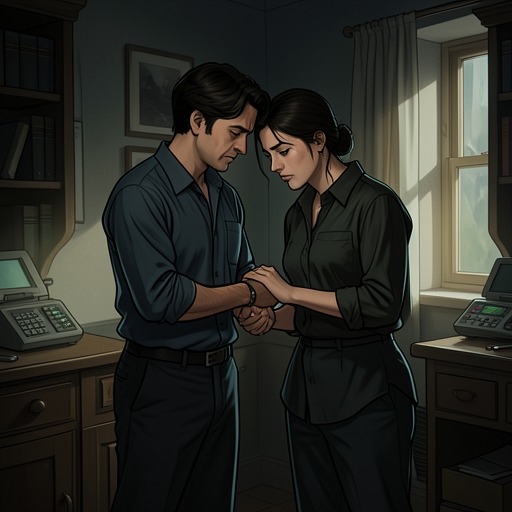
For the narrator, that possibility of admission carries a more intimate meaning. In a moment of frank self-description, he acknowledges letting someone into his motel room while pretending that he trusts people, even as he recognizes his own habit of making excuses for a former partner who used violence. The room is not proof that trust has been achieved; it is a setting in which the narrator can expose the distance between allowing someone close and feeling safe. SeaView’s significance is consequently both practical and relational: it offers a room to keep, a return point in town, and a vulnerable threshold at which help and intimacy may be accepted without being mistaken for certainty.