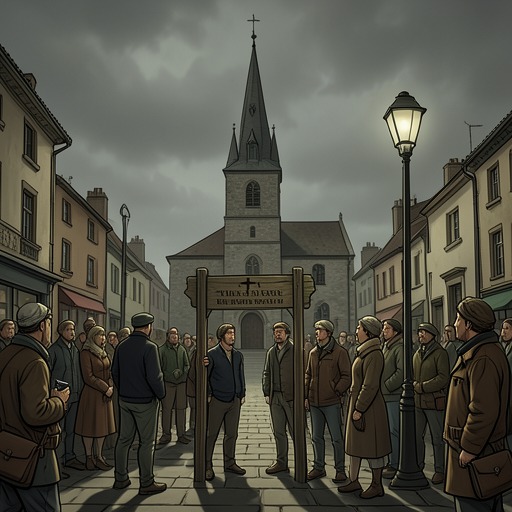
St. Nacho’s selective-visibility rule
Jacob's LadderSt. Nacho’s selective-visibility rule is the idea that the town is not simply available to everyone who might look for it: Muse says that people cannot see St. Nacho’s unless it wants them to. The conversation leaves the claim unsettled. Cam does not call the town literally invisible, but acknowledges its relative lack of distinction; later, the narrator’s question about whether St. Nacho’s wants them turns the proposed rule from local mystery into a personal question of belonging.
Formulation and Source
The rule enters the story as something Muse has told the narrator, not as an established explanation offered by an authoritative voice. The narrator reports that Muse connects people’s arrival in St. Nacho’s with the place’s intense spiritual energy, then describes the town’s selective visibility as another part of her account. The two ideas are associated, but the conversation does not establish how spiritual energy would make the town visible or invisible, or what determines whom it admits to sight.
That distinction matters: the rule is reported as a belief about the town, while the surrounding exchange provides suggestive but limited corroboration. No mechanism is demonstrated, and no general test is proposed for deciding who can see St. Nacho’s. The account offers a possibility that makes the town’s unusual quality legible without turning it into a fully explained system.
Cam’s Qualification
The narrator expects Cam to reject the claim as crazy or laugh at it. His silence, and his willingness to respond without ridicule, changes the tone of the exchange. He does not confirm every part of Muse’s explanation, but neither does he close the subject down as nonsense. His response gives the idea room to remain in play.
Cam’s qualification is precise: he will not say that St. Nacho’s is invisible, yet he agrees that it seems to have stayed relatively unremarkable. That is not the same as confirming selective visibility. Instead, his observation shifts the claim away from an absolute supernatural barrier and toward an ambiguity in how the town presents itself. St. Nacho’s might be overlooked or unremarkable; the conversation does not establish that these qualities result from a conscious choice by the town.
This restraint preserves the difference between what Muse says and what Cam can attest to. The rule gains weight because another person does not dismiss it, but it remains a proposition rather than a proven fact. The scene therefore holds two explanations together: a spiritual account of the town’s pull and a more modest observation about its apparent lack of distinction.
From Visibility to Wanting
Later, the rule becomes personally consequential when the narrator considers whether St. Nacho’s wants them. The thought follows practical possibilities: giving up the apartment in Los Angeles when the time comes, moving to the town, and finding work there. Against those concrete plans, the question of being wanted by St. Nacho’s gives relocation a more uncertain, almost reciprocal dimension.
The narrator does not settle that question. They recognize instead that St. Nacho’s has called to them, and allow that perhaps the town wants them too. The distinction leaves the rule open: being drawn to a place is not proof that it has chosen someone, but the narrator experiences the attraction as strong enough to imagine a response. Their readiness to settle down with a place, if not with a person, makes that possibility especially resonant without resolving it.
Narrative Significance and Limits
The rule links the town’s mystery to the ordinary act of deciding where to live. At first, selective visibility sounds like a claim about access: who can see St. Nacho’s at all. By the later reflection, the emphasis has shifted toward attachment: whether the place’s call amounts to welcome. The movement from seeing to wanting gives the rule emotional significance while keeping its supernatural status uncertain.
Its limits are part of its effect. The evidence does not explain what St. Nacho’s wants, how it might hide itself, or whether the narrator’s sense of being called demonstrates that the rule is true. Cam’s careful refusal to describe the town as invisible reinforces that uncertainty. St. Nacho’s remains both a place that appears relatively unremarkable and a place the narrator feels drawn toward; the rule names the possibility that those impressions belong to a larger mystery, without claiming to solve it.