The Bodily Reality and Triggers of Trauma
Jacob's LadderThe Bodily Reality and Triggers of Trauma is the novel’s portrayal of traumatic memory as a physical present, not simply a recollection of past violence. A tightening grip, a sudden screech of tires, or the sound of breaking glass can provoke alarm before the survivor has time to reason through what is happening. The body becomes both the site where violence persists and the first means by which danger is registered; recovery therefore involves not only remembering differently, but also finding ways to regain trust in perception and regain a sense of safety.
Violence and the Limits of Self-Protection
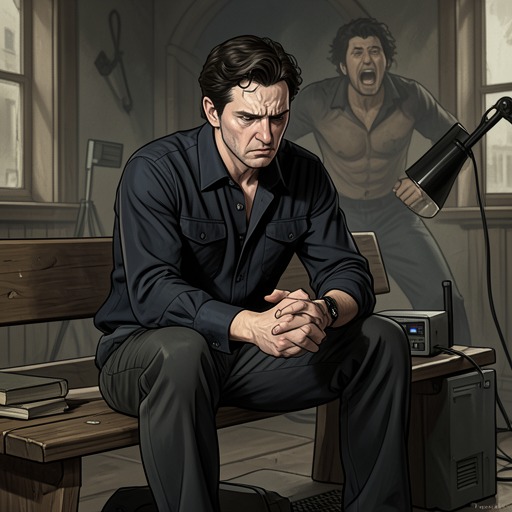
Jacob’s response to Sander’s violence exposes the gap between believing oneself capable of self-defense and being able to control what happens in an abusive encounter. Jacob is combat-trained in Krav Maga and had believed he could always take care of himself. He is also attracted to men who are big and brutal, a detail that complicates any simple distinction between desire and danger. When Sander’s grip tightens and his face darkens with fury, Jacob experiences genuine alarm. The scene makes physical threat immediate: training and confidence do not make him invulnerable, nor do they give him command over another person’s violence.
That contrast matters because the novel does not treat survival as proof that a person should have been able to prevent abuse. Jacob’s prior confidence belongs to his understanding of himself; the assault reveals its limits without making him responsible for what Sander does. The resulting vulnerability is not an abstract lesson. It is bound to the body that is grabbed, threatened, and later made to react to cues associated with danger. Trauma’s persistence begins in the discrepancy between what a survivor believes he ought to be able to manage and what violence can take out of his control.
The Support Group and the Difficulty of Telling
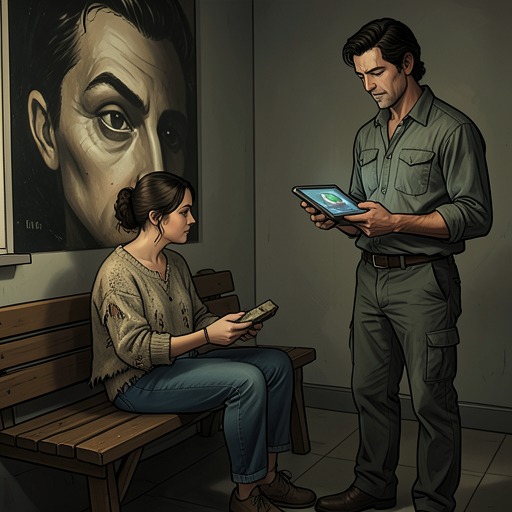
JT approaches Jacob with knowledge of domestic violence support: through his work as a first responder, he has encountered many things, researched ways of helping victims, and learned that a support group meets in St. Nacho’s. The offer provides a route toward assistance, but getting Jacob into the room does not make speaking easy. At the meeting, he holds coffee among women sitting silently in a small circle of chairs, their bodies described as clenched. He is unsure how he arrived there, and the group’s quiet gives the scene a tension quite different from a reassuring image of disclosure.
When Jacob is told that he need not share if he does not feel ready, he rises so abruptly that his chair tips over and clatters across the quiet room. The gesture conveys distress without requiring him to explain it. The permission to remain silent is present, yet being in the circle is still difficult enough to produce a sudden, conspicuous physical response. The scene distinguishes access to support from an immediate ability to use it: an invitation can open a door, but it cannot dictate the pace at which someone crosses the threshold or finds words for what happened.
Analise and Trauma’s Return in the Body
Analise provides a parallel, distinct account of survival. Muse explains that Analise’s former husband stabbed her about sixteen times, that he went to jail, and that it was a miracle she lived. Analise speaks to very few people apart from Mary Catherine and Muse’s mother. She works early mornings at the pie shop and has another job in the afternoons, but Muse also says she has PTSD and is sometimes badly affected by it. Her work and restricted social contact coexist: continuing to work does not mean that the effects of violence have disappeared.
The novel gives those effects a bodily and sensory shape through Jacob’s explanation of what reliving can feel like. A survivor may feel that the violence is happening again, rather than experience it as a memory safely located in the past. Adrenaline surges and the fight-or-flight response takes over. The sound of glass breaking and the smell of burning buildings can seem present; the experience is real in its force even when it is not happening now. In that state, the survivor can lose trust in the senses that ordinarily distinguish present surroundings from remembered danger. The account does not reduce trauma to an image or a metaphor: it emphasizes the confusion, bodily intensity, and loss of orientation through which it is lived.
Everyday Triggers and the Work of Recovery
Jacob’s walk home from a bar shows how an ordinary sound can set off that bodily return. In a tense and angry mood, he hears a car speed around the corner, its tires screeching, and jumps back. His heart races; he relives some of the worst moments of his life until he can control his breathing again. Loud noises, cars backfiring, and even the breaking glass common in restaurants can remind him of experiences he would rather not revisit. The trigger is not confined to a place that is objectively dangerous. It appears in everyday surroundings, where a sudden sound can make it hard for him to remember where he is.
The walk toward SeaView Motel through a sleepy St. Nacho’s offers a counterpoint to that disorientation. The aftereffects, which can otherwise last for hours, begin to ease as Jacob moves through town. He imagines the surf’s push and pull drawing his anxiety out to sea. The image does not claim that the trauma has been cured; it registers a change in intensity, a temporary settling made possible by the place around him. St. Nacho’s offers relief through atmosphere and familiarity rather than through a promise that the past can be erased.
Recovery also has practical, ordinary dimensions. Jacob is helping Mary Catherine Jensen bake pies and hopes his brother will come for him on Friday. These details place him among work, plans, and relationships while he is still living with the aftereffects of violence. Elsewhere, when Yasha is pulled toward a tarp at a crash scene, JT explains that he must triage people according to their needs and that ambulances are on the way. The moment is not presented as a cure for trauma, but it shows care taking the form of explanation and action amid danger. Together, such scenes resist a single dramatic definition of healing: bodily alarm can recur, while support, purposeful work, a familiar landscape, and attentive care make room for life to continue.